About Eudonia angustea Curtis, 1827
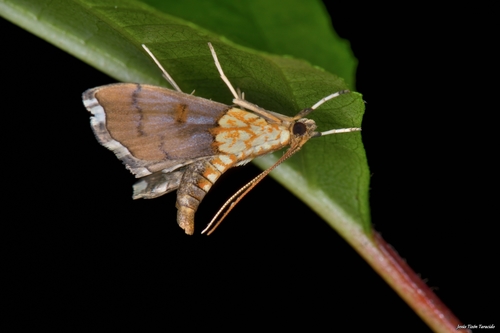
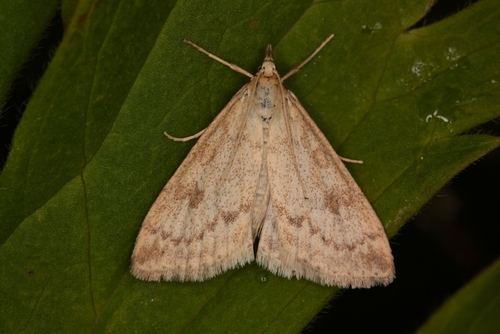
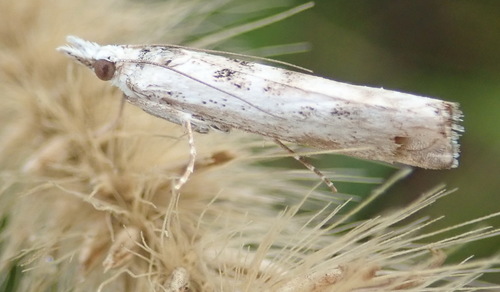
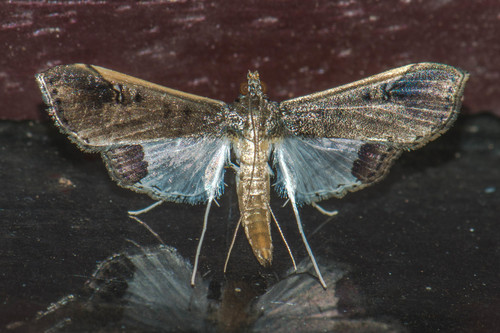
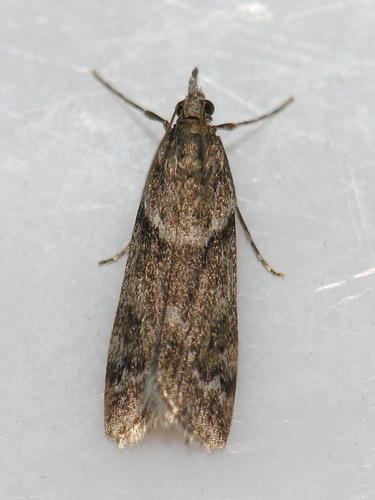
Eudonia angustea is a moth species in the Crambidae family, first described by John Curtis in 1827. It is distributed across southern and western Europe, the Canary Islands, Madeira, and Turkey. This species has a wingspan ranging from 17 to 22 millimeters, or 0.67 to 0.87 inches. Its forewings are narrow, whitish, mixed with brownish tones and sprinkled with black scales, with a darker base. The forewing lines are whitish with dark edges; the first line is oblique, and the second is sinuate. The orbicular spot is outlined in black, and the claviform spot is black, touching the first forewing line. There is a black X-shaped discal mark on the forewing, with the upper half filled with light brownish color. The subterminal line is cloudy, whitish, and barely touches the second line. The hindwings are whitish-grey, becoming obscurely darker toward the outer edge. Full-grown larvae are blackish-grey with a faint greenish tinge, have darker or nearly black spots, a pale brown head, and a dark brown to almost black plate on the second body segment. Adult moths are active from July through late autumn. The larvae feed on mosses that grow on walls and in sand dunes.