About Eudocima phalonia (Linnaeus, 1763)
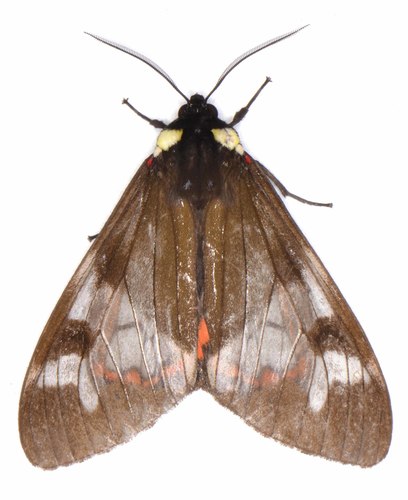
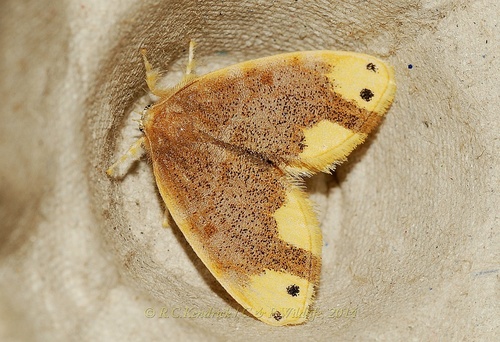
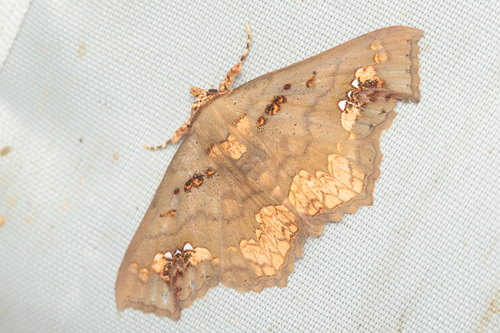
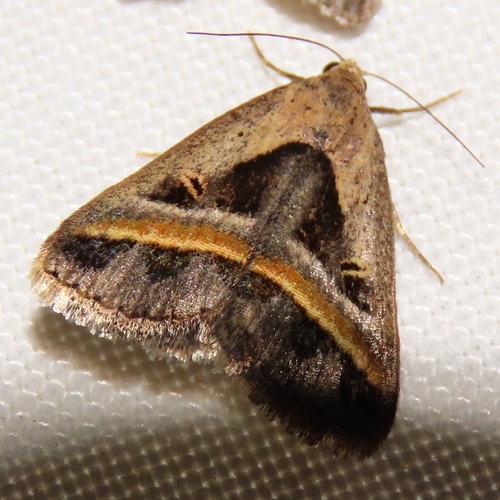
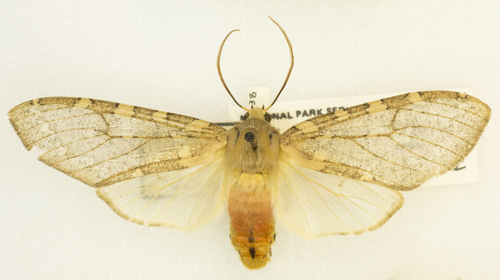
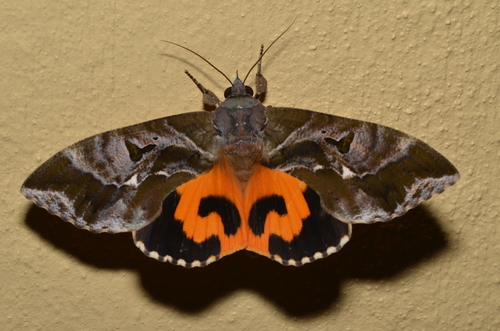
Eudocima phalonia (Linnaeus, 1763) shows clear sexual dimorphism in adult morphology. Males have a wingspan of approximately 80–94 mm, while females have a larger wingspan ranging from 90–110 mm. In males, the third joint of the palps is long and spatulate at its tip. Males have non-crenulate forewing cilia, whereas females have crenulate forewing cilia. The head and thorax are reddish brown with plum-colored suffusion, and the abdomen is orange. Male forewings are reddish brown, typically with a greenish tinge and scattered dark speckles. An oblique, generally dark and indistinct antemedial line is present, though it is sometimes pale and prominent. The reniform spot is indistinct. A curved postmedial line is present, and an oblique streak from the wing apex almost always meets this line. Hindwings are orange, with a large black lunule located beyond the lower angle of the cell. A marginal black band running from the costa to vein 2 holds pale spots on the cilia. The ventral side of the forewing has an orange postmedial band. Female forewings are much more variegated, marked with dark reddish brown striae. The female reniform spot is dark, and extends a spur along the median nervure to below the orbicular speck. A triangular white mark is usually present on the postmedial line below vein 3. The larva has a dilated 11th somite, surrounded by a tubercle. The larval body is purplish brown, with a brown dorsal region from the 6th to 11th somites. Larval legs are red. Spiracular scarlet patches are largest toward the posterior of the body, and are surrounded by irregular white markings; on the 9th somite, this marking forms an oblique white bar. A yellow sub-basal mark is found on the 4th somite. The 5th and 6th somites bear black ocelli with yellow irises and white pupils. Two yellow patches are visible on the 11th somite. Adult Eudocima phalonia are classified as an agricultural pest. They damage many fruit crops by piercing fruit with their strong proboscis to suck out juice. Control attempts have targeted this species using adult baits, egg parasites, and larval parasitoids. Ecologically, larvae feed primarily on vines in the family Menispermaceae, but have also adapted to feed on species of the genus Erythrina. Recorded larval host plants include Erythrina crista-galli, Erythrina fusca, Erythrina variegata, Carronia multisepala, Hypserpa decumbens, Legnephora moorei, Pleogyne australis, Sarcopetalum harveyanum, Stephania aculeata, Stephania forsteri, Stephania japonica, and Tinospora smilacina. Fruits are the plant part most commonly affected by this species. Infested fruits leak sap, and develop internal caterpillar feeding damage, and may drop prematurely. Adults penetrate the fruit skin or rind with their strong, barbed proboscis. Damaged fruit tissue becomes spongy and develops many lesions.