About Eudocima aurantia (Moore, 1877)
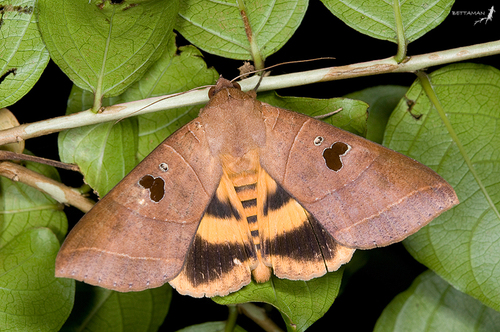
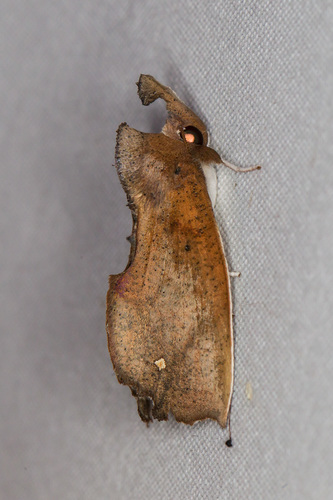
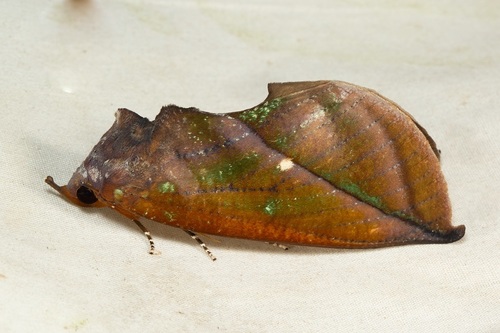
Eudocima aurantia (Moore, 1877) has a wingspan of approximately 90–120 mm. Its palpi have a long third joint that is spatulate at the tip. The forewings have an apex that extends outwards into a rounded lobe. The head and thorax are ferrous in color, with a plum-colored suffusion. The abdomen is orange. The forewing is ferrous, marked with dark stria and a slight purple bloom, and its veins are speckled with blue. The reniform spot is green and indistinct. A dark line runs from the apex to the center of the inner margin; there are sometimes green patches located beyond this line. The hindwings are orange, with a large black lunule beyond the lower angle of the cell. A submarginal patch is visible between veins 1 and 2. The ventral side is orange. The forewings have a black mark below the angle of the cell, and another black mark beyond the cell between veins 3 and 5. The hindwings show the same lunule and patch that appear on their upperside. The larva has a pinkish grey dorsal surface that darkens with suffusion up to a V-shaped yellow band. It has black spiracles, and marbled rufous-orange ocellate marks outlined in white, which are crossed by three ferrous lines. The larvae feed on plants of the Cocculus species. The moth resembles a leaf, which fools predators such as birds. Both adult moths and caterpillars are pests of various fruits. They pierce fruit to suck its juice; caterpillars additionally eat the fruit flesh. Affected fruits may fall prematurely due to the pest attack. Parasitoids including Telenomus lucullus and Euplectrus melanocephalus are used as biological control measures for this species.