About Eucomis regia (L.) L'Hér.
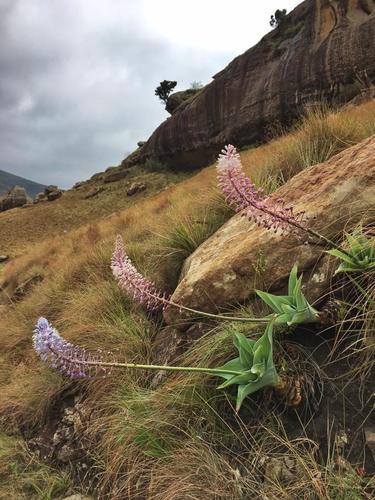
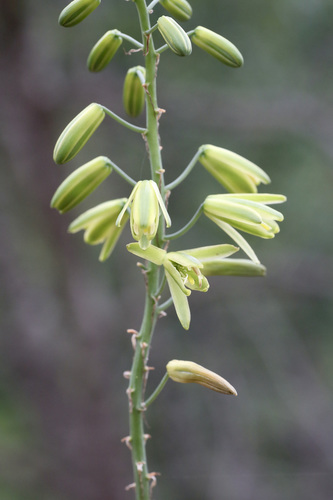
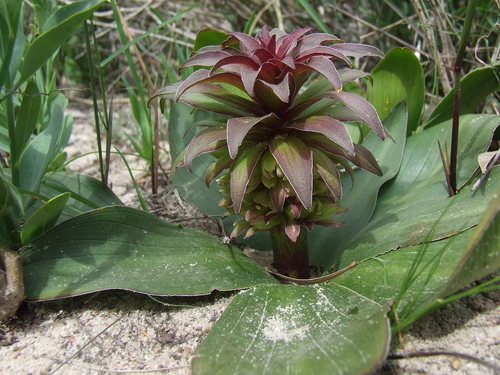
Eucomis regia (L.) L'Hér. is a winter-growing bulbous plant. When in flower, it reaches a height of up to 20 cm (8 in) or less. It grows from a small ovoid bulb, which is usually solitary, and measures roughly 3–5 cm (1+1⁄4–2 in) across. Its leaves are around 10–20 cm (4–8 in) long and 3 cm (1+1⁄4 in) wide. They have a rough surface, are ridged along the leaf veins, and have very small indentations along their margins. The leaves lie flat on the ground. E. regia flowers from late winter to early spring, and dies down completely during the dry summer. Its greenish flowers have no obvious pedicels (stalks), and are sunken into the scape (stem). The flowers produce an unpleasant smell. The flower spike is topped by a head or "coma" of ovate bracts, which are long enough in some forms to almost completely hide the flowers. Eucomis regia is native to the Cape Provinces of South Africa. It occurs in two areas in the southwest of the Western Cape and the Northern Cape, within the winter rainfall zone. It is restricted to heavy clay soils in open areas or in renosterveld vegetation, growing amongst rocks on shaded south-facing hillsides. Eucomis regia has been called "possibly the least attractive Eucomis". Since it is only half-hardy and needs a completely dry rest period in summer, it must be grown in a greenhouse in temperate climate regions such as the British Isles.