About Eucomis bicolor Baker
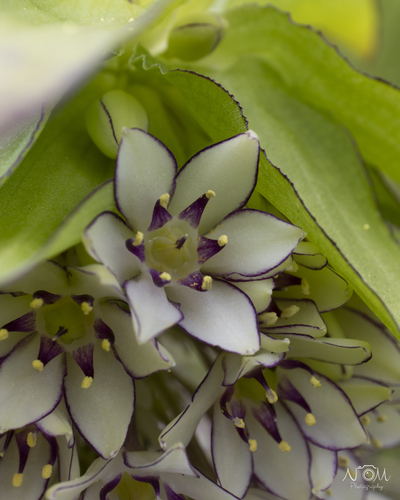
Eucomis bicolor Baker is a bulbous perennial that grows from a large bulb. It reaches 30 to 60 cm (12 to 24 inches) in height, growing a basal rosette of wavy leaves 30 to 50 cm (12 to 20 inches) long. In late summer, which is August in the UK, it produces a stout flowering stem called a peduncle, which often has purple markings. Its inflorescence is a raceme of pale green flowers with purple edges; the tepals of these flowers are up to 15 mm (1⁄2 inch) long, and the flowers grow on flower stalks called pedicels 2 cm (3⁄4 inch) long. The inflorescence ends in a head called a coma made of pale green leafy bracts that are sometimes tinged with purple. When viewed close up, the flowers give off a strongly unpleasant smell. The ovary of this species is green. Six homoisoflavanones — eucomin, eucomol, (E)-7-O-methyl-eucomin, (—)-7-O-methyleucomol, (+)-3,9-dihydro-eucomin, and 7-O-methyl-3,9-dihydro-eucomin — can be isolated from the bulbs of E. bicolor. E. bicolor is native to Southern Africa, where it occurs in the Cape Provinces, Lesotho, KwaZulu-Natal, the Free State, and the Northern Provinces. Along the Drakensberg escarpment, it grows in damp grassland, often near streams, at elevations up to 2,500 m (8,200 ft). This species is primarily pollinated by flies, including blowflies, house flies, and flesh flies, which are drawn to the sulphur compounds found in the flowers' scent. In cultivation, E. bicolor is not fully frost-hardy. In the United States, it is rated as hardy for USDA zones 8 through 10, and needs winter mulch to survive in colder zones 6 and 7. In the United Kingdom, it is reported to be hardy down to −10 °C (14 °F) if kept dry over the winter. To flower successfully in summer, it requires full sun exposure and abundant water. This species has been awarded the Royal Horticultural Society's Award of Garden Merit. The cultivar E. bicolor 'Alba' produces plain white flowers and has no purple coloration anywhere on the plant. E. bicolor resembles Eucomis autumnalis, but can be told apart from that species by its longer flower pedicels.