About Euchrysops cnejus (Fabricius, 1798)
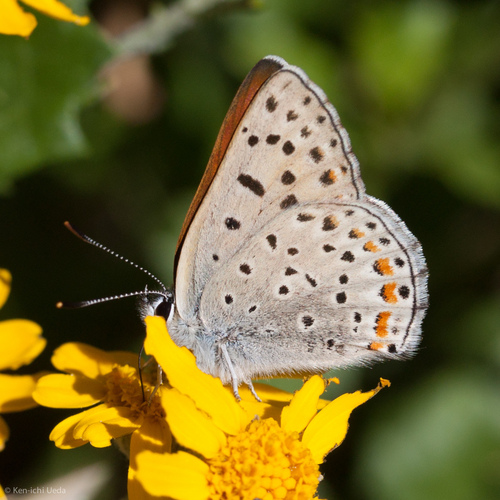
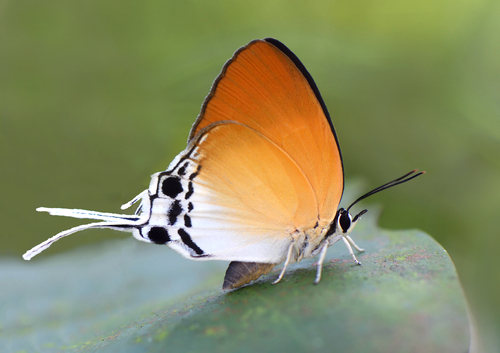
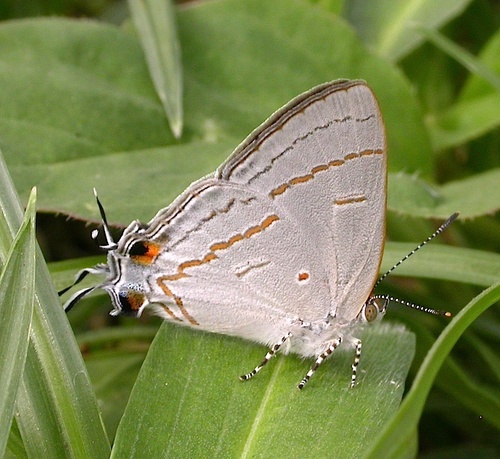
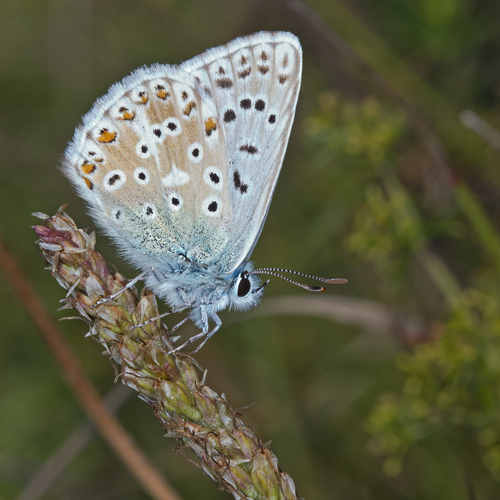
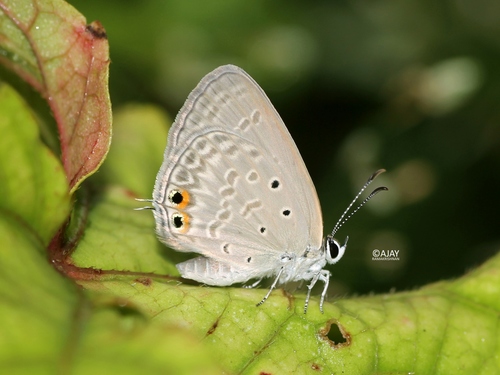
Euchrysops cnejus (Fabricius, 1798) exhibits distinct physical differences between males and females. For males, the upperside is pale purplish suffused with a bluish shade that is only visible in certain lighting. On the male forewing, there is a slender black anteciliary line, edged narrowly on the inner side with fuscous dark brown; this dark brown edging is broader at the apex than at the tornal angle. On the male hindwing, there is a subterminal black spot in interspace 1 and another similar spot in interspace 2. These two spots are close to equal in size, edged on the outer side by a white thread and on the inner side with ochraceous; the ochraceous edging is more prominent on the spot in interspace 2. The male hindwing also has a slender anteciliary black line, with an inner narrow margin of diffuse fuscous brown. The cilia of both male forewings and hindwings are pale; the tail at the apex of vein 2 of the hindwing is black and tipped with white. The male underside is silver grey; some individuals have a pale yellowish tint, while others have a faint brown tint. Both male forewings and hindwings have the following brown spots, each edged slenderly on both sides with white: a transverse elongate spot on the discocellulars; a transverse discal series of spots that is straight on the forewing and bisinuate on the hindwing. On the hindwing, this series is capped near the costa by a prominent white-encircled round black spot. There are also an inner and an outer subterminal transverse series of spots: the inner subterminal series on the hindwing is lunular, and the outer series is made of rounded spots. The white edging for both series is also lunular. Both wings have very slender anteciliary black lines. The male hindwing additionally has a transverse curved subbasal series of generally three, often four white-encircled spots: the spot nearest the costa is prominent and black, while the other spots are brown. The male’s antennae, head, thorax, and abdomen are dark brown, with the abdomen paler than the other parts. The shafts of the antennae are speckled with white, and the thorax has a small amount of purplish pubescence. On the underside of the male, the palpi, thorax, and abdomen are white. For females, the upperside is dark brown. On the female forewing, a posteromedial somewhat triangular area, extending outward from the base for about two-thirds the length of the wing, is blue, and there is a slender jet-black anteciliary line. On the female hindwing, the posterior area from about the level of the middle of the cell is slightly suffused with blue, extending outward from the base for about two-thirds the length of the wing. There is a transverse, postdiscal, incomplete series of sagittate (arrowhead-shaped) white spots pointing inwards, followed by a subterminal transverse series of round spots. The anterior three of these round spots are dark brown and encircled with bluish white; the two tornal spots are jet-black, subequal in size, larger than the other spots, edged inwardly with bright ochraceous, and outwardly by very slender white lines. Finally, the female hindwing has a jet-black slender anteciliary line. The cilia of both female forewings and hindwings are conspicuously white. The female underside matches the male in ground colour and markings, but the two tornal black spots have metallic bluish-green scaling on their outer edges. The female’s antenna, head, thorax, and abdomen are similar to those of the male, but the shafts of the female antennae are conspicuously ringed with white. This species is distributed from the Arabian Peninsula across all of India except areas at very high elevations, and it is widely distributed across the Malayan subregion. Its range extends to Australia and the South Sea Islands.