About Eucera longicornis (Linnaeus, 1758)
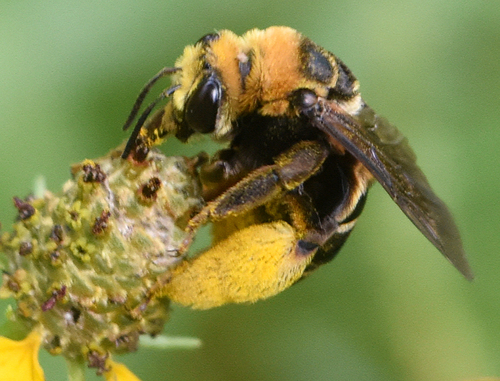
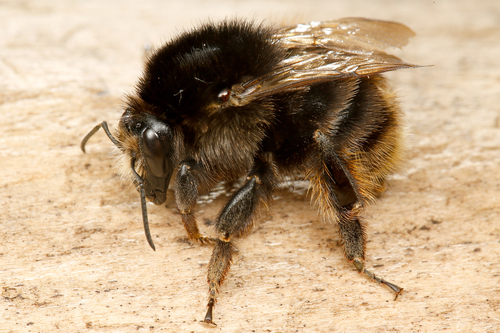
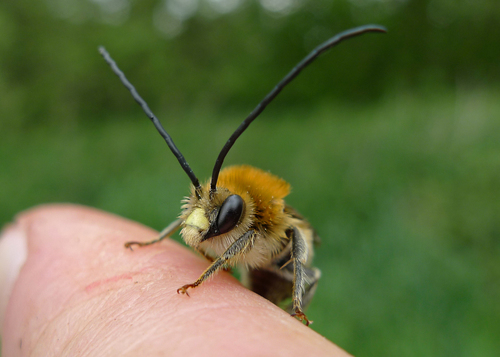
Eucera longicornis (Linnaeus, 1758) is a bee species with entirely black head, thorax, and abdomen. The upper surface of the thorax is covered in pale brown downy hairs; this colour transitions to yellowish down on the sides of the thorax and pale grey down on its underside. Males have yellow clypeus and labrum, plus very long antennae that match the combined length of the head and body; females have shorter antennae.
This bee is found across the Palearctic realm, with a range extending from Western Europe east to Siberia and China. In Britain, it has a patchy distribution across southern England and Wales. It can be quite numerous in suitable habitats, and typically nests in aggregations. It most often occurs near the coast in bare areas and short turf, in open grassy areas within woodland, and sometimes on heathlands.
Ecology: Adult females dig and prepare burrows, usually in clay soil, kneading the burrow walls to create a smooth surface. Nests are provisioned with a paste made from a mixture of pollen and honey, and a single egg is laid on this paste. After hatching, the larva feeds on the stored paste. Most individuals overwinter as pre-pupae inside the burrow, pupate the following spring, and emerge as adults shortly after pupation. When males leave the burrow, they pull their long antennae through a notch on the first leg segment (the tarsus) to scrape off any attached residual membranes. A small number of individuals overwinter in the adult stage instead. Active adult bees fly between May and July. In the Mediterranean region, males of this species act as pollinators for the bee orchid Ophrys apifera. Research on long-horned bees has found that species that feed on flowers with hidden pollen evolved and diversified faster than species that use easily accessible pollen.