About Eucalyptus youngiana F.Muell.
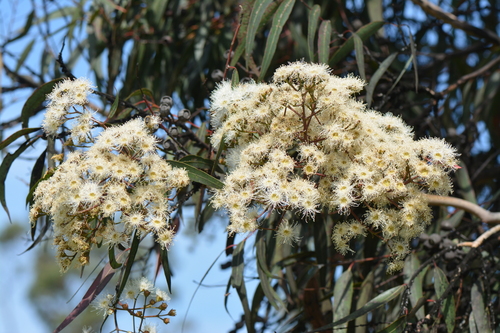
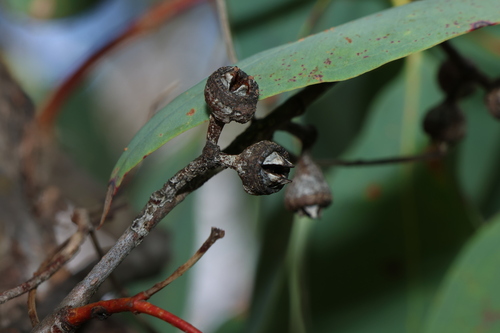
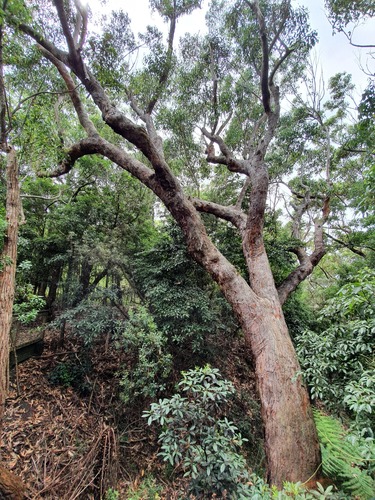
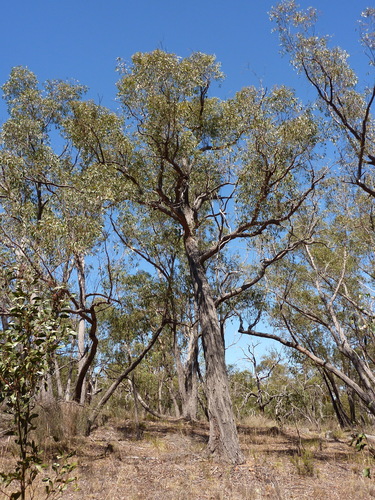
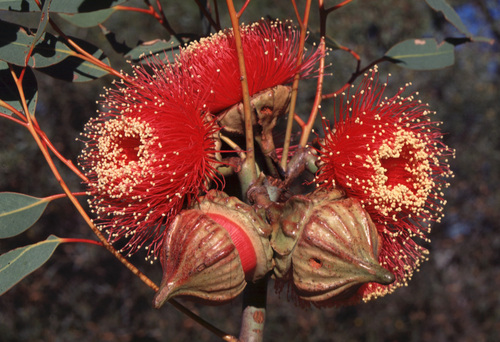
Eucalyptus youngiana F.Muell. is most commonly a mallee that typically reaches 4 to 8 meters (13 to 26 feet) in height, and less commonly grows as a tree up to 10 meters (33 feet) tall. This species forms a lignotuber. It has rough, flaky, dark grey-brown bark covering part or all of its trunk, with smooth, pinkish-grey to creamy bark on the upper sections of the plant. Young plants and coppice regrowth have greyish green leaves that range from egg-shaped to lance-shaped, measuring 70–160 mm (2.8–6.3 in) long and 25–45 mm (0.98–1.77 in) wide. Adult leaves are the same dull bluish green shade on both sides, are lance-shaped, 85–170 mm (3.3–6.7 in) long and 15–37 mm (0.59–1.46 in) wide, tapering to a 15–32 mm (0.59–1.26 in) long petiole. Flower buds grow in groups of three in leaf axils, on an unbranched peduncle that is 10–25 mm (0.39–0.98 in) long, with individual buds attached to pedicels 5–15 mm (0.20–0.59 in) long. Mature buds are oval, 45–60 mm (1.8–2.4 in) long and 30–45 mm (1.2–1.8 in) wide, with a horn-shaped or beaked operculum 28–42 mm (1.1–1.7 in) long. Flowering occurs between June and October, and the flowers can be red, pink, or bright yellow. The fruit is a woody, short, broad, hemispherical capsule that is 15–30 mm (0.59–1.18 in) long and 33–60 mm (1.3–2.4 in) wide, with coarse longitudinal ridges on its surface. The seeds are brown, shaped like an irregular pyramid, and 2.5–4 mm (0.098–0.157 in) long. Eucalyptus youngiana, commonly called large-fruited mallee, grows in sandy soil on flat terrain, and is often found growing alongside Triodia species. It occurs across arid and semi-arid areas, ranging from north of Kalgoorlie in Western Australia, through the Great Victoria Desert, to Tarcoola and Bulgunnia Station in South Australia.