About Eucalyptus woodwardii Maiden
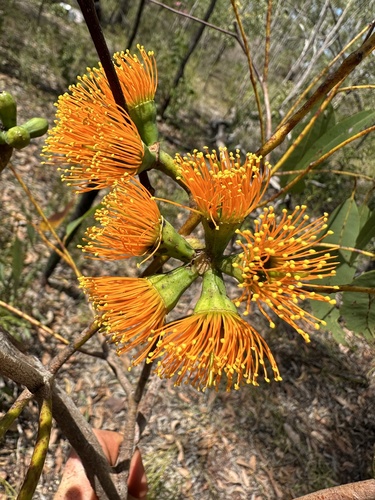
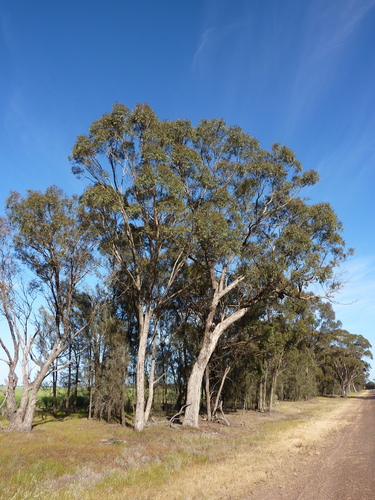
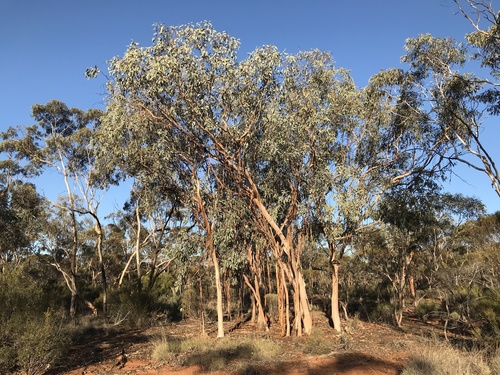
Eucalyptus woodwardii Maiden, commonly known as lemon-flowered gum, typically grows to 6 to 15 metres (20 to 49 ft) in height, with a canopy that spreads over 3 metres (10 ft). It has smooth bark in shades of white, pink, greenish or light copper, which sheds in ribbon-like pieces. Stalked juvenile leaves range in shape from ovate to broad-lanceolate to elliptical, and grow up to 18 cm by 9 cm. Adult leaves are arranged disjunctly and are also stalked; their blades are broad-lanceolate, tapered at the base, around 18 centimetres (7 in) long and 5 cm (2.0 in) wide. All leaves are dull, grey-green to glaucous, and concolorous. Lemon yellow flowers bloom from late winter to late spring. Each axillary, simple conflorescence holds three to seven flowered umbellasters on terete peduncles. The buds are rostrate or urceolate in shape, with a calyx calyptrate that sheds early. The resulting fruit is bell or urceolate shaped, about 1.5 cm (0.59 in) long and 1.4 cm (0.55 in) wide, with depressed discs and enclosed valves. The seeds inside the fruit are red, linear, and cuboid. This species is only found naturally east of Kalgoorlie in the Karonie area of Western Australia, where it grows on flats and rises in sand or deep sandy loam soil. Eucalyptus woodwardii is a very popular ornamental tree in southern Australia, valued for its attractive, large, lemon-yellow flowers. Its cascading yellow flower clusters and grey weeping foliage, paired with drought and frost tolerance, make it suitable for many gardens. It attracts bees and birds, has a medium growth rate, and requires little pruning. It is commonly used as a privacy screening plant or as a standalone feature plant, and is commercially available as seed or tubestock. Hybrids between this species and coral gum (E. torquata), named Torwood, were developed in the 1970s.