About Eucalyptus viminalis Labill.
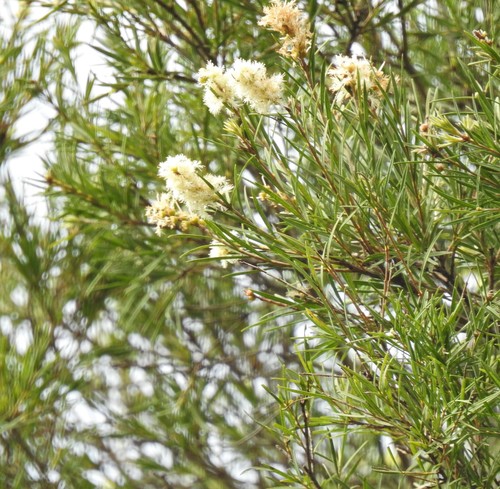
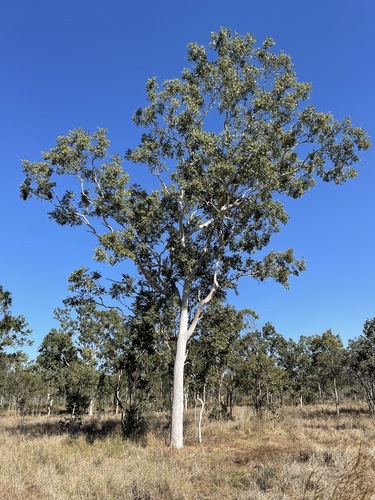
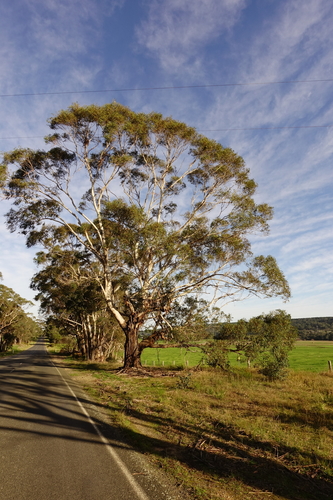
Eucalyptus viminalis Labill. is a tree that typically grows to a height of 50 m (160 ft), sometimes reaching up to 90 m (300 ft), and forms a lignotuber. Its bark is smooth, often powdery, and ranges from white to pale brown, shed in long ribbons that sometimes remain hanging on the upper branches; rough, fibrous bark is sometimes present on the lower trunk. Young plants and coppice regrowth have sessile leaves arranged in opposite pairs, with shapes ranging from lance-shaped to curved or oblong. These leaves are 25–150 mm (0.98–5.91 in) long and 5–35 mm (0.20–1.38 in) wide. Adult leaves are arranged alternately, are the same shade of green on both sides, and are lance-shaped to curved, 85–232 mm (3.3–9.1 in) long and 8–30 mm (0.31–1.18 in) wide, tapering to a 10–25 mm (0.39–0.98 in) long petiole. Flower buds are arranged in groups of three or seven on an unbranched peduncle 4–10 mm (0.16–0.39 in) long; individual buds are either sessile or sit on pedicels up to 5 mm (0.20 in) long. Mature buds are oval to spindle-shaped, 5–9 mm (0.20–0.35 in) long and 3–6 mm (0.12–0.24 in) wide, with a conical, rounded or beaked operculum. Flowering occurs from December to May, and the flowers are white. The fruit is a woody, cup-shaped or hemispherical capsule 3–8 mm (0.12–0.31 in) long and 5–9 mm (0.20–0.35 in) wide, with prominently protruding valves. Five subspecies of Eucalyptus viminalis are recognized with distinct distributions and habitats. Subspecies cygnetensis, commonly called rough-barked manna gum, grows in higher rainfall areas of South Australia (including Kangaroo Island and the southern Mount Lofty Ranges) and extends east to the Grampians in Victoria. Subspecies hentyensis, commonly called western Tasmanian sand gum, grows in sandy soil on the west coast of Tasmania, north from Strahan. Subspecies pryoriana, commonly called Gippsland manna gum, grows in sandy coastal soil from the Bellarine Peninsula to Lake Tyers in the Gippsland Lakes in Victoria. Subspecies siliceana is only known from the Wail State Forest in the Wimmera region of Victoria, where it grows in deep sand. Subspecies viminalis is widely distributed and abundant in well-watered areas of south-eastern Australia, ranging across the coast and ranges of New South Wales, the southern half of Victoria, and the Eyre Peninsula and Kangaroo Island in south-eastern South Australia. It also occurs in Tasmania, where some specimens reach almost 90 m (300 ft) tall. In terms of uses, Indigenous Australians used the wood of this tree to make shields and wooden bowls. The tree produces a sweet, white, crumbly substance called manna from its bark. This sugary substance, valued by Aboriginal people, forms when sap exudes from the tree and dries in hot summer air, eventually falling to the ground as small, irregular lumps. There is ongoing debate about what causes the sap leakage: some sources attribute it to cicada borings, while others link it to the activity of a gall-making insect.