About Eucalyptus vernicosa Hook.fil.
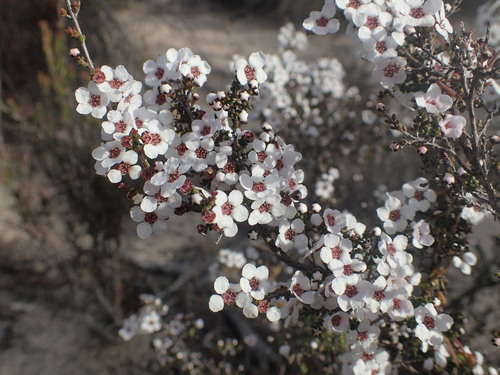
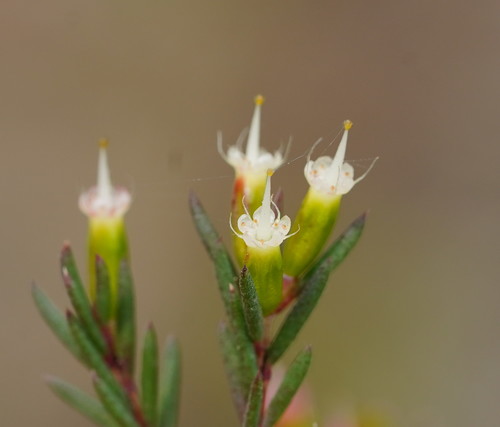
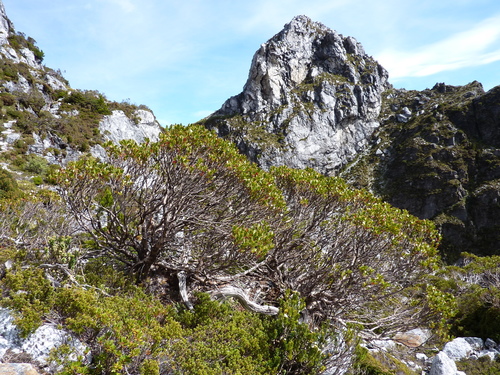
Eucalyptus vernicosa Hook.fil. is most often a shrub up to 1 metre (3 feet 3 inches) tall, or sometimes a mallee up to 4 metres (13 feet) tall, and it forms a lignotuber. It has smooth grey or greyish-brown bark. Young plants and coppice regrowth have crowded, sessile, glossy green, egg-shaped leaves that are 7–20 mm (0.28–0.79 in) long and 3–15 mm (0.12–0.59 in) wide, arranged in opposite pairs. Adult leaves are also crowded and glossy green, with shapes ranging from egg-shaped to elliptical or round. They are 10–32 mm (0.39–1.26 in) long and 8–15 mm (0.31–0.59 in) wide with a rounded base, borne on a petiole 1–8 mm (0.039–0.315 in) long, and arranged in either opposite pairs or alternately. Flower buds are arranged in groups of three in leaf axils, on an unbranched peduncle up to 2 mm (0.079 in) long. Individual buds are sessile or nearly sessile; occasionally two buds in a group are lost, leaving buds that appear to be single. Mature buds are oval, 8–9 mm (0.31–0.35 in) long and 3–5 mm (0.12–0.20 in) wide, greenish brown and finely wrinkled, with a conical operculum that is shorter than the floral cup. Flowering occurs in most months of the year, peaking between December and February, and the flowers are white. The fruit is a woody hemispherical or bell-shaped capsule 5–8 mm (0.20–0.31 in) long and 5–9 mm (0.20–0.35 in) wide, with valves positioned near the rim of the capsule. Eucalyptus vernicosa is endemic to Tasmania, where it only occurs in alpine regions from the west to the southwest of the island, including Cradle Mountain. It grows at elevations between 700 metres and 1350 metres above sea level, most often on peaty acid soils over quartzite or sandstone bedrock. It is usually found above the tree line, and can be a dominant species in alpine heath communities, alongside plants from the genera Richea, Athrotaxis, and Orites. This habitat typically receives high annual average rainfall, between 1000 mm and 2500 mm per year, and has very cold winters with continuous frosts and snow lasting for several months. The small size and tough leaves of this species are thought to be a response to this harsh climate and nutrient-poor soils. Eucalyptus vernicosa has long been traditionally noted as an example of a morphological continuum with Eucalyptus johnstonii and Eucalyptus subcrenulata. A study conducted at Mount Arrowsmith found a strong relationship among these three species, linking growing altitude to changes in glaucousness, leaf morphology, growth rates, growth habit, capsule shape, bark thickness and degree of frost resistance. The study suggested that the three taxa represent close relatives of a single species that is diverging to adapt to an environmental cline. However, more recent genetic studies show that E. vernicosa is more distantly related to the E. johnstonii/E. subcrenulata complex, and the apparent morphological clinal intergradation between E. vernicosa and E. subcrenulata is likely the result of parallel evolution. In horticulture, several species of Tasmanian alpine eucalypts, including E. vernicosa, are grown as ornamental trees and shrubs in Europe, and especially in the United Kingdom. This is due to their evergreen growth habit and the similarity of European and UK climates to the species' native habitat.