About Eucalyptus urophylla S.T.Blake
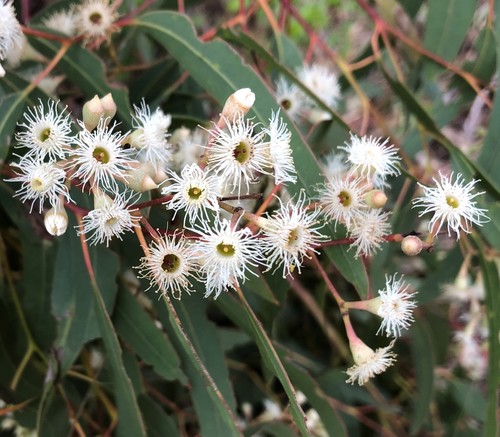
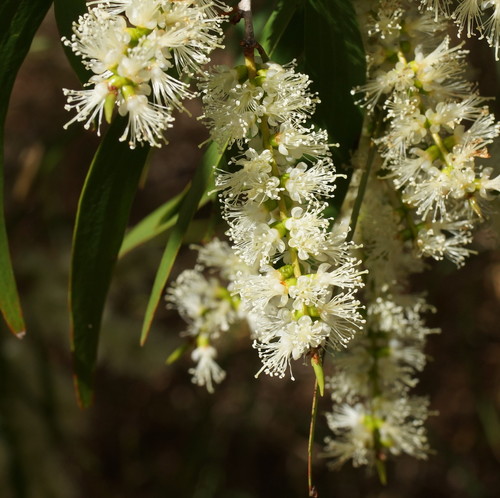
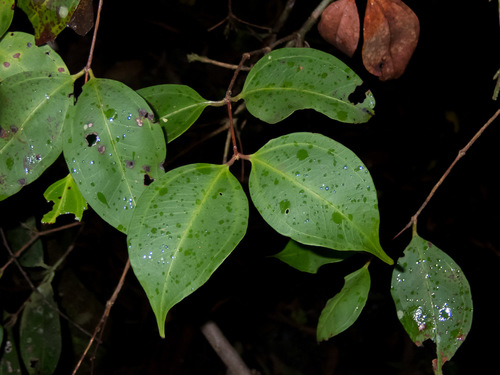
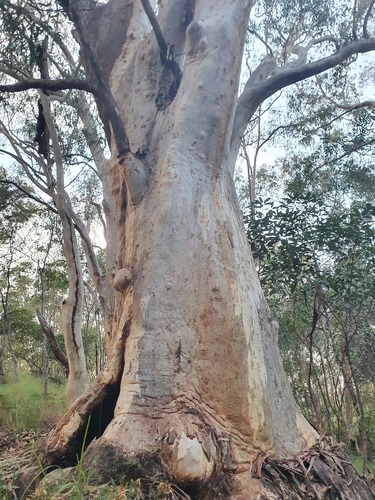
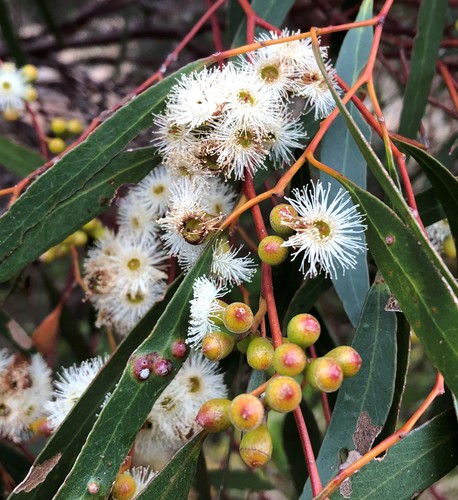
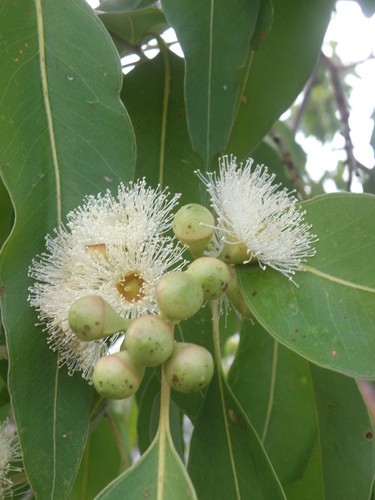
Eucalyptus urophylla S.T.Blake is an evergreen eucalypt that typically grows as a tree reaching 25 to 45 metres (82 to 148 ft) in height, but will grow as a gnarled shrub when growing conditions are unfavourable. Trees have a straight, branchless bole that can extend up to 30 m (98 ft) up the trunk, and the trunk can reach up to 2 m (7 ft) in diameter. Bark appearance varies with growing conditions, but it is typically persistent, subfibrous, and red-brown to brown, with a smooth to shallow texture marked by close longitudinal fissures; it sometimes has a rougher texture, most often at the base of the trunk. Mature evergreen adult leaves are discolourous, arranged subopposite to alternately, and broadly lanceolate, measuring 10 to 15 centimetres (4 to 6 in) long and 5 to 8 cm (2 to 3 in) wide. E. urophylla begins flowering two to three years after establishment, and flowering occurs during the dry season. It produces a simple axillary conflorescence, with solitary umbels holding five to eight flowers that are 8 to 22 millimetres (0.315 to 0.866 in) in length. After flowering, it produces a fruit called a gum-nut, which is a cup-shaped eucalypt capsule holding three to valves and a double operculum. Each fruit contains four to six small, black, semicircular seeds, which reach maturity six months after flowering. This species is quite variable in bark texture, and fruit size and shape. This species is native to the Lesser Sunda Islands of Indonesia, where it has a scattered distribution across seven islands: Adonara, Alor, Flores, Lembata, Pantar, Timor and Wetar. Its total natural range spans around 500 kilometres (311 mi), and it grows at elevations from sea level up to around 3,000 metres (9,843 ft). It is endemic to monsoonal regions that experience two to eight dry months per year. It can tolerate nutrient-poor, damp, well-aerated soils, most of which are volcanic in origin. It is most often found on mountain slopes and in valleys, where it frequently dominates open, usually secondary montane forests. It commonly grows in soils formed from basalt, schist and slate, and is rarely found near limestone. It has been introduced as a plantation timber species outside its native range: it was planted in Java in 1890, Brazil in 1919, and Australia in 1966, and more recently introduced to Cameroon, Congo, Gabon, French Guiana, Ivory Coast and Madagascar in Africa, and Malaysia, Vietnam, southern China and Papua New Guinea in Asia. It is classified as an invasive weed in Brazil, and is a known minor host of fall armyworm. This tree is used to produce a range of products including charcoal, furniture, building poles, fenceposts, wall paneling, fibreboard, pulp, paper and fuel. Vietnam alone holds 200,000 hectares (772 sq mi) of E. urophylla plantations. It can also be used for reforestation within its native range.