About Eucalyptus urnigera Hook.fil.
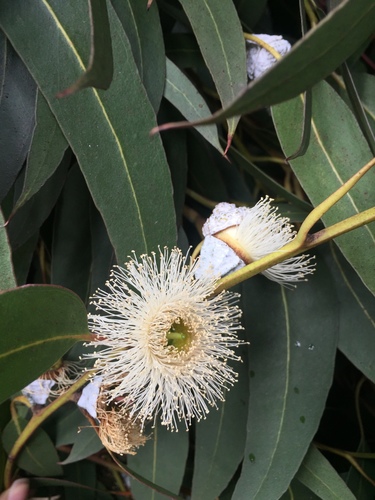
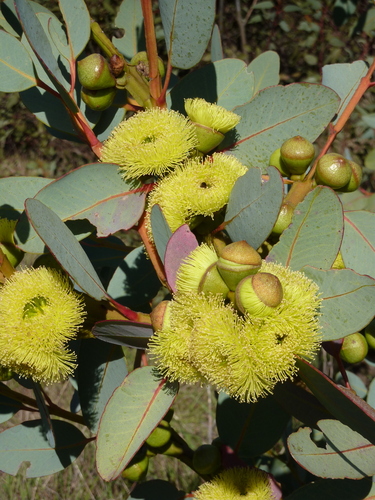
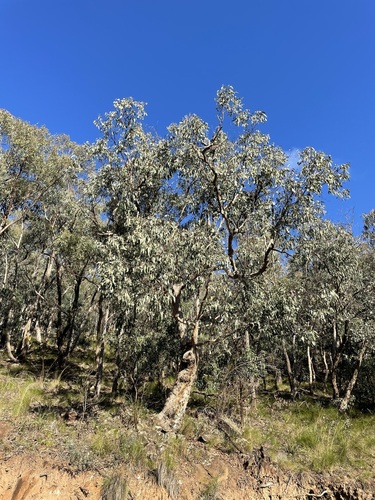
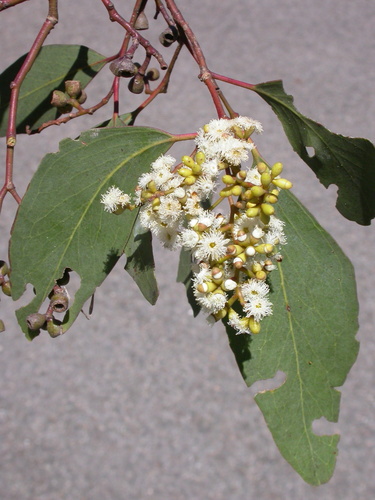
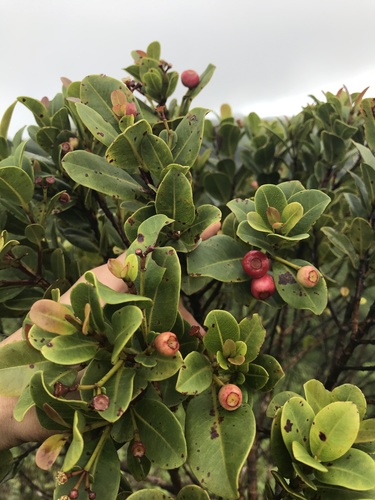
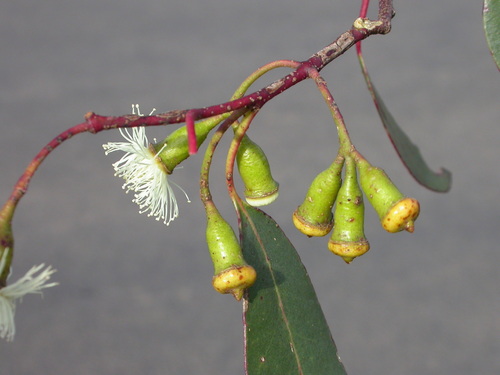
Eucalyptus urnigera Hook.fil. is an evergreen tree that usually reaches 5 to 15 metres (16 to 49 feet) in height, though specimens growing in sheltered low-altitude locations have been recorded as tall as 45 metres (148 feet). It typically spreads up to 10 metres (33 feet) wide. This tree has a lignotuber, and often has a gnarled form when growing in exposed areas. In more sheltered, lower-altitude sites, it grows tall and straight. Its bark is smooth and mottled, with shades of grey, orange-tan to olive green over a cream base, and it sheds in flakes. Its branchlets are often glaucous. Young plants and coppice regrowth produce sessile, heart-shaped to round leaves that are 12 to 28 millimetres (0.47 to 1.10 inches) long and 13 to 28 millimetres (0.51 to 1.10 inches) wide. These leaves are arranged in opposite pairs, have stem-clasping bases, and finely notched or scalloped edges. Foliage colour ranges from dark green in sheltered environments to glaucous in exposed areas. Adult leaves are arranged alternately, are the same shade of green on both sides, and are lance-shaped to broadly lance-shaped or elliptical. They measure 35 to 90 millimetres (1.4 to 3.5 inches) long and 10 to 28 millimetres (0.39 to 1.10 inches) wide, tapering to a petiole 7 to 30 millimetres (0.28 to 1.18 inches) long. The lateral veins of adult leaves diverge at angles between 25 and 60 degrees. Flower buds are arranged in leaf axils in groups of three, on a down-turned peduncle 5 to 25 millimetres (0.20 to 0.98 inches) long, with individual buds on pedicels 1 to 13 millimetres (0.039 to 0.512 inches) long. Mature buds are cylindrical or urn-shaped, often glaucous, and 10 to 13 millimetres (0.39 to 0.51 inches) long and 5 to 7 millimetres (0.20 to 0.28 inches) wide. They have a flattened hemispherical, slightly beaked operculum that is wider than the floral cup at the junction. Flowering occurs in most months, with a peak from April to July, and the flowers are white. The fruit is a woody, urn-shaped capsule 9 to 15 millimetres (0.35 to 0.59 inches) long and 6 to 11 millimetres (0.24 to 0.43 inches) wide, with valves held below the rim level. Eucalyptus urnigera is an endemic alpine eucalypt of Tasmania, belonging to the subgenus Symphomyrtus. It is the dominant eucalypt species at altitudes from 600 to 1,000 metres (1,969 to 3,281 feet), growing on moist but well-drained dolerite slopes and talus. It is restricted to mountains in south-eastern Tasmania, including the Mount Wellington range, Mount Field, and isolated pockets stretching from Tylers Hill near Southport (100 kilometres, 62 miles, south of Hobart) north to Alma Tier near Interlaken and Mount Seymour east of Oatlands in central Tasmania. A small population also grows on the eastern side of Maria Island, off Tasmania's east coast. It usually occurs below the altitude range of E. coccifera (snow gum) and above the mixed and wet sclerophyll forests of lower slopes, though it can grow within both of these vegetation types. The flowers of E. urnigera are pollinated by birds, including the yellow-throated honeyeater (Lichenostomus flavicollis), black-headed honeyeater (Melithreptus affinis), and strong-billed honeyeater (Melithreptus validirostris). In Tasmania, Eucalyptus urnigera has no commercial use as a timber tree, but it is valued as a specimen tree in cooler regions of the United States and the British Isles. Grafton Nursery in Worcestershire, UK, considers it superior to Eucalyptus gunnii, a eucalypt commonly grown in the UK. Its colourful bark and foliage make it a useful garden ornamental. Its lignotuber allows it to coppice, and it has been proposed as a suitable variety for firewood production in the United Kingdom.