About Eucalyptus uncinata Turcz.
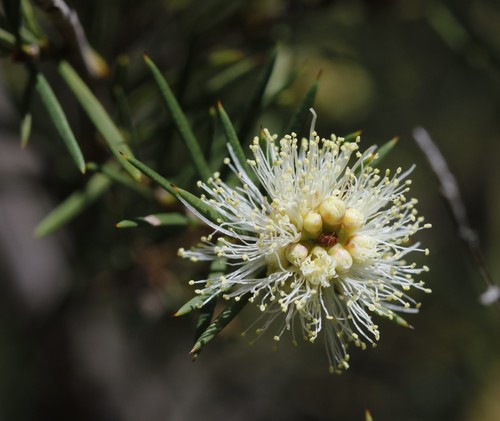
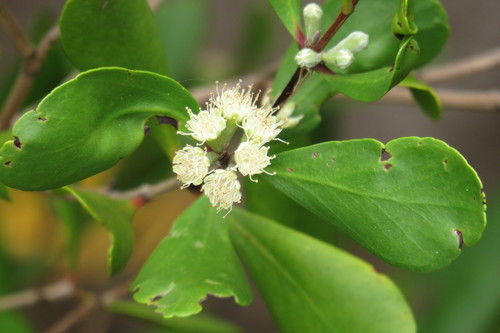
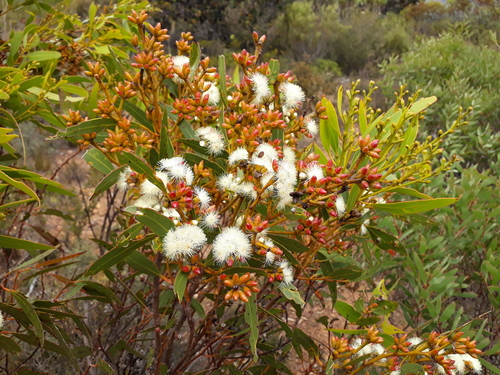
Eucalyptus uncinata Turcz., commonly called hook-leaved mallee, is a mallee that typically grows 1 to 8 meters tall and forms a lignotuber. It has smooth grey to light brown bark shed in short, curly strips, and sometimes a short stocking of fibrous bark near its base. Young plants and coppice regrowth have leaves arranged in opposite pairs joined at their bases, with each half-leaf shaped like an egg to round, between 17 and 55 millimeters long and wide. Adult leaves are the same shade of glossy green on both sides, shaped like a narrow lance to a lance, between 65 and 115 millimeters long and 10 to 25 millimeters wide, tapering to a petiole 7 to 25 millimeters long. Flower buds are arranged in leaf axils in groups of nine, eleven or thirteen on a flattened, unbranched peduncle 3 to 20 millimeters long; individual buds are sessile or on pedicels up to 2 millimeters long. Mature buds are oval to spindle-shaped, 7 to 15 millimeters long and 3 to 5 millimeters wide, with a conical or rounded operculum about the same length as the floral cup. Flowering occurs between January and April, and the flowers are creamy white. The fruit is a woody barrel-shaped, oval or cylindrical capsule 5 to 9 millimeters long and 4 to 8 millimeters wide, with valves positioned below the rim level. This species is found on coastal and sub-coastal sand plains and low hills between York, the Stirling Range, Salmon Gums and Israelite Bay, and grows mostly in open shrubland. It is part of the western mallee subgroup, which is characterized by several other eucalypts including Eucalyptus oleosa, Eucalyptus moderata, Eucalyptus incrassata, Eucalyptus foecunda, Eucalyptus redunca and Eucalyptus eremophila. The understorey of its habitat is predominantly shrubby, with species of Melaleuca and Acacia, and occasional Triodia.