About Eucalyptus umbra F.Muell. ex R.T.Baker
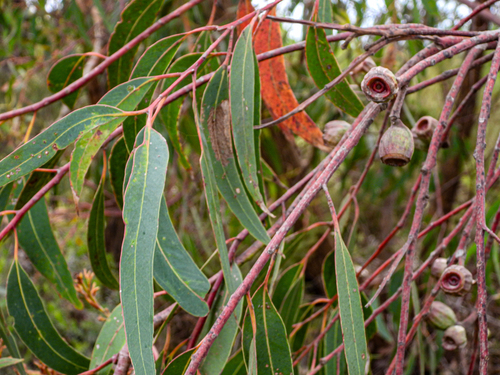
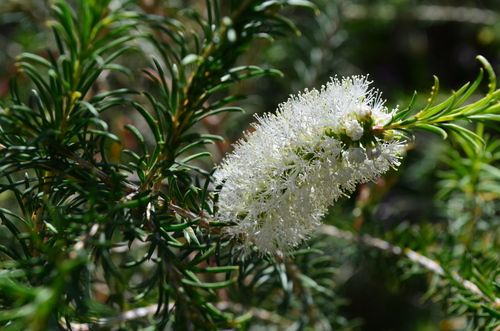
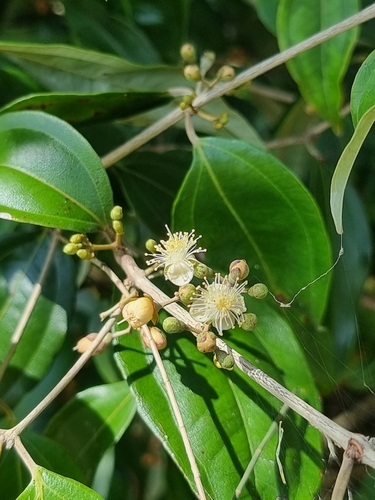
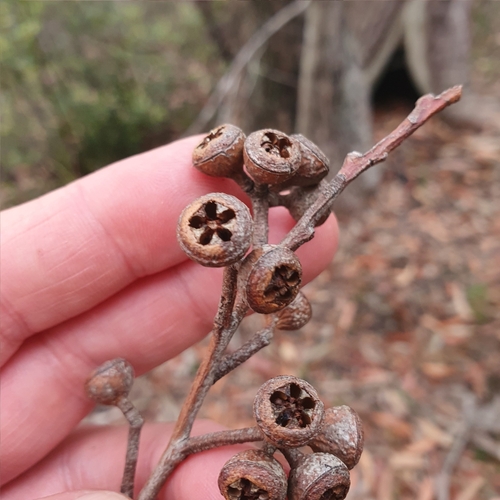
Eucalyptus umbra, commonly known as broad-leaved white mahogany, is a tree that typically reaches a height of 25 meters (82 feet) and forms a lignotuber. Young plants and coppice regrowth have sessile leaves that are broadly egg-shaped to lance-shaped, measuring 80–200 mm (3.1–7.9 in) long and 35–100 mm (1.4–3.9 in) wide. These juvenile leaves are held horizontally, arranged in opposite pairs, and their bases surround the stem. Adult leaves are arranged alternately, are the same shade of green on both sides, and are lance-shaped to curved. They measure 60–180 mm (2.4–7.1 in) long and 15–45 mm (0.59–1.77 in) wide, tapering to a petiole 10–20 mm (0.39–0.79 in) long. Flower buds are mostly arranged in panicles at the ends of branchlets, on a peduncle 6–20 mm (0.24–0.79 in) long, with individual buds borne on pedicels 3–7 mm (0.12–0.28 in) long. Mature buds are oval, about 6 mm (0.24 in) long and 3–4 mm (0.12–0.16 in) wide, with a conical to beaked operculum. Flowering occurs between September and February, and the flowers are white. The fruit is a woody cup-shaped to hemispherical capsule, 3–7 mm (0.12–0.28 in) long and 6–10 mm (0.24–0.39 in) wide, with valves located near or below rim level. This species is found in high rainfall coastal areas of New South Wales between Sydney and Grafton. It grows in dry sclerophyll forest or woodland, usually on poor, shallow, dry soils. It can be distinguished from Eucalyptus latisinensis, the white mahogany of coastal Queensland, by its broader juvenile leaves. Eucalyptus umbra is a member of the white mahogany group as recognized by Ken Hill. Other species in this group are E. acmenoides, E. mediocris, E. carnea, E. apothalassica, E. helidonica, E. psammitica and E. latisinensis.