About Eucalyptus torquata Luehm.
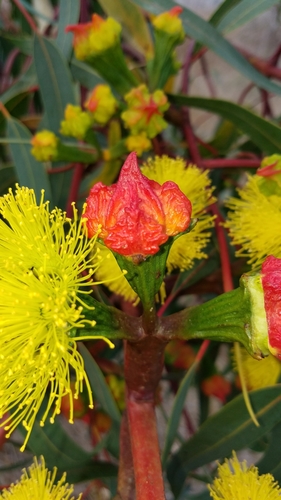
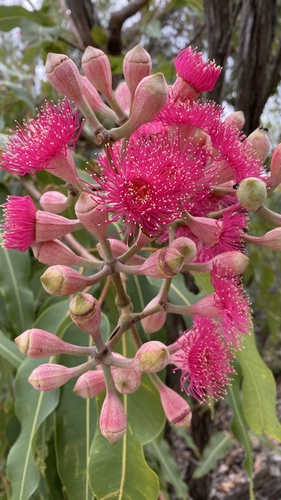
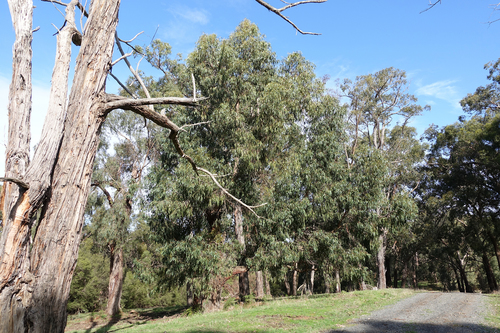
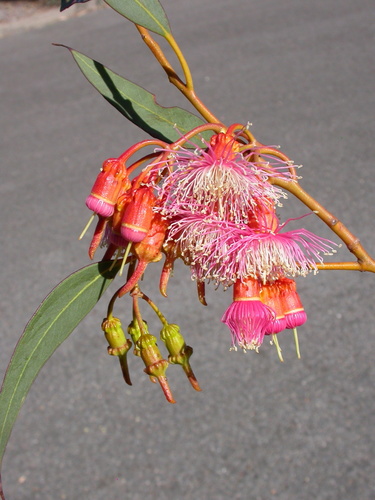
Eucalyptus torquata Luehm. is a small, stout tree that produces beautiful flowers. In its native habitat, it grows to a height between 4 and 11 metres (13 and 36 ft), and has a spreading growth habit. It forms clusters of orange barrel-shaped buds with horned caps, which are followed by abundant red or pink flowers that bloom between August and December. Rough bark that persists on the trunk and branches; it is a fibrous-flaky box-type bark, colored grey-black, grey, or black, with whitish patches. The leaves are greyish green, with a lanceolate-shaped blade that measures 90 to 120 mm (3.5 to 4.7 in) long and 15 to 20 millimetres (0.6 to 0.8 in) wide. Leaves are tapered at the base, and their petioles are quadrangular, narrowly flattened, or channelled. Conflorescences have a diameter of 35 mm (1.4 in); flowers are typically coral-pink, though plants with white, cream, or red flowers are also recorded. Conflorescences are simple and axillary, with three to seven flowers borne on umbellasters that have terete peduncles. Buds are rostrate or urceolate in shape, not pruinose, and the calyx calyptrate sheds early. Fruits that develop after flowering are cylindrical, with a depressed disc and enclosed valves.
This species is found on hillsides around Kalgoorlie and Coolgardie, extending south to approximately Widgiemooltha in the Goldfields region of Western Australia. It grows in stony loam, clay, or red sandy soils.
Commonly known as coral gum, this tree is often cultivated for small gardens, used as an ornamental plant or street tree, especially in arid areas. When grown from seed, it will often flower within two years. It can also be grown in large containers when planted in well-drained soils.