About Eucalyptus todtiana F.Muell.
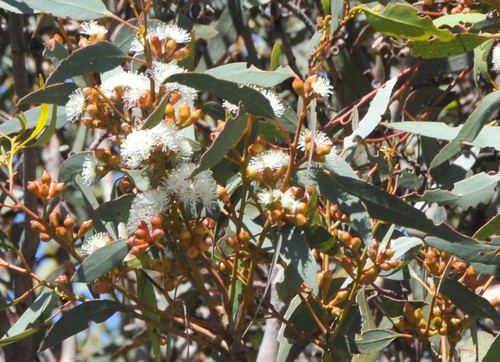
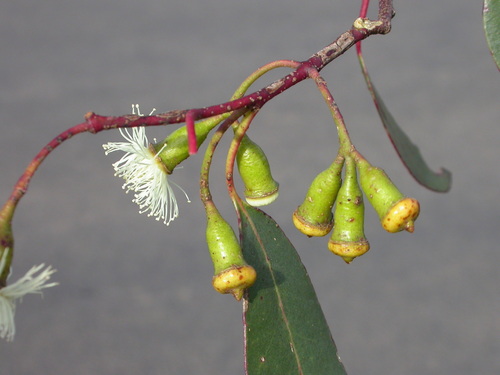
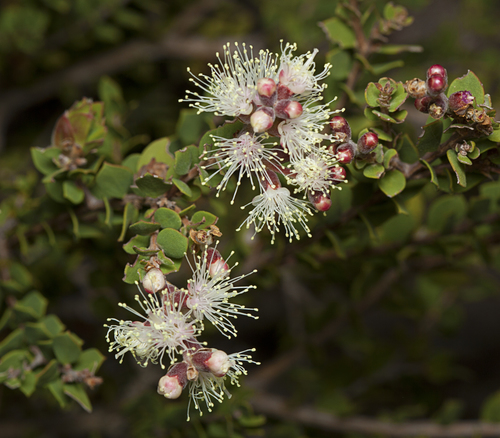
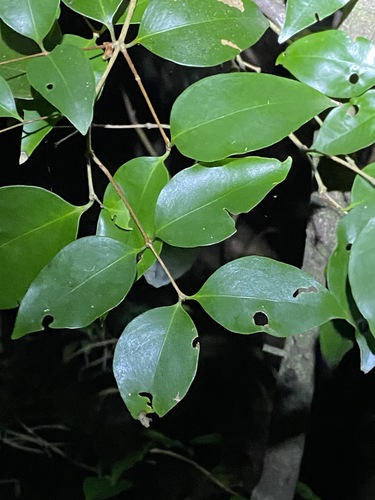
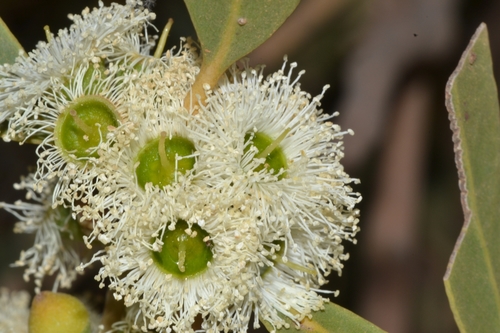
Eucalyptus todtiana F.Muell., commonly known as coastal blackbutt, is a tree or mallee that typically reaches 2 to 15 meters in height and forms a lignotuber. It has a weeping growth habit, with rough, fibrous, prickly bark on the lower trunk, rough scaly bark on the upper trunk, and smooth grey to pinkish bark on the branches. Young plants and coppice regrowth have sessile, elliptical to oblong leaves 55–130 mm long and 10–16 mm wide, arranged in opposite pairs. Adult leaves are arranged alternately, are light green and lance-shaped, 80–125 mm long and 15–22 mm wide, tapering to a 4–22 mm long petiole. This species has a dense, spreading to pendulous crown. Flower buds are arranged in groups of seven, nine or eleven in leaf axils, on an unbranched peduncle 12–35 mm long, with individual buds borne on 1–3 mm long pedicels. Mature buds are oval, 8–11 mm long and 6–7 mm wide, with a conical to rounded operculum. Flowering occurs from January to April, and the flowers are creamy white. The fruit is a woody cup-shaped to hemispherical capsule 11–21 mm long and 14–25 mm wide, with valves positioned near the rim. This species grows in scrub and open woodland on sandy flats and gentle slopes of the coastal plain between Perth and Dongara, Western Australia, within the Avon Wheatbelt, Geraldton Sandplains, Jarrah Forest and Swan Coastal Plain biogeographic regions. It is a slow growing, long lived species that provides habitat for many local fauna including nectar-feeding birds, bats, lizards and insects. Eucalyptus todtiana is not often grown in cultivation. Saplings grow rapidly when planted in an open position, while mature plants grow slowly and produce abundant flowers. It is tolerant of both frost and drought. Indigenous Australians used parts of this tree for medicinal purposes: crushed leaves were used as a nasal decongestant or an antibacterial poultice, and leaves were eaten to relieve dysentery. Gum from the tree was used as an ointment applied to sores, and leaves were also commonly used for bedding.