About Eucalyptus tindaliae Blakely
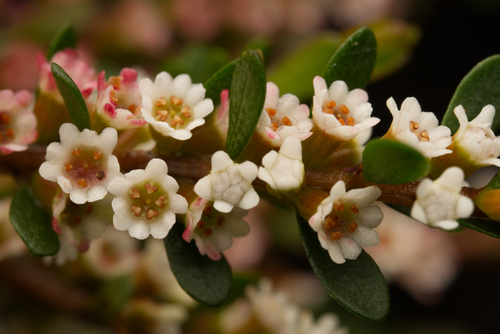
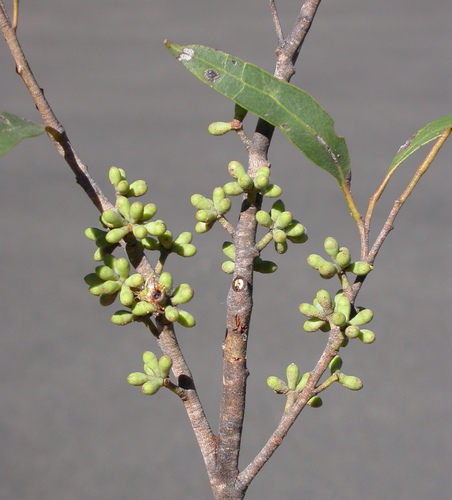
Eucalyptus tindaliae, commonly known as Tindal's stringybark, is a tree that typically reaches a height of 27 to 30 meters (89 to 98 feet) and forms a lignotuber. It has rough, stringy grey bark covering its trunk and larger branches. Young plants and coppice regrowth have glossy green leaves that are paler on the lower surface; these leaves range from egg-shaped to lance-shaped, measuring 30–95 mm (1.2–3.7 in) long and 14–45 mm (0.55–1.77 in) wide. Adult leaves are roughly the same shade of green on both sides, shaped from lance-shaped to curved. They measure 60–140 mm (2.4–5.5 in) long and 12–37 mm (0.47–1.46 in) wide, tapering to a petiole that is 6–20 mm (0.24–0.79 in) long. Flower buds are arranged in leaf axils in groups of between nine and fifteen, on an unbranched peduncle 5–18 mm (0.20–0.71 in) long. Individual buds are either sessile or on pedicels up to 2 mm (0.079 in) long. Mature buds are oval, 3–7 mm (0.12–0.28 in) long and 3–4 mm (0.12–0.16 in) wide, with a conical to rounded operculum. Flowering occurs from May to August in the northern part of this species' range, and from January to March in the southern part. The flowers are white, and the fruit is a woody hemispherical capsule 3–7 mm (0.12–0.28 in) long and 6–10 mm (0.24–0.39 in) wide, with valves that sit at or below the rim level of the capsule. This species grows on heavy soils in closed forest in near-coastal areas, between the Atherton Tableland and Coffs Harbour.