About Eucalyptus tereticornis Sm.
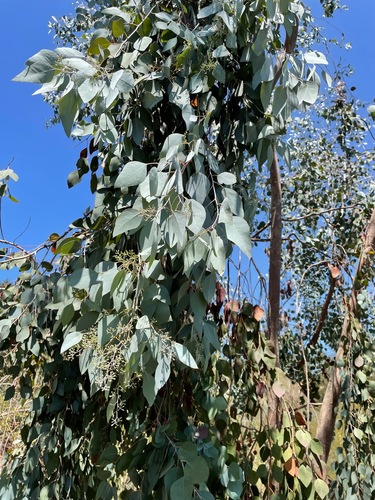
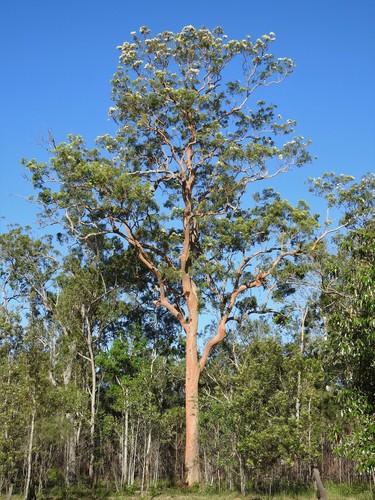
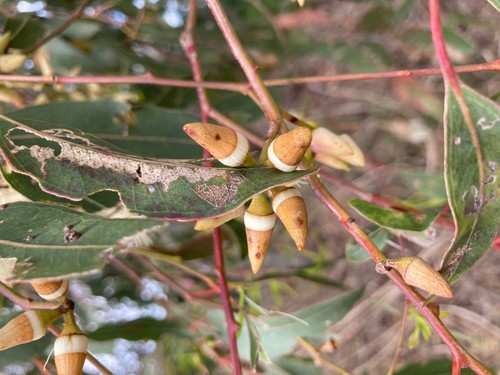
Eucalyptus tereticornis Sm. is a tree that typically grows 20 to 50 meters (66 to 164 feet) tall, and it forms a lignotuber. Its trunk is straight, usually unbranched for more than half of the tree’s total height, and can reach up to 2 meters (6 feet 7 inches) in diameter at breast height. Above the unbranched section, the limbs are unusually steeply inclined compared to other Eucalyptus species. The tree sheds its bark in irregular sheets, leaving a smooth trunk surface marked by patches of white, grey, and blue, which correspond to areas that shed their bark at different times. Young plants and coppice regrowth have dull bluish green, egg-shaped leaves that are 60–130 mm (2.4–5.1 in) long and 30–80 mm (1.2–3.1 in) wide. Adult leaves are the same shade of green on both sides, shaped from lance-shaped to curved, 80–220 mm (3.1–8.7 in) long and 10–35 mm (0.39–1.38 in) wide, tapering at the base to a 13–30 mm (0.51–1.18 in) long petiole. Flower buds grow in leaf axils in groups of seven, nine, or eleven, on an unbranched 7–25 mm (0.28–0.98 in) long peduncle, with individual buds growing on 2–6 mm (0.079–0.236 in) long pedicels. Mature buds are elongated oval-shaped, 9–16 mm (0.35–0.63 in) long and 3–6 mm (0.12–0.24 in) wide, with a conical to horn-shaped operculum that is much longer than the floral cup. Flowering has been recorded in most months, and the flowers are white. The fruit is a woody, hemispherical capsule 2–6 mm (0.079–0.236 in) long and 4–8 mm (0.16–0.31 in) wide, with prominently protruding valves. This species has a wide distribution, occurring across the widest latitudinal range of any Eucalyptus species, from southern Papua New Guinea at 15°S to southeastern Victoria at 38°S. Forest red gum, as it is commonly known, is one of the key canopy species of the threatened Cumberland Plain Woodlands. Subspecies basaltica grows in eucalypt woodland from Kroombit Tops to near Sydney, with a disjunct population in the Carnarvon Range. Subspecies mediana is endemic to eastern Victoria, where it grows near river banks, wetlands, low hills and plains. Subspecies rotunda is endemic to a small area near Mitchell in Queensland, growing along creek banks. Subspecies tereticornis is the most widely distributed of the four subspecies, and grows in open forest from Cape York Peninsula in Queensland to near Bega in southern New South Wales, as far inland as Roma, and is also found in the Central and Oro Provinces of Papua New Guinea. This tree has strong, hard, durable heartwood, with a density of approximately 1100 kg per cubic meter. The wood is used for construction in heavy engineering projects, such as making railway sleepers. Its leaves are used to produce cineole-based eucalyptus oil.