About Eucalyptus tenuiramis Miq.
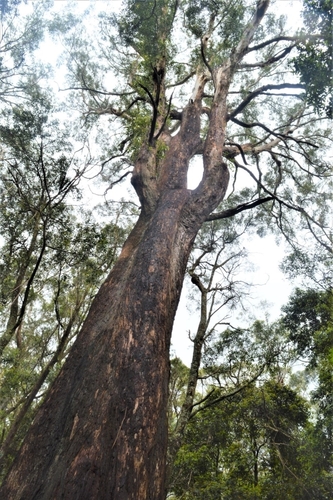
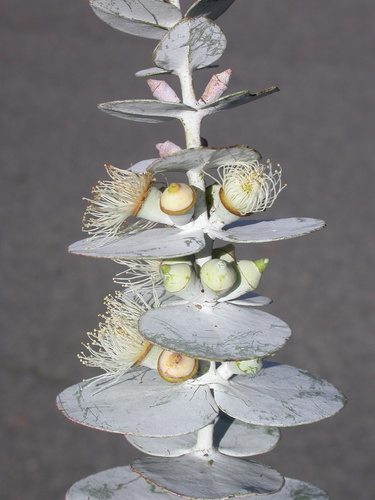
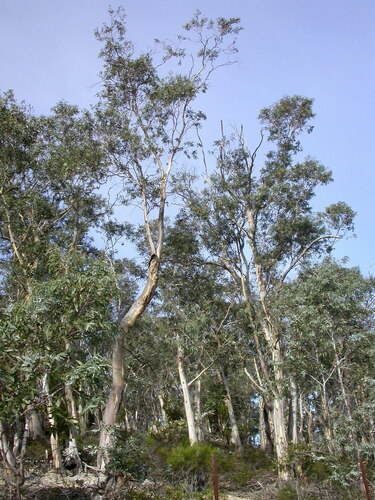
Eucalyptus tenuiramis, commonly known as silver peppermint, is a tree that typically grows to 25 metres (82 feet) in height and forms a lignotuber. It has smooth bark ranging in colour from white to grey or yellowish. Young plants and coppice regrowth have sessile, egg-shaped leaves arranged in opposite pairs, measuring 17–60 mm (0.67–2.36 in) long and 10–38 mm (0.39–1.50 in) wide. Adult leaves are broadly lance-shaped to elliptical, 55–130 mm (2.2–5.1 in) long and 10–25 mm (0.39–0.98 in) wide, tapering to a 7–12 mm (0.28–0.47 in) long petiole. Flower buds are arranged in groups of nine to fifteen in leaf axils, on an unbranched peduncle 4–12 mm (0.16–0.47 in) long, with individual buds attached to 1–4 mm (0.039–0.157 in) long pedicels. Mature buds are oval to club-shaped, 5–8 mm (0.20–0.31 in) long and 3–4 mm (0.12–0.16 in) wide, with a conical or rounded operculum. Flowering occurs between November and February, and the flowers are white. The fruit is a woody capsule that is cup-shaped, hemispherical or conical, 5–12 mm (0.20–0.47 in) long and 6–11 mm (0.24–0.43 in) wide, with valves positioned near the rim of the capsule. Silver peppermint grows in open forest, often in pure stands, on lowlands and hills in south-eastern Tasmania. It occurs most commonly in the Derwent River valley, and is also found on the Freycinet Peninsula and Flinders Island.