About Eucalyptus stellulata Sieber ex DC.
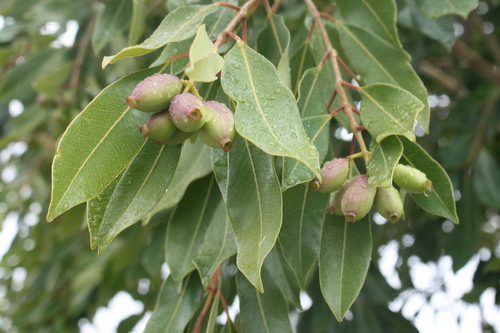
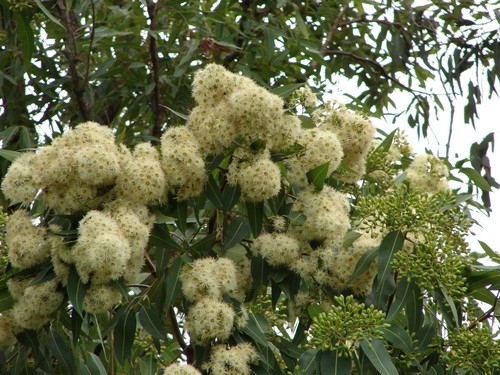
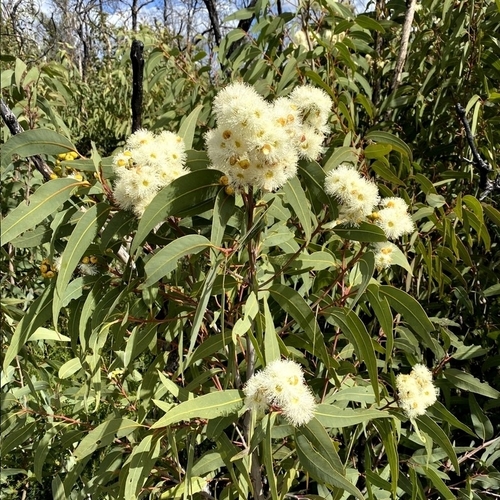
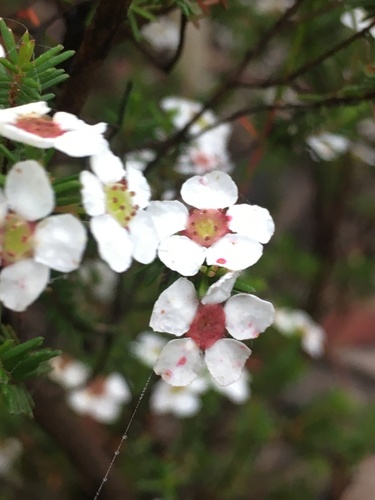
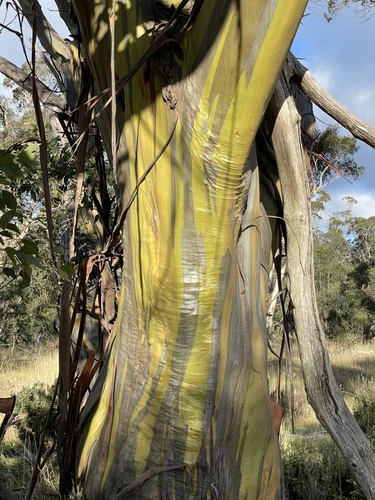
Eucalyptus stellulata Sieber ex DC. is a tree or mallee that typically grows to 15 metres (49 feet) tall, and forms a woody lignotuber. It has rough, short fibrous greyish bark on the lower section of its trunk, and smooth, somewhat oily olive green bark on the upper trunk and branches. Young plants and coppice regrowth have sessile, elliptical leaves that grow in opposite pairs, measuring 40–100 millimetres (1.6–3.9 inches) long and 30–50 millimetres (1.2–2.0 inches) wide. Adult leaves are arranged alternately, glossy green on both sides, and range from lance-shaped to elliptical. They are 47–110 millimetres (1.9–4.3 inches) long and 9–32 millimetres (0.35–1.26 inches) wide, tapering to a 4–13 millimetre (0.16–0.51 inch) long petiole. The leaf veins of this species are almost parallel. Flower buds grow in star-like clusters of 9 to 15 in leaf axils, on an unbranched peduncle 1–6 millimetres (0.039–0.236 inches) long, with individual buds being sessile. Mature buds are spindle-shaped, 4–6 millimetres (0.16–0.24 inches) long and about 2 millimetres (0.079 inches) wide, with a pointed, conical operculum. Flowering occurs between February and May, and the flowers are white. The fruit is a sessile, cup-shaped or shortened spherical capsule that is 3–5 millimetres (0.12–0.20 inches) long and wide, with valves located near the rim of the capsule.
Commonly called black sallee, this eucalyptus occurs from near Tenterfield in New South Wales, extending south along the Great Dividing Range to the eastern highlands of Victoria. It is common in grassy eucalyptus woodland, often growing near swamps and alongside streams, and usually grows on soils of relatively good fertility.