About Eucalyptus spathulata Hook.
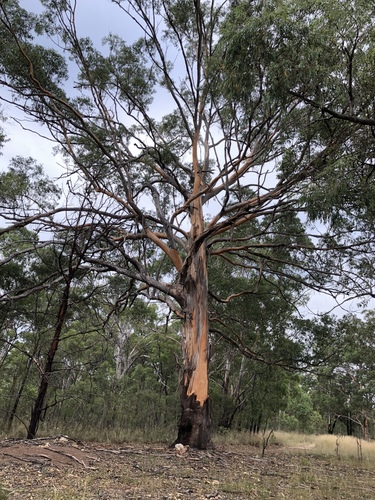
Eucalyptus spathulata Hook., commonly known as swamp mallet, is a low-branching mallee that typically grows to 8–12 m (26–39 ft) in height, and does not form a lignotuber. It has a dense crown, and its trunk is usually relatively short with a diameter of 1–2 m (3 ft 3 in – 6 ft 7 in), though older trees may develop larger trunks, and the base is sometimes fluted. The bark on both the trunk and branches is smooth, satin-like, and coloured greyish brown or reddish brown.
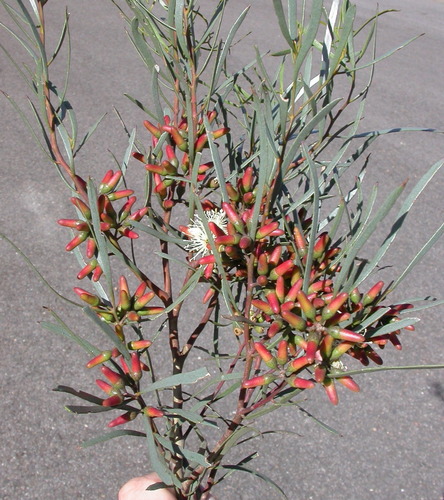
Young plants have linear leaves that are 35–50 mm (1.4–2.0 in) long, 3–5 mm (0.12–0.20 in) wide, and are either sessile or borne on a short petiole. Adult leaves are also linear, glossy green and the same shade on both sides, measuring 35–95 mm (1.4–3.7 in) long and 2–6 mm (0.079–0.236 in) wide, tapering to a petiole 1–7 mm (0.039–0.276 in) long.
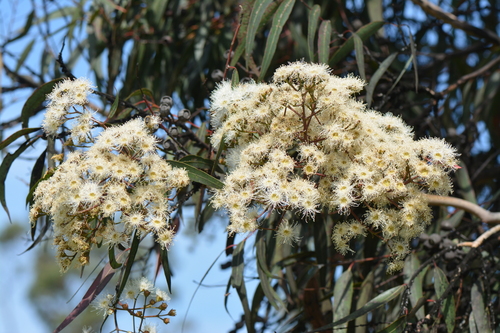
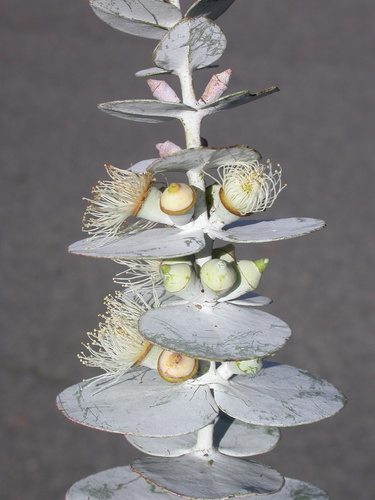
Flowers are arranged in groups of three or seven in leaf axils, on an unbranched peduncle 3–15 mm (0.12–0.59 in) long, with individual buds borne on pedicels 2–6 mm (0.079–0.236 in) long. Mature buds are oval to spindle-shaped, 10–13 mm (0.39–0.51 in) long and 3–5 mm (0.12–0.20 in) wide, with a horn-shaped or conical operculum that is two to three times as long as the floral cup. Flowering occurs between December and March, and the flowers are white. The fruit is a woody cup-shaped to conical capsule 3–8 mm (0.12–0.31 in) long and 4–7 mm (0.16–0.28 in) wide, with valves positioned near the rim.
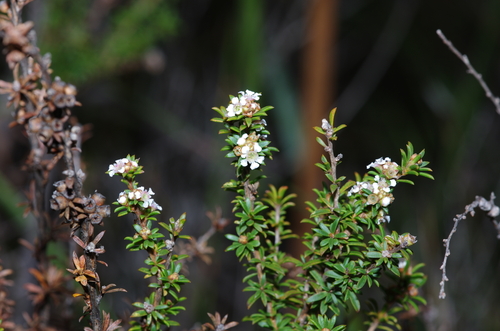
This species is found on flats, broad valley floors, rises, within and around saline depressions, and along the edges of salt lakes in the southern Wheatbelt and inland Great Southern regions of Western Australia, where it grows in sandy or sandy-clay soils over granite. Subspecies E. spathulata subsp. spathulata occurs in the Blackwood River and Pallinup River drainage systems, while E. spathulata subsp. salina is restricted to the more northerly Salt River catchment. It grows in woodland communities with an understorey that includes a variety of melaleuca species: M. acuminata, M. pauperiflora, M. lateriflora, M. brophyi, and the M. uncinata group. Other associated species are Bossiaea halophila, Gahnia ancistrophylla, and Brachyscome lineariloba, all of which are well suited to calcareous, saline, low-lying areas.
In horticulture, Eucalyptus spathulata has a moderate to high growth rate and can live for over 15 years. It is widely cultivated in southern Australia, and can be grown in saline and poorly drained sites. Its dense, hard, pale brown wood is used for fuelwood and craftwood. It is planted in gardens as an ornamental tree and as a windbreak, and produces pollen that is desirable for apiculture. Its bark is rich in tannin, and its leaves contain cineole. This tree is both drought and frost tolerant, can withstand salt-laden winds, and has also been cultivated in California.