About Eucalyptus socialis F.Muell. ex Miq.
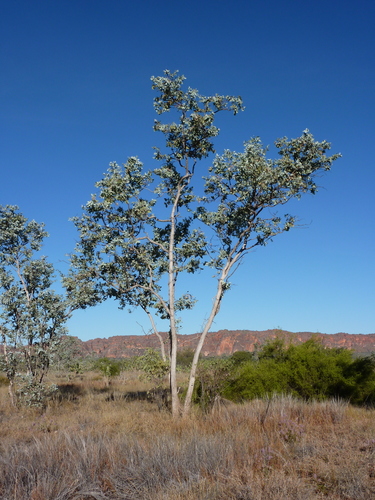
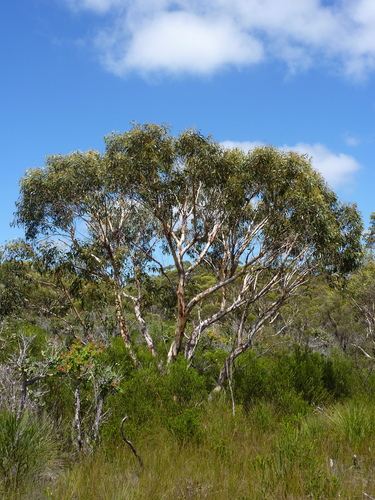
Eucalyptus socialis F.Muell. ex Miq. is a mallee eucalyptus that typically grows 5 to 7 metres (16 to 23 ft) tall, though it can reach up to 12 metres (39 ft), and forms a woody lignotuber. Its canopy usually reaches around 5 metres (16 ft) wide. It generally has rough grey bark on its trunk, with smooth, dull grey bark above that is shed in long ribbons. Young plants and coppice regrowth have square cross-section stems, with dull green to greyish leaves that are egg-shaped to lance-shaped or elliptical. These young leaves measure 40–80 mm (1.6–3.1 in) long and 18–42 mm (0.71–1.65 in) wide.
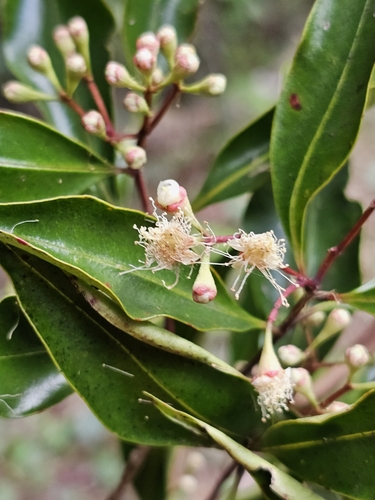
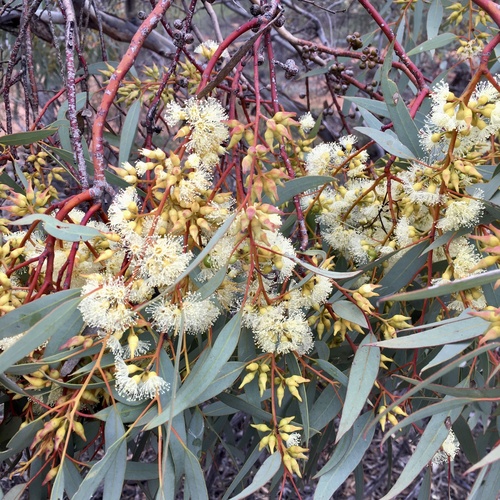
Adult leaves are arranged alternately along stems, and are the same dull green or greyish colour on both sides. They are lance-shaped, 50–140 mm (2.0–5.5 in) long and 10–22 mm (0.39–0.87 in) wide, tapering to a 10–30 mm (0.39–1.18 in) long petiole. Flower buds grow in groups of 7 to 13 in leaf axils, on an unbranched peduncle 4–23 mm (0.16–0.91 in) long, with individual buds attached to 3–8 mm (0.12–0.31 in) long pedicels. Mature buds are oval to spindle-shaped, 8–17 mm (0.31–0.67 in) long and 3–5 mm (0.12–0.20 in) wide, with a conical, beaked or horn-shaped operculum 5–12 mm (0.20–0.47 in) long. Flowering can occur in most months of the year, and the flowers are white to pale yellow. The fruit is a woody urn-shaped to shortened spherical capsule, 4–9 mm (0.16–0.35 in) long and 4–8 mm (0.16–0.31 in) wide. Valves are enclosed within the capsule, and the fragile remains of the style protrude from the opening.
Eucalyptus socialis is one of the most widely distributed mallee species in Australia. In Western Australia, it grows on calcareous flats and rocky scree slopes in the Pilbara and Goldfields-Esperance regions, in red-grey loam over limestone. It also occurs across most of South Australia, and is particularly common in southern areas including the Eyre Peninsula, Gawler Range, Flinders Ranges and Adelaide foothills. Its range extends into the southern Northern Territory (around the Alice Springs region) and into parts of Queensland, where it grows in open woodlands, often alongside E. dumosa, E. gracilis and E. leptophylla. In New South Wales, it is found west of Condoblin, with a sporadic distribution from Wilcannia, growing in mallee shrubland communities on red aeolian sands. In Victoria, it occurs in the north-west of the state.
After bushfires, this species can resprout from its base. It has a mortality rate of less than 30% even when 100% of its leaves are scorched.
Eucalyptus socialis can produce large amounts of biomass, yielding 10 to 20 metric tons (11 to 22 short tons) per hectare per year. In Australian wheatbelt regions, it provides benefits including reducing soil salinity, providing shade for livestock, acting as a windbreak, and reducing erosion. Indigenous Australians traditionally used this species for multiple purposes: they made bowls and leaf-based medicines, fashioned shields and spears from the bark, and collected water from its roots. It is sold commercially for horticulture, and is noted for its ability to grow in poor soils. Its nectar is very attractive to bees and butterflies, which feed on it during its spring to summer flowering period. It is drought- and salt-tolerant, grows best in full sun and well-drained soils, and is slow-growing. It is used in revegetation projects and as a small ornamental tree for gardens.