About Eucalyptus sideroxylon A.Cunn. ex Woolls
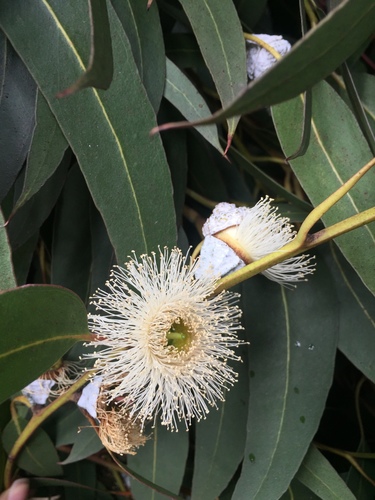
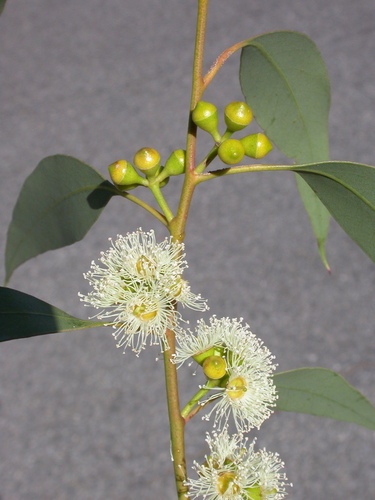
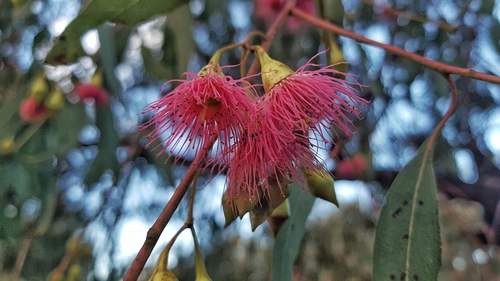
Eucalyptus sideroxylon, commonly known as mugga ironbark, is a tree that typically reaches 25–35 meters (82–115 feet) in height, and forms a lignotuber. Its trunk and larger branches are covered in dark grey to black, deeply furrowed ironbark, while the thinnest branches have smooth white to grey bark. Young plants and coppice regrowth have lance-shaped, oblong, or linear leaves that measure 30–110 mm (1.2–4.3 in) long and 5–35 mm (0.20–1.38 in) wide. Adult leaves are lance-shaped, the same shade of green on both sides, 50–140 mm (2.0–5.5 in) long and 10–40 mm (0.39–1.57 in) wide, tapering to a 5–25 mm (0.20–0.98 in) long petiole. Flower buds grow in clusters in leaf axils, on an unbranched peduncle 7–29 mm (0.28–1.14 in) long, with each individual bud attached to a 3–15 mm (0.12–0.59 in) long pedicel. Mature buds are oval or diamond-shaped, 6–15 mm (0.24–0.59 in) long and 4–6 mm (0.16–0.24 in) wide, with a conical to beaked operculum. Flowering occurs from April to December, and flowers can be white, red, pink, or creamy yellow. The fruit is a woody, cup-shaped to shortened spherical capsule 5–11 mm (0.20–0.43 in) long and 5–10 mm (0.20–0.39 in) wide, with valves that sit below the rim of the capsule. This tree species is widespread and often abundant in woodland areas from south-eastern Queensland, through New South Wales, to Victoria. Its subspecies Eucalyptus sideroxylon subsp. improcera is only known from Barakula State Forest, north-northwest of Chinchilla. The leaves of Eucalyptus sideroxylon are used to produce cineole-based eucalyptus oil. In New South Wales, apiarists place beehives in red-ironbark woodlands to collect honey from this species.