About Eucalyptus siderophloia Benth.
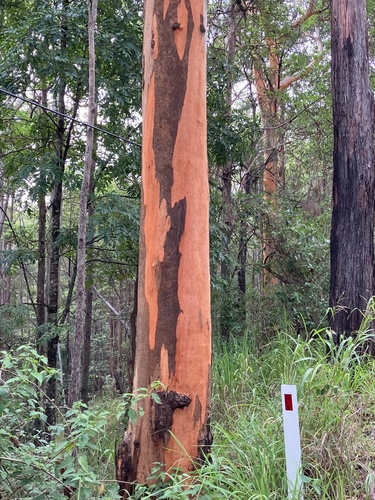
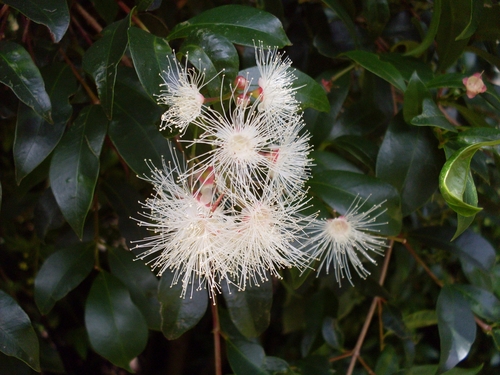
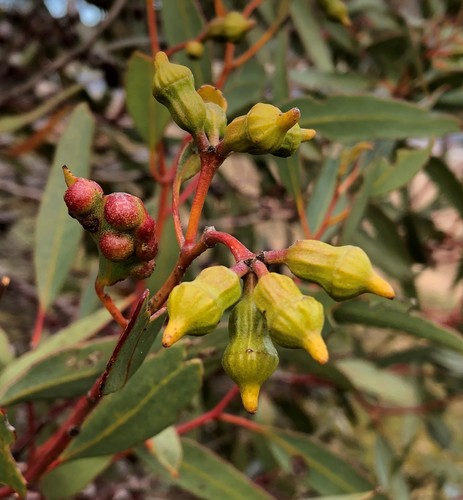
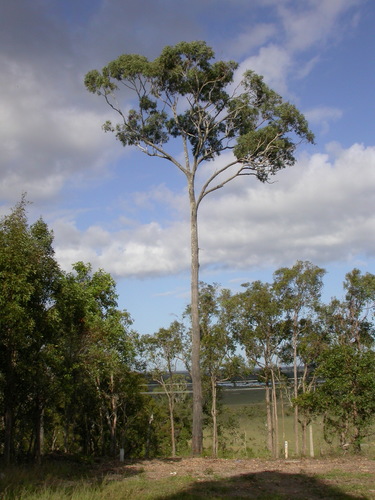
Eucalyptus siderophloia Benth. is a tree species that typically reaches a height of 20 to 45 meters (66 to 148 feet) and forms a lignotuber. It has hard, rough, furrowed grey or black bark covering its trunk and larger branches, though the thinner branches sometimes have smooth bark. Young plants and coppice regrowth have egg-shaped to lance-shaped leaves that are paler on the lower surface, measuring 50 to 120 millimeters (2.0 to 4.7 inches) long and 15 to 48 millimeters (0.59 to 1.89 inches) wide. Adult leaves are the same shade of green on both sides, are lance-shaped to curved, 85 to 175 millimeters (3.3 to 6.9 inches) long and 15 to 30 millimeters (0.59 to 1.18 inches) wide, tapering to a petiole 10 to 25 millimeters (0.39 to 0.98 inches) long. Flowers are mostly arranged at the ends of branchlets, in groups of seven, growing on a branched peduncle 5 to 12 millimeters (0.20 to 0.47 inches) long, with individual buds attached to pedicels 2 to 8 millimeters (0.079 to 0.315 inches) long. Mature buds are diamond-shaped or spindle-shaped, 5 to 10 millimeters (0.20 to 0.39 inches) long and 3 to 4 millimeters (0.12 to 0.16 inches) wide, with a conical operculum. Flowering occurs mainly from September to January, and the flowers are white. The fruit is a woody cup-shaped or conical capsule 3 to 8 millimeters (0.12 to 0.31 inches) long and 4 to 7 millimeters (0.16 to 0.28 inches) wide, with valves positioned near the rim level. This ironbark species grows in forests on coastal lands and adjacent foothills, in soils of reasonable fertility, ranging from around Maryborough and Springsure in Queensland to near Sydney in New South Wales. Its sapwood is usually resistant to the lyctus borer. While it is not an easy timber to work with, it has a beautiful appearance similar to that of some rainforest species. Common uses for its timber include flooring, decking, shipbuilding, poles, construction, railway sleepers, and heavy engineering.