About Eucalyptus salubris F.Muell.
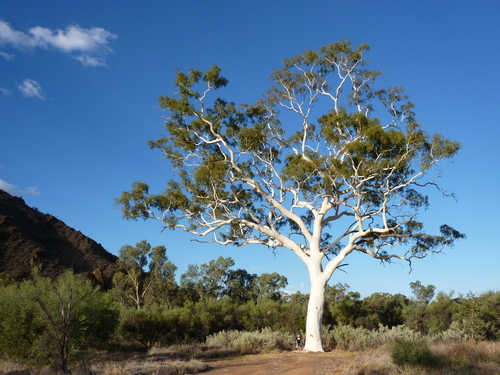
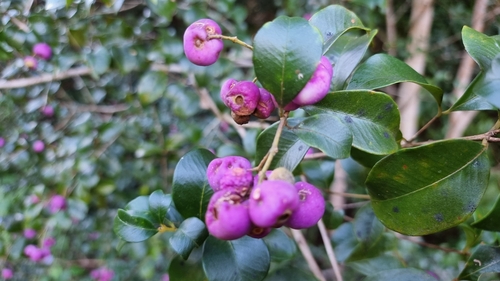
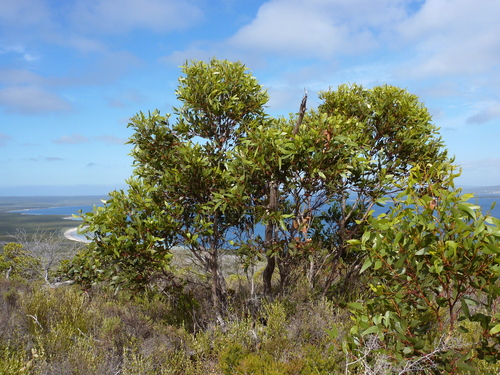
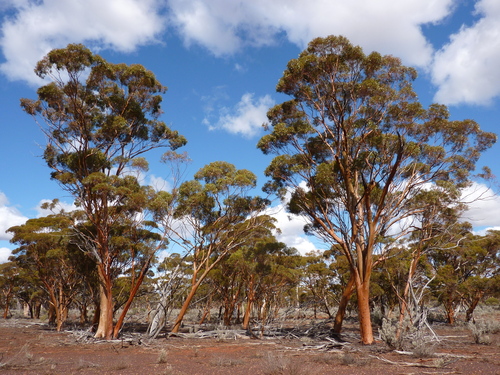
Eucalyptus salubris F.Muell. grows as a mallet, typically reaching 4–15 m (13–49 ft) in height, and does not form a lignotuber. It is one of nine true gimlet eucalyptus species that produce flower buds in groups of seven. It has smooth, distinctly fluted trunks and stems, and produces white or cream flowers from September to March. Adult leaves are arranged alternately on branchlets, are the same glossy green colour on both sides, and have petioles 7–20 mm (0.28–0.79 in) long. The leaf blade is narrowly lance-shaped, usually 65–105 mm (2.6–4.1 in) long and 7–15 mm (0.28–0.59 in) wide, with a base that tapers to the petiole and a pointed apex. Flowers are arranged in groups of seven in leaf axils, borne on stout, unbranched peduncles. The flower groups are broadest near the tip and roughly 0.4 to 2 cm (0.16 to 0.79 in) long. The fruit are hemispherical to cone-shaped, with the narrower end oriented toward the base, and 0.5 to 0.7 cm (0.20 to 0.28 in) wide. The rim of tissue around the fruit edge where the operculum (cap) was attached ranges from level to sloping. Seed capsules remain on the tree until the following spring, and abundant quantities of capsules are often present; every gram of seed contains approximately 400 viable seeds. This gimlet species has a wide distribution in Western Australia, occurring throughout the Avon Wheatbelt and Coolgardie biogeographic regions, with outlying populations as far west as Perth and as far south as Esperance. It is also widespread across the Wheatbelt and southern part of Western Australia’s Goldfields-Esperance region, ranging from Mullewa in the north-west, to near Pingrup in the south-east, and extending east and north to Norseman, Zanthus in the western Great Victoria Desert, and to around Laverton in the north. It typically grows on gentle slopes, in a range of soil types including red loams, red clay loams, yellow and red sand, and laterite. Ecological studies show that large, unfragmented populations of Eucalyptus salubris produce approximately twice as many seeds per capsule as smaller, fragmented populations. Seed weight, seed germination rate, first-year seedling survival and first-year seedling vigour are not affected by population fragmentation or size. Current data indicates that increased fragmentation and smaller population size can reduce pollen quality and/or quantity, leading to lower overall seed production. This species is used for fence posts, as an ornamental tree, and as a shelterbelt or shade tree for livestock. Its flowers produce nectar for honey production, its pollen is valued for apiculture, and its bark has a high tannin content. It is a frost-resistant and drought-tolerant tree that is grown around the world. In Western Australia, the species’ preference for rich loamy soils has led to large stands being cleared to make space for farmland.