About Eucalyptus salmonophloia F.Muell.
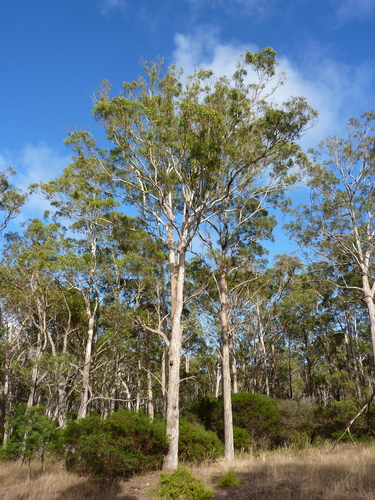
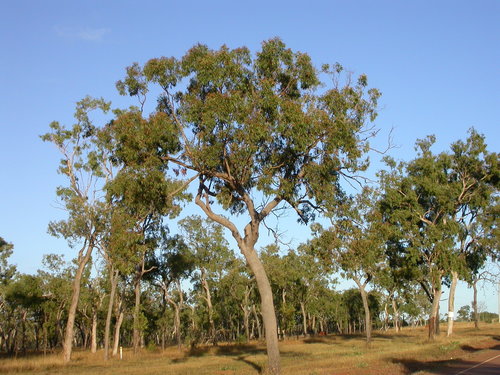
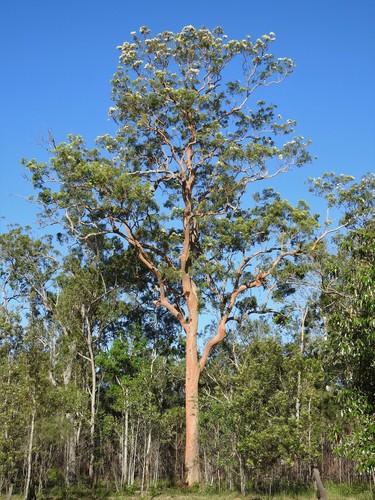
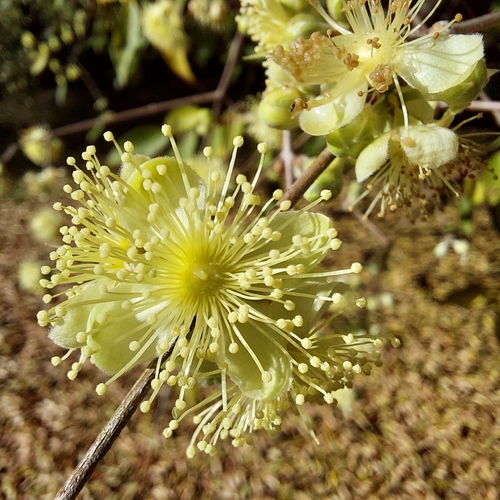
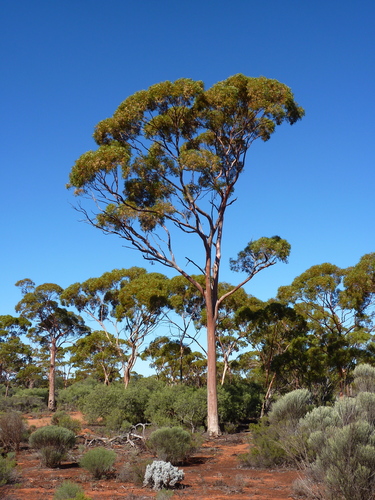
Eucalyptus salmonophloia F.Muell. is a tree that typically reaches 4 to 30 m (13 to 98 ft) in height and 8 to 10 m (26 to 33 ft) in width, and does not form a lignotuber. It has fairly shallow roots that spread radially a considerable distance from the tree's base, though roots are deep enough to give the tree drought resistance. Taller individuals can have trunks up to 12 m (39 ft) long. Epicormic buds can form higher up the stem, allowing the tree to resprout after fire. It has an erect growth form with an umbrella-shaped canopy; the tree's crown can spread as wide as 30 m (98 ft), providing shade over a large area. It has thick, friable, smooth pale grey-silver bark that is shed in plates or flakes, revealing salmon-coloured new bark. Grey-silver bark is usually present in winter and spring, while copper-coloured bark is more common in autumn and summer. No oil glands are present in the pith of branchlets. Seedlings and coppice growth have circular cross-section stems. Young plants have dull grey-green to green, egg-shaped to broadly lance-shaped, petiolate leaves 70–90 mm (2.8–3.5 in) long and 12–30 mm (0.47–1.18 in) wide. Leaves on younger plants are arranged in opposite pairs for the first approximately ten nodes, then switch to an alternate arrangement for the rest of growth. Adult leaves are alternately arranged, the same glossy green shade on both sides. They are narrow lance-shaped to curved, 60–120 mm (2.4–4.7 in) long and 6–17 mm (0.24–0.67 in) wide, tapering to a 7–20 mm (0.28–0.79 in) long leaf stalk, and are quite fragrant. The leaves have dense reticulation, with faint lateral veins oriented 30°–40° from the midrib. The intramarginal vein is located approximately 1 mm (0.039 in) from the leaf margin. Oil glands in the leaves are situated at the intersections of veinlets. The darker green, burnished leaf appearance is distinctive to this species in its native range. Leaves transpire through stomata year-round, even during drought. This tree typically flowers in summer between November or December and March, but flowering has also been recorded in May and between August and October. Flowering occurs about every three years. Inflorescences hold creamy white flowers. Axillary flower buds are arranged in groups of nine to thirteen in leaf axils, on an unbranched peduncle 4–13 mm (0.16–0.51 in) long, with individual buds on pedicels 2–4 mm (0.079–0.157 in) long. Mature buds are oval to spherical, 4–7 mm (0.16–0.28 in) long and 3–4 mm (0.12–0.16 in) wide. The flower bud cap, formed by fused sepals, opens when mature to expose reproductive organs. The cap is conical to rounded and bears a scar. Stamens are bent irregularly, with spherical to cubic anthers attached at the base that split along slits. A blunt stigma sits atop a long, straight style. At the base of the stigma are three chambers, each holding four vertically arranged rows of ovules. The fruit is a woody hemispherical capsule 3–5 mm (0.12–0.20 in) long and 4–5 mm (0.16–0.20 in) wide, with a hemispherical or obconical hypanthium 2 to 3 mm (0.079 to 0.118 in) long and 3 to 4 mm (0.12 to 0.16 in) wide, with three protruding but fragile valves. Capsules usually remain on the tree until the following summer or longer, with each gram containing approximately 600 viable seeds. The brown seeds are flattened egg-shaped with a smooth surface, and measure 0.8 to 2 mm (0.031 to 0.079 in) in length. Trees can retain seed-bearing fruits for up to six years. Seeds can withstand repeated cycles of wetting and drying; however, wet seeds kept at low temperatures can germinate but rarely survive. Salmon gum belongs to a group of eucalypts that require a catastrophic event to trigger large-scale seed release. This species has a haploid chromosome number of 12. Eucalyptus salmonophloia resembles E. salicola, with both sharing a similar growth habit and salmon-coloured bark; however, E. salmonophloia is distinguished by its egg-shaped to lance-shaped juvenile leaves and spherical buds, and E. salicola can tolerate saline habitats. Eucalyptus salmonophloia occurs in large woodland communities in the southern Wheatbelt and Goldfields-Esperance region of Western Australia. Its range extends through the following IBRA regions: from the Geraldton Sandplains in the northwest, south through the Avon Wheatbelt into the Jarrah Forest region, and east through the Murchison, Mallee, Esperance Plains and Coolgardie regions as far as the Great Victoria Desert. In western areas, only remnant populations remain, extending from York and Northam south to around Jerramungup, mostly due to agricultural clearing. Eastern populations are far less disturbed, extending as far east as Cundeelee, north to the Mt Gibson area, and south to around Salmon Gums. This tree usually dominates its communities, forming a sparse upper canopy. It grows on broad valleys, plains, and low hills in areas that receive as little as 250 millimetres (10 in) of rain per year, and thrives in alkaline loamy soils, red clay loam, red clay, and red sandy soils, often with gravel. It is found in granite soils in western areas and calcareous soils in eastern areas. Its range extends from the Mediterranean climate of south-west Western Australia east into semi-arid climate areas, across an annual rainfall gradient from 500 mm (20 in) in the west near York to around 200 mm (7.9 in) north of Zanthus. It can grow in moderately saline soils, tolerating salinity levels of less than 10,000 mS/m. It may grow in pure stands, mixed with other eucalypt species (especially Eucalyptus salubris, Eucalyptus transcontinentalis and Eucalyptus longicornis), or as remnant individuals in mallee or lower woodland communities. Associated overstorey species include Eucalyptus salubris, Eucalyptus longicornis, Eucalyptus wandoo and Eucalyptus loxophleba subsp. loxophleba, while common understorey species include Acacia erinacea, Templetonia sulcata, Melaleuca acuminata, Santalum acuminatum, Sclerolaena diacantha, Rhagodia drummondii, Austrostipa trichophylla and Calandrinia calyptrata. This tree has been introduced to Morocco and Pakistan. According to the Western Australian Department of Parks and Wildlife, Eucalyptus salmonophloia is listed as not threatened under Western Australia's Wildlife Conservation Act 1950. As of 2019, it is recognised as Vulnerable by the International Union for Conservation of Nature (IUCN) due to its severely fragmented population. The eucalypt woodlands of Western Australia's wheatbelt region, of which salmon gum is a key species, were listed as critically endangered in December 2015 under the Environment Protection and Biodiversity Conservation Act 1999. The species' historic range was estimated to cover over 287,718 km² (111,089 sq mi), but current range is estimated at 182,713 km² (70,546 sq mi); habitat area decline has been attributed to land clearing for agriculture. This eucalypt species is known to have a lifespan of over 150 years, with a moderate growth rate. The Ngadju people, traditional inhabitants of the Great Western Woodland, rarely burned old-growth E. salmonophloia forests, as they knew the area would take centuries to fully recover. Two main types of salmon gum woodland have been identified within the Great Western Woodlands: communities of Eucalyptus salmonophloia and Eremophila ionantha with a mix of species from other families, located mostly in central and southern parts of the woodland, often on mid-slopes with sandy soils, more consistent rainfall and cooler temperatures; and communities of Eucalyptus salmonophloia and Maireana sedifolia found in more arid areas in the north of the woodlands, composed mostly of other chenopod species. Additional salmon gum community types include: communities of Eucalyptus salmonophloia and Melaleuca pauperiflora subsp. fastigiata, found in both the Wheatbelt and further east; communities of Eucalyptus salmonophloia and Atriplex semibaccata, located in northwestern parts of the Wheatbelt; and communities of Eucalyptus salmonophloia and Templetonia sulcata, found in southwestern parts of the Wheatbelt where annual rainfall is higher. Hollows in live or dead trees with a diameter at breast height of over 300 mm (12 in) are known nesting sites for six species of black cockatoo, two of which are endangered, including Carnaby's black cockatoo. The birds use these sites as breeding habitat when they are located in woodlands or forests. Carnaby's black cockatoos also use the species' flowers and seeds as a food source. Fallen hollow logs of this tree in the Wheatbelt region are used as habitat by echidnas. Studies of pollination and reproduction have found that large, unfragmented populations of E. salmonophloia produce roughly the same number of seeds per capsule as fragmented smaller populations. Seed weight, germination rate, seedling survival, and first-year seedling vigour are all independent of population fragmentation or size. Data suggests that increased fragmentation and smaller population size can reduce pollen quality and/or quantity, leading to reduced seed production, but no fitness effects on matured seed have been recorded. It is thought that the resilience of seed maturation fitness in small fragmented populations comes from wide outcrossing via long-distance pollen dispersal by birds between populations, or more efficient zygotic selection in fruits that only allows more highly outbred seeds to mature. Given this species is long-lived and large, it is thought to be predominantly outcrossing with a mixed mating system. The durable timber of Eucalyptus salmonophloia is used to make railway sleepers and mining shaft supports. Historically, the mining industry felled this tree for construction and as a fuel source, and along with two acacia species it is credited with enabling development of the goldfields. It had advantages as a fuel because it could be burned immediately in boilers, unlike other hardwoods that required months of drying before use. Its ash was also thought to contain more potash than other woods. In 1922, Western Australia's forest department promoted this very dense timber as the second strongest in Australia. It is still commonly used for wood fires and makes excellent firewood. It is an excellent species for rehabilitation projects and soil stabilization, as it is drought tolerant, frost resistant, fast growing, and able to grow in poor soils. The heartwood is fine-textured and dense, with a reddish to dark red-brown colour, and has considerable potential for use in high-value furniture, flooring, panelling, craftwood, and musical instruments such as flute head joints. Craftsmen rate the wood as good for turning, machinability, boring, screwholding, stability, sanding, gluing, and finishing. Honey flow for apiculture is reported from December to March. The honey produced is clear and fine, and feral bees can use hollow tree trunks as hive sites. Green wood has a density of approximately 1160 kg/m³, with an air-dried density of approximately 1040 kg/m³. Like many eucalypt species, the leaves are a good source of essential oils: E. salmonophloia can yield up to 3.6% oil from its foliage, which may contain up to 77% cineole.