About Eucalyptus rubida H.Deane & Maiden
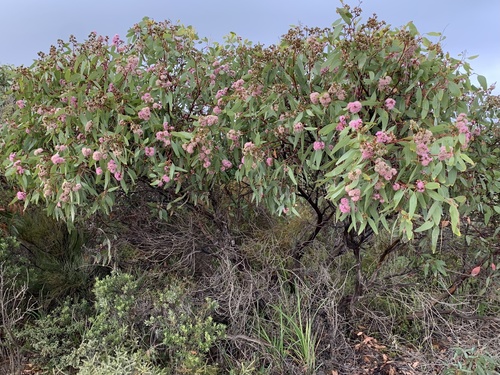
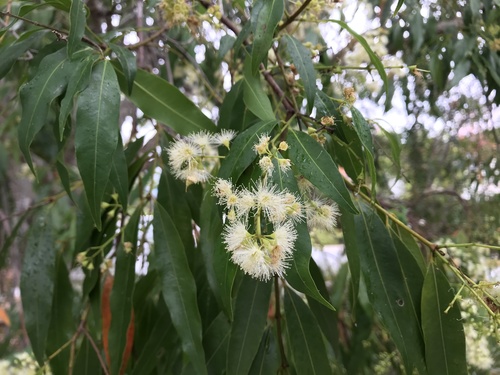
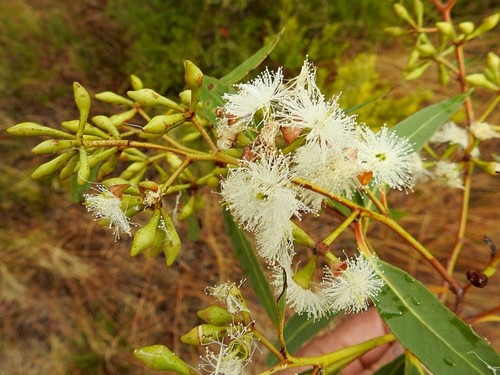
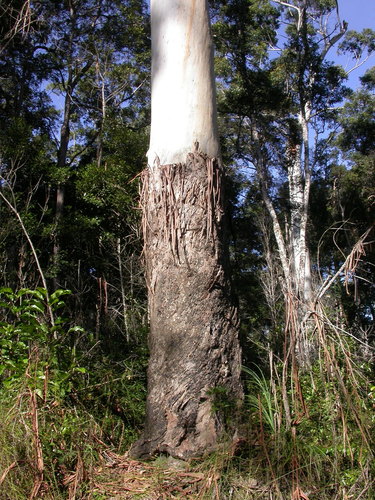
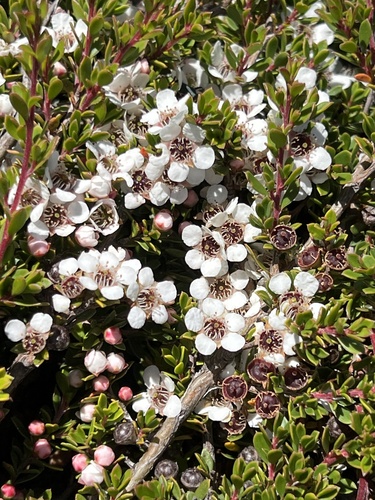
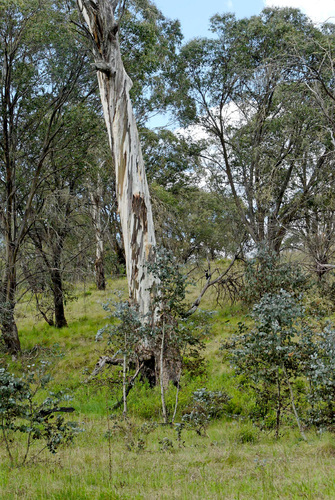
Eucalyptus rubida H.Deane & Maiden, commonly known as candlebark, is a tree that typically grows to 20–40 m (66–131 ft) tall and forms a lignotuber. It has smooth, powdery bark that is greyish or pink in color, and sheds in long ribbons; sometimes, persistent fibrous bark remains near the base of the trunk. Young plants and coppice regrowth have sessile, glaucous, more or less round leaves 2–6 mm (0.079–0.236 in) wide, arranged in opposite pairs. Adult leaves are arranged alternately, and are lance-shaped to curved, 80–175 mm (3.1–6.9 in) long and 8–34 mm (0.31–1.34 in) wide, tapering to a 10–35 mm (0.39–1.38 in) long petiole. Flower buds are arranged in groups of three in leaf axils on an unbranched peduncle; individual buds are sessile, or on pedicels up to 4 mm (0.16 in) long. Mature buds are oval to spindle-shaped, 5–9 mm (0.20–0.35 in) long and 3–5 mm (0.12–0.20 in) wide, with a conical to rounded operculum. Flowering occurs mainly from December to April, and the flowers are white. The fruit is a woody, cup-shaped, hemispherical or bell-shaped capsule 3–6 mm (0.12–0.24 in) long and 4–8 mm (0.16–0.31 in) wide, with valves that sit near rim level or protrude slightly. This species grows in woodland and forest, usually in shallow soils on tablelands, hills and slopes. Subspecies barbigerorum occurs on the Northern Tablelands north of Armidale. Subspecies rubida occurs on the Southern Tablelands of New South Wales, mainly on the northern side of the Great Dividing Range in Victoria between Halls Gap and Delegate, and on the tablelands and mountain slopes of eastern Tasmania.