About Eucalyptus resinifera Sm.
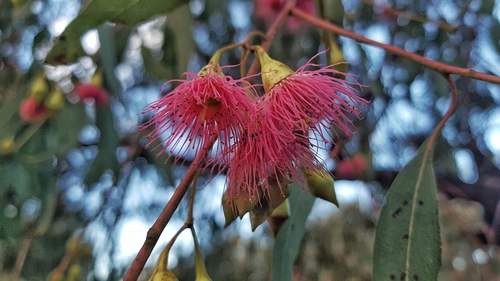
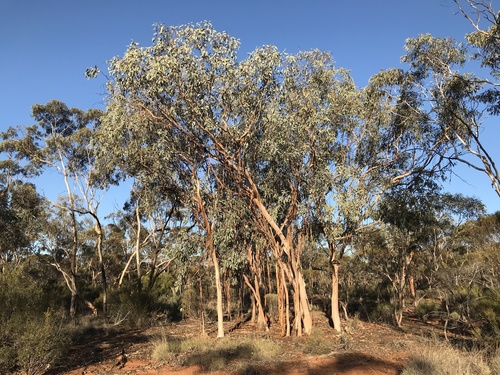
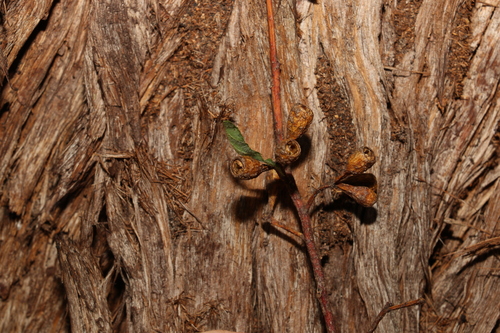
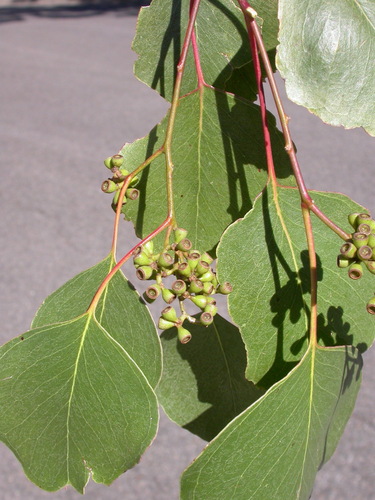
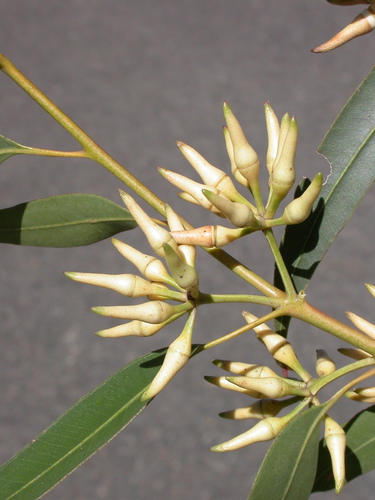
Eucalyptus resinifera Sm., commonly known as red mahogany, is a tree species that typically grows to 45 metres (148 feet) tall and forms a lignotuber. It has rough, stringy or fibrous, reddish brown bark that forms long strips along its trunk and branches. Young plants and coppice regrowth have dull green, lance-shaped leaves that are paler on the lower surface, measuring 65–155 mm (2.6–6.1 in) long and 17–45 mm (0.67–1.77 in) wide. Adult leaves are arranged alternately, with dark glossy green upper surfaces, paler lower surfaces, and are either lance-shaped or curved. They are 80–180 mm (3.1–7.1 in) long and 20–36 mm (0.79–1.42 in) wide, tapering to a 15–25 mm (0.59–0.98 in) long petiole and ending in a fine, long point. Flower buds are arranged in leaf axils in groups of seven, nine or eleven, on an unbranched peduncle 10–22 mm (0.39–0.87 in) long, with individual buds growing on 5–8 mm (0.20–0.31 in) long pedicels. Mature buds are oval to spindle-shaped, 10–16 mm (0.39–0.63 in) long and 4–7 mm (0.16–0.28 in) wide, with a conical, horn-shaped or beaked operculum. Flowering occurs in December, and the flowers are white. The fruit is a woody capsule that is hemispherical, conical or cup-shaped, measuring 3–8 mm (0.12–0.31 in) long and 6–10 mm (0.24–0.39 in) wide, with strongly protruding valves. Red mahogany is found in coastal areas from Nowra in New South Wales to Gladstone in Queensland, Australia, with isolated disjunct populations further north as far as Coen. It grows in forest on flats, valleys and gentle slopes, and prefers medium to high fertility soils. Subspecies hemilampra occurs between Taree and Gladstone, while subspecies resinifera occurs between Nowra and Taree, and grows disjunctly north of Gladstone. Ecologically, red mahogany has wildlife value as a food tree for koalas. The timber of red mahogany is well regarded for its high quality: it is very hard and heavy, and has dark-red heartwood. It has multiple uses including flooring, panelling, cladding, boat building, railroad ties and general construction, and it is also a good choice for making poles and charcoal. E. resinifera has been exported to be grown as a crop on plantations in multiple regions: Africa (Madagascar, South Africa and Zimbabwe), Western Europe (Italy and Portugal), and the United States (Hawaiian Islands).