About Eucalyptus regnans F.Muell.
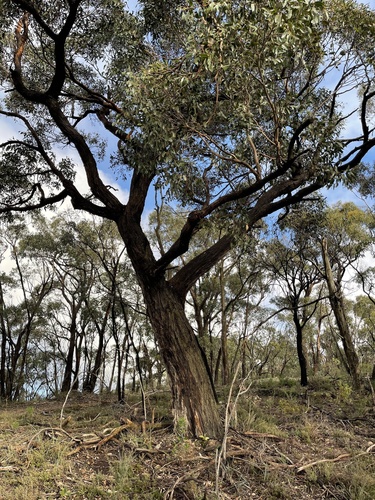
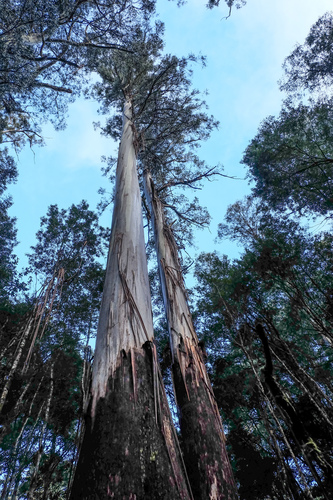
Eucalyptus regnans F.Muell. is a broad-leaved evergreen tree that does not form a lignotuber. It typically reaches a height of 70–114 m (230–374 ft), with an open, small crown relative to the size of the rest of the tree. The trunk is straight, with smooth cream, greyish, or brown bark, and a base stocking of more or less fibrous or flaky bark that extends 5–20 m (16–66 ft) up the trunk. The trunk usually has a diameter at breast height (DBH) of 2.5 m (8 ft 2 in).
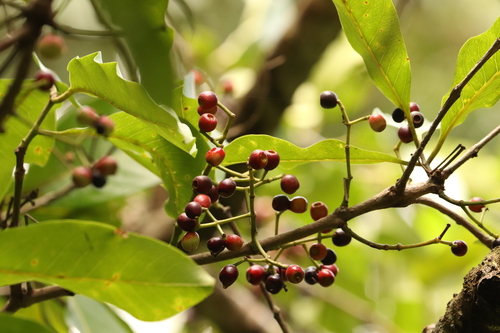
Young plants and coppice regrowth have glossy green, egg-shaped, petiolate leaves held horizontally, which measure 55–120 mm (2.2–4.7 in) long and 22–50 mm (0.87–1.97 in) wide. Adult leaves are arranged alternately along stems, are the same shade of glossy green on both sides, and are lance-shaped to broadly lance-shaped or sickle-shaped. They are 90–230 mm (3.5–9.1 in) long and 15–50 mm (0.59–1.97 in) wide, tapering to a reddish petiole 8–25 mm (0.31–0.98 in) long. Both upper and lower leaf surfaces are dotted with numerous tiny, circular or irregularly shaped oil glands. Secondary leaf veins arise at an acute angle from the midvein, and tertiary venation is sparse.
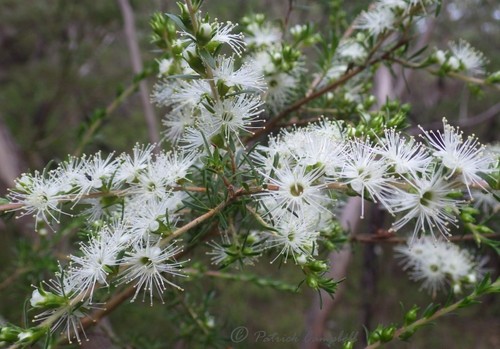
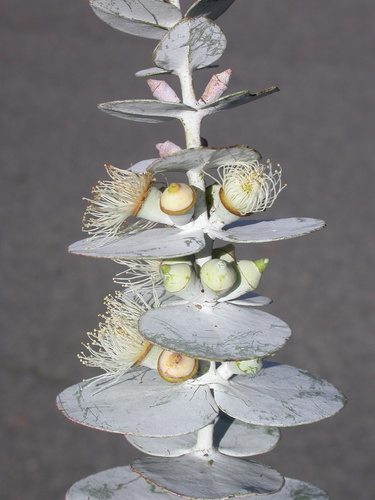
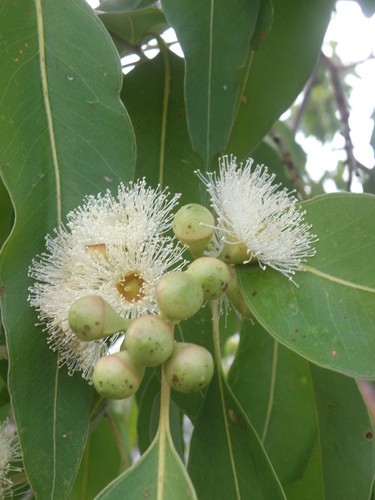
Flower buds are arranged in leaf axils in groups of 9 to 15, on one or two unbranched peduncles 4–14 mm (0.16–0.55 in) long; individual buds grow on pedicels 3–7 mm (0.12–0.28 in) long. Mature buds are oval, 4–7 mm (0.16–0.28 in) long and 2–4 mm (0.079–0.157 in) wide, with a rounded operculum. Flowering occurs from March to May, and the flowers are white. The fruit is a woody, cup-shaped or conical capsule 5–8 mm (0.20–0.31 in) long and 4–7 mm (0.16–0.28 in) wide, borne on a pedicel 1–7 mm (0.039–0.276 in) long, and usually has three valves positioned near the level of the rim. Seeds are pyramid-shaped, 1.5–3 mm (0.059–0.118 in) long, with the hilum at the end. Seedlings have kidney-shaped cotyledons; the first two to three pairs of leaves are arranged in opposite pairs along the stem, before shifting to alternate arrangement.
Eucalyptus regnans occurs across a 700 km by 500 km region in the southern Australian states of Victoria and Tasmania. It mostly grows in cool, mountainous areas that receive over 1,000 millimetres (39 in) of rainfall per year. The species reaches its highest elevation of about 1,100 metres (3,600 ft) above sea level on the Errinundra Plateau in north-eastern Victoria, and grows as low as near sea level in some southern parts of its Tasmanian distribution. In Victoria, tall stands are found in the Otway, Dandenong, Yarra and Strzelecki ranges, as well as Mount Disappointment and East Gippsland. Its current distribution is much reduced from its historical range: most E. regnans forest across Gippsland was cleared for farmland between 1860 and 1880, and in the Otway Ranges between 1880 and 1900, while severe bushfires impacted the area in 1851, 1898 and 1939. In Tasmania, it is found in the Huon and Derwent River valleys in the southeast of the state.
In the Otways, Eucalyptus regnans grows in wet forest in pure stands or in association with Eucalyptus cypellocarpa (mountain grey gum), Eucalyptus obliqua (messmate), and Eucalyptus globulus subsp. bicostata (Victorian blue gum). Other tree species it grows with include Eucalyptus viminalis (manna gum), Eucalyptus nitens (shining gum), Nothofagus cunninghamii (myrtle beech), and Acacia dealbata (silver wattle). Forests dominated by this species can be interspersed with rainforest understory, including species such as Atherosperma moschatum (southern sassafras), Phyllocladus aspleniifolius (celery-top pine), Eucryphia lucida (leatherwood), and Anodopetalum biglandulosum (horizontal). It grows best on deep friable clay loam soils, often of volcanic origin; in areas with poorer soils, it is confined to watercourses and valleys.
Eucalyptus regnans is valued for its timber, and has been harvested in very large quantities. In addition to logging within its natural Australian range, it is grown in plantations in New Zealand and Chile, and to a limited extent in South Africa and Zimbabwe. Its primary uses are sawlogging and woodchipping; it was a major source of newsprint in the 20th century, and much of the current woodchip harvest is exported to Japan. While the area of natural stands with large old trees is rapidly decreasing, substantial areas of regrowth exist, and the species is increasingly grown in plantations. Its long, straight, fast-growing trunks are considered much more commercially valuable than old growth timber.
Its timber is medium weight (about 680 kg/m3 or 1,150 lb/cu yd) and rather coarse (stringy) in texture, with common gum veins. The wood is easy to work, has a straight grain, and produces long, clear sections free of knots. It also works reasonably well for steam-bending. Primary uses for sawn wood are furniture, flooring (where its very pale blonde colour is highly prized), panelling, veneer, plywood, window frames, and general construction. It has sometimes been used for wood wool and cooperage. However, the wood tends to collapse on drying, so it needs steam reconditioning for high-value applications. It is highly regarded by builders, furniture makers, and architects.
Genetic comparison of logged stands and natural stands of Eucalyptus regnans found only minor differences in nuclear DNA between the two: undisturbed stands have slightly stronger spatial genetic structure, logged stands have higher levels of genetic differentiation, and greater partitioning of genetic diversity among logged sites. Analysis of chloroplast DNA showed more substantial differences, with higher levels of diversity in logged sites than in burnt or undisturbed sites. This suggests chloroplast DNA enters logged populations via the use of non-local seed during regeneration.
In horticulture, Eucalyptus regnans is too large for most gardens, but may be suitable for parks. It is propagated from seed; the best germination rates are obtained by refrigerating seed for three weeks before sowing. Seed may be stored for several years if kept refrigerated and dry. Seedlings are grown in containers but are more prone to damping off than other eucalypts, and are highly susceptible to Phytophthora cinnamomi and P. nicotianae. Young plants are generally planted out when they are 8 or 9 months old. They are at risk of being eaten by grazing rabbits, wallabies, and possums, which can destroy young plantations in severe cases. American horticulturist and entrepreneur Ellwood Cooper noted its rapid growth but demanding soil requirements in his 1876 work Forest Culture and Eucalyptus Trees. Eucalyptus regnans requires fertile soil with good drainage and 1,000 millimetres (39 in) of annual rainfall spread over the year. It has poor tolerance to temperatures below −7 °C (19 °F) or drought. Outside Australia, successful plantations have been established in New Zealand, South Africa, Kenya, and Tanzania.