About Eucalyptus punctata DC.
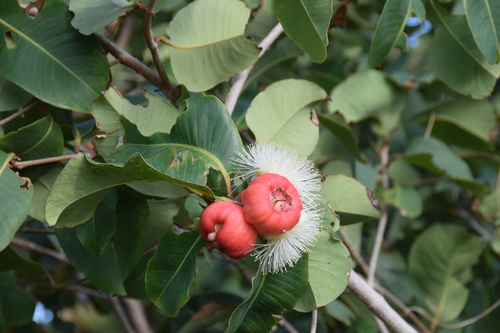
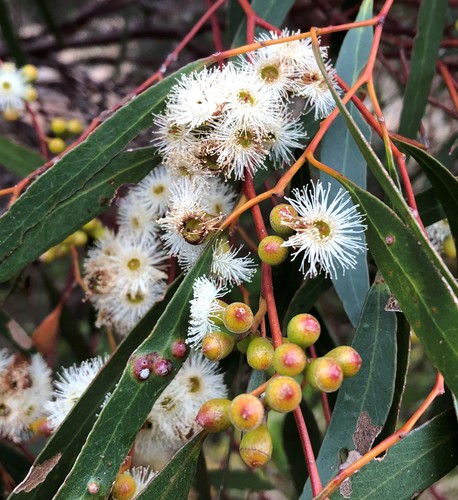
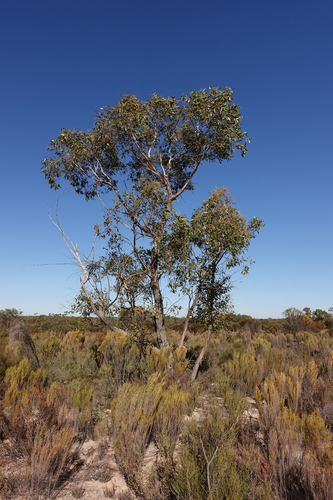
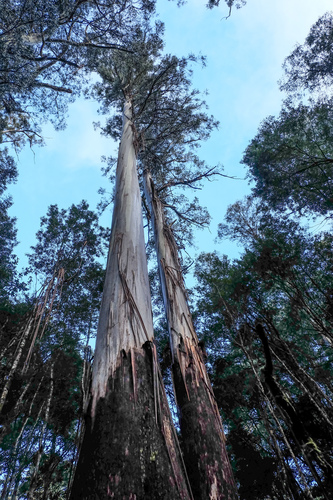
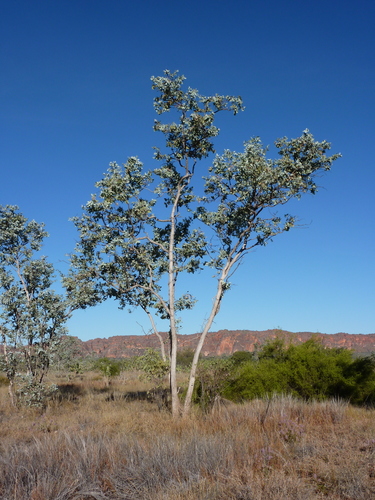
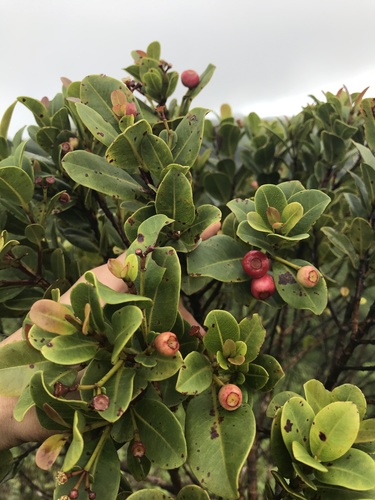
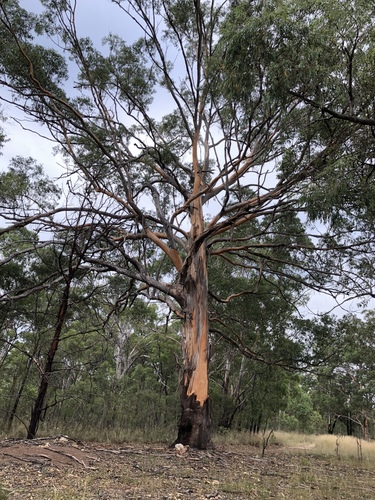
Eucalyptus punctata DC., commonly known as grey gum, is a tree that typically grows to a height of 35 metres (115 feet) and forms a lignotuber. It has smooth grey, brown, or cream-coloured bark that is shed in patches. Young plants and coppice regrowth have dull green leaves that are paler on the lower surface; these leaves are egg-shaped to lance-shaped, 55–115 mm (2.2–4.5 in) long, 15–35 mm (0.59–1.38 in) wide, and petiolate. Adult leaves are glossy dark green, paler on the lower surface, lance-shaped, curved, or egg-shaped, 60–180 mm (2.4–7.1 in) long and 14–37 mm (0.55–1.46 in) wide, tapering to a petiole 13–26 mm (0.51–1.02 in) long. Flower buds are arranged in groups of seven in leaf axils on an unbranched peduncle 10–20 mm (0.39–0.79 in) long, with individual buds on pedicels 2–8 mm (0.079–0.315 in) long. Mature buds are oval, 6–9 mm (0.24–0.35 in) long and 4–9 mm (0.16–0.35 in) wide, with a conical to rounded operculum. Flowering occurs from December to March, and the flowers are white. The fruit is a woody, cup-shaped or hemispherical capsule 4–9 mm (0.16–0.35 in) long and 6–10 mm (0.24–0.39 in) wide. Grey gum occurs through ranges and near coastal areas from near Gympie in Queensland to near Nowra in New South Wales. It is most common on transition zone soil types between sandstone and shale, and grows in tall open sclerophyll forest. Associated tree species include Corymbia gummifera (red bloodwood), C. intermedia (pink bloodwood), C. maculata (spotted gum), Eucalyptus globoidea (white stringybark), E. piperita (Sydney peppermint), E. pilularis (blackbutt), E. melliodora (yellow box), E. cypellocarpa (mountain grey gum), E. crebra (narrow-leaved ironbark), E. paniculata (grey ironbark), E. umbra (broad-leaved white mahogany), E. acmenoides (white mahogany), and Angophora species (apples). Grey gum regenerates by regrowing from the base and branches after bushfire, and individual trees live for over a hundred years ecologically. The grey-headed flying fox (Pteropus poliocephalus) eats this species' flowers, while its leaves form a staple diet of the koala (Phascolarctos cinereus). Leaves collected in winter contain less nitrogen than leaves collected in summer, and koalas make up this difference by eating more leaves during winter months. The brown-headed honeyeater (Melithreptus brevirostris) and yellow-tufted honeyeater (Lichenostomus melanops) have been observed eating gum exudate from this tree's stems. Fieldwork at several sites around central New South Wales has shown that the red wattlebird (Anthochaera carunculata) and noisy friarbird (Philemon corniculatus) prefer to forage on the foliage of grey gum over other tree species; when both bird species are present, the red wattlebird appears to oust the noisy friarbird. The timber of Eucalyptus punctata is very hard and durable, and is used in construction and for railway sleepers. The species' multicoloured bark, which appears periodically, gives it horticultural appeal, and it has potential use in large parks, reserves, and open fields.