About Eucalyptus populnea F.Muell.
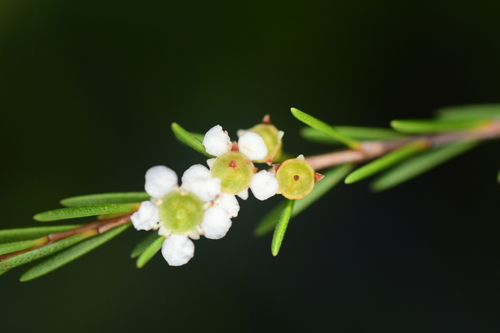
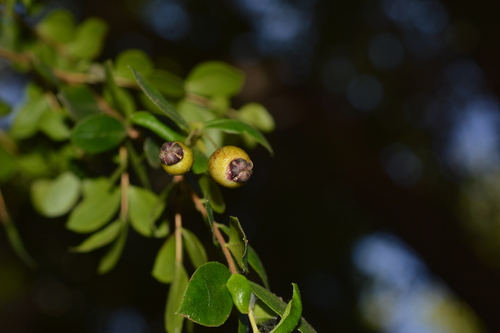
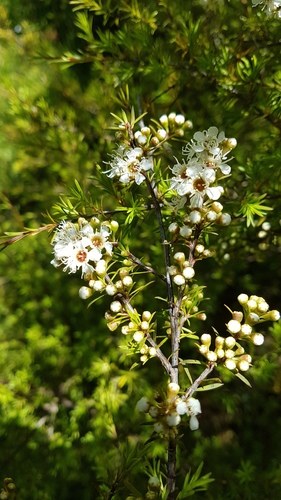
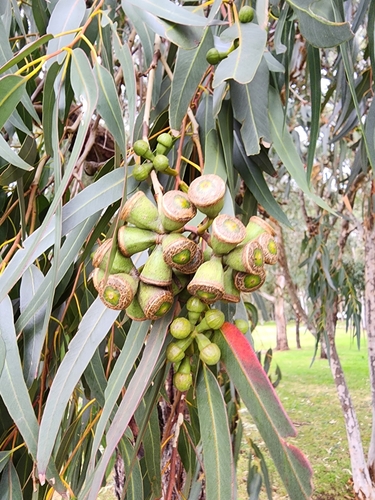
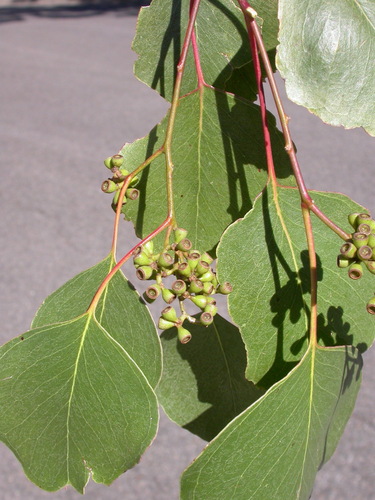
Eucalyptus populnea F.Muell. is a tree that typically grows to a height of 20 metres (66 feet) and forms a lignotuber. It has rough, fibrous or flaky, greyish bark on its trunk and larger branches, while thinner branches have smooth grey bark shed in short ribbons. Young plants and coppice regrowth have egg-shaped to almost round, dull greyish green leaves, 60–115 mm (2.4–4.5 in) long and 35–95 mm (1.4–3.7 in) wide. The leaf crown of mature trees has glossy green leaves the same shade on both sides, which range from egg-shaped and elliptical to more or less round. These leaves are 40–110 mm (1.6–4.3 in) long and 18–50 mm (0.71–1.97 in) wide, tapering to a 10–32 mm (0.39–1.26 in) long petiole. Flower buds are mostly arranged in groups of seven to fifteen or more on the ends of branchlets, on a branched peduncle 4–11 mm (0.16–0.43 in) long, with each individual bud on a 1–4 mm (0.039–0.157 in) long pedicel. Mature buds are oblong to spherical, 3–5 mm (0.12–0.20 in) long and 2–3 mm (0.079–0.118 in) wide, with a conical to rounded operculum. Flowering occurs from August to December and the flowers are white. The fruit is a woody, conical, hemispherical or cup-shaped capsule 2–4 mm (0.079–0.157 in) long and wide, with its valves near the rim level. Common name poplar box, this eucalypt is widespread in New South Wales, found on western plains north from Narrandera and Pooncarie, and extends into Queensland as far as Rockhampton. It is most abundant on the northern and central sections of these western plains, and becomes gradually less common in the far west of New South Wales, where it is restricted to more reliably watered, sandier areas. Eucalyptus populnea is most commonly found on red soils with texture ranging from sandy loam to clay loam, where it grows alongside gum coolibah (E. intertexta), grey box (E. microcarpa) and white cypress pine (Callitris glaucophylla). It occurs less commonly on sandplains made of deep loamy sands, growing there with ironwood (Acacia excelsa) and mulga (Acacia aneura). In the far west of New South Wales it grows in small terminal drainage depressions with sandy soils overlying clay at depth. Within its native range, it is a favoured food tree for koalas. The flowers of E. populnea produce good quality honey that is very dense and pale amber in colour, though the supply is limited. Its timber is hard and durable, suitable for fence posts and construction work, but is not easy to work with and is susceptible to white ant attack. This species can be propagated easily and is not difficult to establish, making it suitable for use as a windbreak. It is also an excellent fuel, producing a great deal of heat and burning cleanly.