About Eucalyptus polybractea F.Muell. ex R.T.Baker
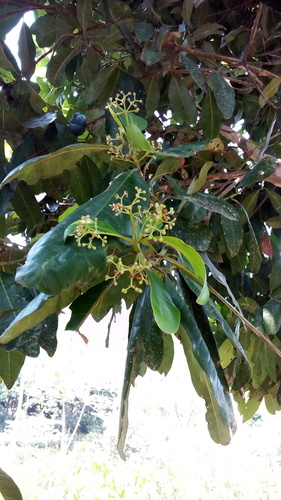
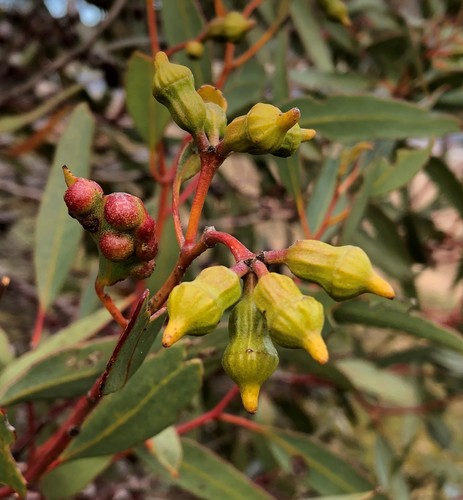
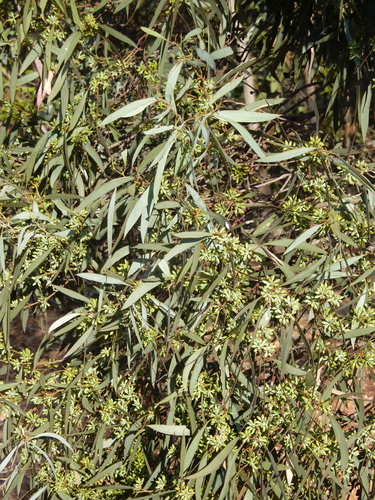
Eucalyptus polybractea, commonly known as blue-leaved mallee, is a mallee that typically reaches a height of 8 to 10 metres (26 to 33 feet), and forms a lignotuber. The lower section of its trunk has rough, fibrous or flaky bark that is greyish to brownish in colour. Above this lower section, the bark is smooth, also ranging from greyish to brownish, and is shed in ribbons. Young plants and coppice regrowth have bluish to glaucous, linear to lance-shaped leaves. These leaves measure 40 to 150 millimetres (1.6 to 5.9 inches) long and 3 to 16 millimetres (0.12 to 0.63 inches) wide. Adult leaves are the same shade of bluish green on both sides, are lance-shaped, and measure 60 to 170 millimetres (2.4 to 6.7 inches) long and 4 to 20 millimetres (0.16 to 0.79 inches) wide. They taper to a petiole that is 4 to 15 millimetres (0.16 to 0.59 inches) long. Flower buds grow in groups of seven, nine or eleven in leaf axils, attached to an unbranched peduncle 4 to 12 millimetres (0.16 to 0.47 inches) long. Individual buds sit on pedicels up to 4 millimetres (0.16 inches) long. Mature buds are shaped like a club or diamond, 4 to 6 millimetres (0.16 to 0.24 inches) long and 3 to 4 millimetres (0.12 to 0.16 inches) wide, with a conical to rounded operculum. Flowering mainly occurs between March and August, and the flowers are white. The fruit is a woody capsule shaped like a cup or barrel, 4 to 7 millimetres (0.16 to 0.28 inches) long and 3 to 5 millimetres (0.12 to 0.20 inches) wide, with valves located near the rim level. Blue-leaved mallee has a wide but sporadic distribution around West Wyalong in New South Wales, and between Stawell and Bendigo in Victoria. It grows in mallee shrubland on loamy soils.