About Eucalyptus platypus Hook.
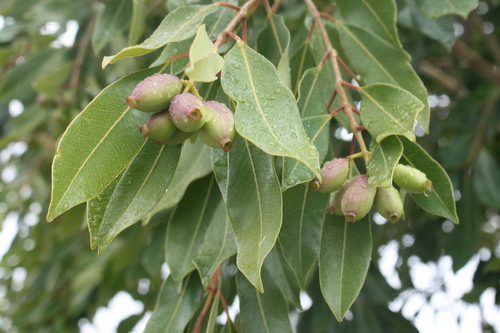
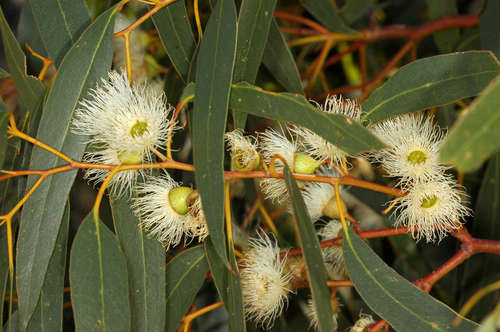
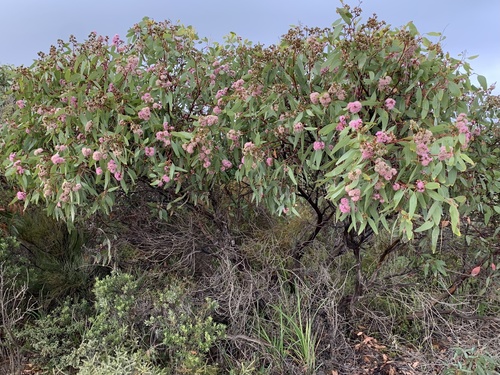
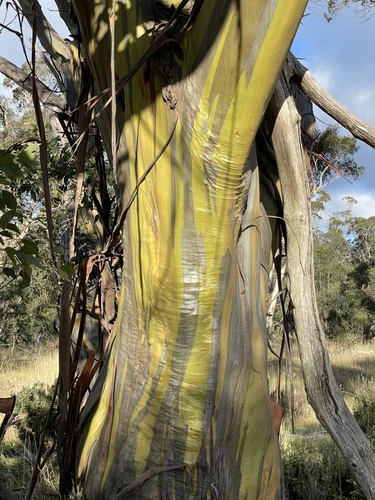
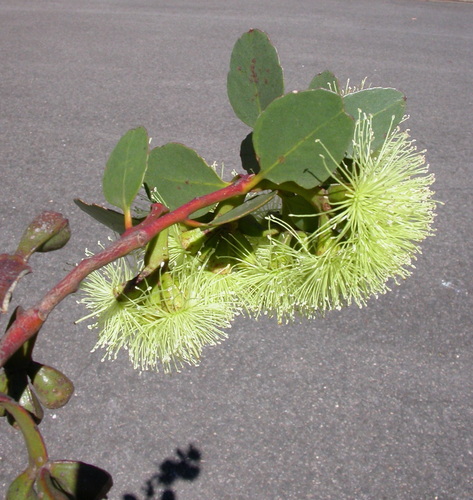
Eucalyptus platypus Hook., also known as moort, is a mallee or marlock that does not form a lignotuber. It typically grows 1.5–10 m tall and 5–10 m wide, with a dense, rounded crown. Its bark is smooth and brownish or copper-coloured. Young plants and coppice regrowth have egg-shaped to almost round leaves that measure 40–65 mm in both length and width. Adult leaves are glossy green the same shade on both sides, broadly elliptical to almost round, 30–50 mm long and 20–40 mm wide, borne on a thick petiole 3–20 mm long. Flower buds are arranged in leaf axils on a broad, flattened, unbranched peduncle that is 13–40 mm long and 10–20 mm wide. The buds are either sessile or borne on pedicels up to 4 mm long. Mature buds are elongated, 25–32 mm long and 7–9 mm wide, with a horn-shaped operculum that is up to three times as long as the floral cup. Flowering occurs either from September to December or from January to March, and the flowers are creamy white, sometimes yellowish green or pinkish. The fruit is a woody, down-turned, conical capsule 10–17 mm long and 10–12 mm wide, with valves located at rim level. This species occurs between Albany and Esperance in Western Australia, growing on plains and hilly, rocky country in the Great Southern and Goldfields-Esperance regions. It grows in sandy, loam or clay soils, often around laterite, and ranges from coastal areas from Broomehill in the west to Ravensthorpe in the east. Eucalyptus platypus is considered a weed on the Eyre Peninsula, where it invades disturbed areas of native vegetation. Its dense low-growing foliage blocks the growth of native understorey species. In horticulture, this fast-growing species is sold commercially and is well suited to heavy soils. It is resistant to frost and drought, and tolerates water logging and smog. It responds well to coppicing and pruning. Its bushy habit makes it suitable for use as a windbreak, and its abundant flowering makes it useful for beekeepers and honey production.