About Eucalyptus planchoniana F.Muell.
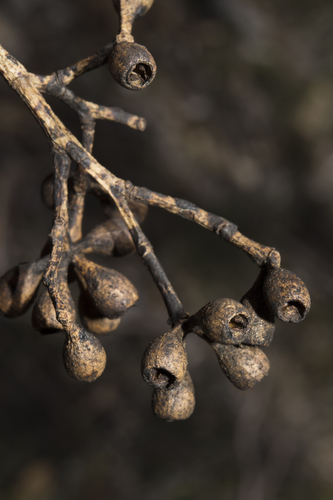
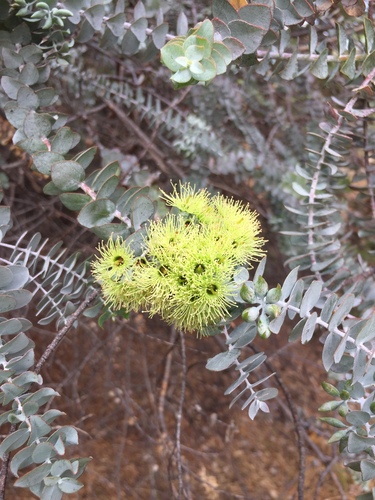
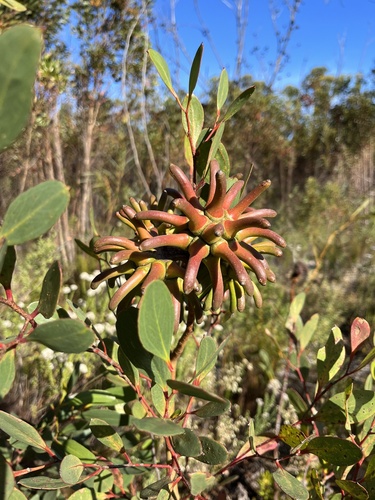
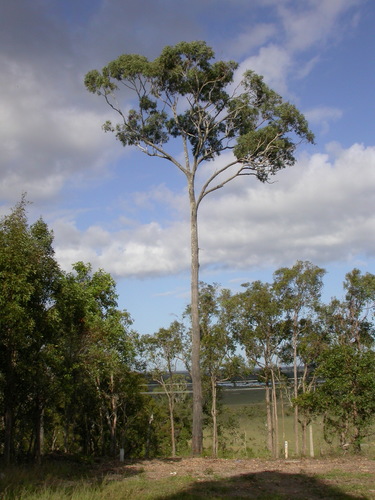
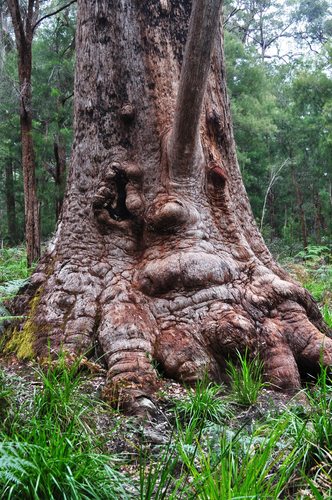
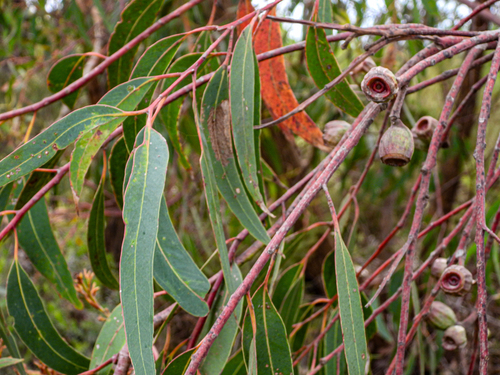
Eucalyptus planchoniana F.Muell. is a tree that typically reaches a height of 20–25 m (66–82 ft) and forms a lignotuber. It has rough, reddish, often prickly, stringy bark on its trunk and larger branches. Young plants and coppice regrowth have petiolate, elliptical to lance-shaped or curved bluish green leaves that are 70–200 mm (2.76–7.87 in) long and 23–70 mm (0.91–2.76 in) wide. Adult leaves are the same shade of green or bluish green on both surfaces, are lance-shaped to curved, 80–260 mm (3.1–10.2 in) long, 15–35 mm (0.59–1.38 in) wide, and borne on a petiole 15–32 mm (0.59–1.26 in) long. Flower buds are arranged in leaf axils on an unbranched, flattened peduncle 20–32 mm (0.79–1.26 in) long, with individual buds attached to pedicels 20–32 mm (0.79–1.26 in) long. Mature buds are oval to spindle-shaped or diamond-shaped, 20–29 mm (0.79–1.14 in) long and 8–10 mm (0.31–0.39 in) wide, with a conical to beaked operculum. Flowering occurs from October to December, and the flowers are white. The fruit is a woody, cup-shaped, cylindrical or barrel-shaped capsule 17–28 mm (0.67–1.10 in) long and 16–26 mm (0.63–1.02 in) wide, with valves positioned below the rim of the capsule. This species, commonly called needlebark stringbark, grows in open forest on low ridges and gentle slopes, ranging from Moreton Island and Stradbroke Island in Queensland, south to Camden Haven in coastal New South Wales, and inland as far as Gibraltar Range National Park.