About Eucalyptus pilularis Sm.
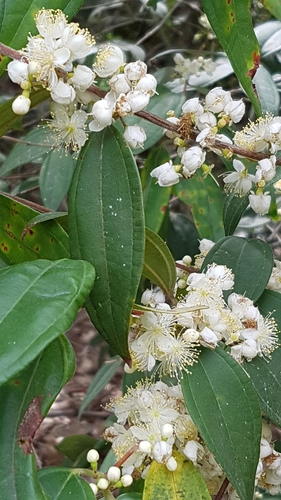
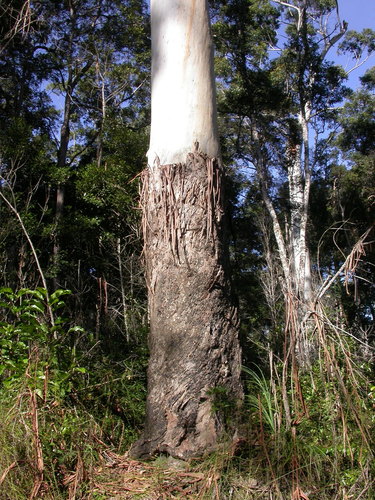
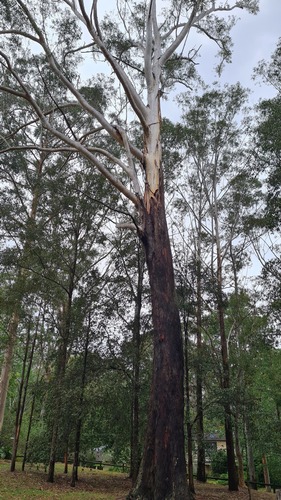
Eucalyptus pilularis Sm. is a tree that typically reaches 70 metres (230 feet) in height, and it does not form a lignotuber. It has finely fibrous, greyish brown bark on the lower half of its trunk, and white, grey, or cream-coloured bark on the upper trunk, which often has insect scribble marks. Young plants have stems that are roughly square in cross-section, with dull green leaves that are paler on the lower surface. These young leaves are sessile and mostly arranged in opposite pairs. Juvenile leaves are lance-shaped, measuring 55–130 mm (2.2–5.1 in) long and 10–36 mm (0.39–1.42 in) wide. Adult leaves are arranged alternately, are a similar shade of glossy green on both sides, and are lance-shaped or curved. They measure 75–170 mm (3.0–6.7 in) long and 12–32 mm (0.47–1.26 in) wide, tapering to an 8–22 mm (0.31–0.87 in) long petiole. Flowers grow in groups of 7 to 15 in leaf axils, on a flattened, unbranched 8–20 mm (0.31–0.79 in) long peduncle. Individual buds are attached to 2–7 mm (0.079–0.276 in) long pedicels. Mature buds are oval, club-shaped, or spindle-shaped, 6–10 mm (0.24–0.39 in) long and 3–5 mm (0.12–0.20 in) wide, with a conical to beaked operculum. Flowering occurs mainly between January and April, or between October and December, and the flowers are white. The fruit is a woody capsule that is hemispherical, shortened spherical, or oval, 5–11 mm (0.20–0.43 in) long and 7–12 mm (0.28–0.47 in) wide, with four valves positioned near or below the rim of the capsule. This species grows in wet sclerophyll or grassy coastal forests from north of Eden on the far south coast of New South Wales to south-eastern Queensland, across a latitudinal range of 37.5 to 25.5 degrees south. It is most commonly found at low to mid altitudes, though it grows up to 800 metres (2,600 feet) above sea level near Wauchope, where it is a dominant species. It usually grows on coastal sandy loams, but also grows well on clay and volcanic soils, and reaches a large size on drier slopes adjacent to rainforest. Its annual rainfall range is between 900 mm and 2000 mm. Most of its distribution is in a warm, humid climate, with a mean minimum temperature of 5 to 10 degrees C in the coldest month, and a mean maximum temperature of 24 to 32 degrees C in the hottest month. Frost can occur at inland and higher altitude sites within its range. This species, commonly known as blackbutt, forms an important canopy component of several endangered ecological communities: blue gum high forest, Illawarra lowlands, bangalay sand forest, and grassy woodland.