About Eucalyptus phoenicea F.Muell.
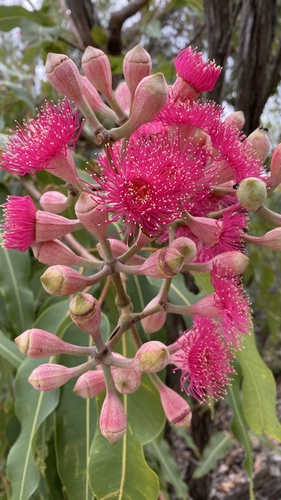
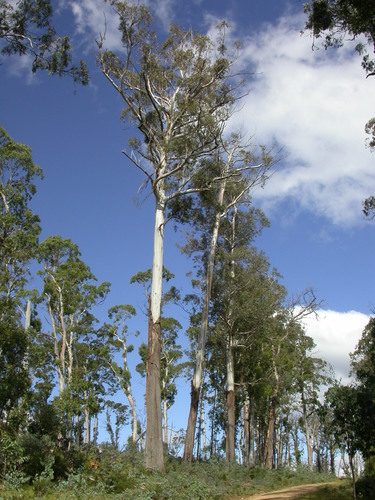
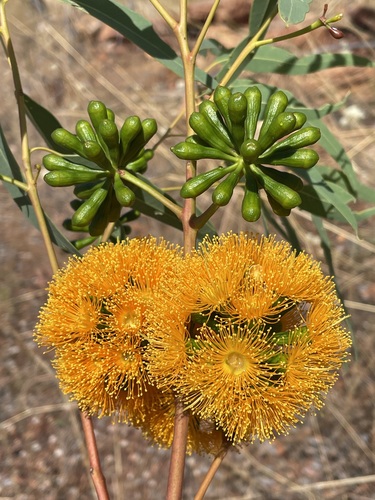
Eucalyptus phoenicea F.Muell. is a tree that typically reaches a height of 4 to 12 metres (13 to 39 ft). It is mostly single-stemmed, and forms a lignotuber. Most of its trunk and larger branches are covered in soft, fibrous, flaky, rough bark that ranges in colour from yellow-grey to orange-brown. Large branches sometimes also have sections of smooth white to pinkish-grey bark. Alternately arranged adult leaves are concolorous to slightly discolorous, and dull green to grey-green in colour. Leaf blades are lanceolate, 6.5 to 14 centimetres (2.6 to 5.5 in) long, 0.9 to 4.5 cm (0.35 to 1.77 in) wide, and taper toward the petiole at the base. Flowering usually occurs between February or March and September or November, and produces orange flowers. Single axillary inflorescences form umbels holding more than seven buds each. Bright green mature buds are shaped like clubs or pears, 0.8 to 1.9 cm (0.31 to 0.75 in) long, 0.5 to 0.8 cm (0.20 to 0.31 in) wide, and develop into bright orange flowers. The woody pedicellate fruits are cylindrical and urn-shaped, with faint longitudinal ribs. Fruits measure 1.9 to 3 cm (0.75 to 1.18 in) long, and are about half as wide as they are long, with a vertically descending disc and two enclosed valves. The dull dark grey to black seeds inside are saucer-shaped, and 3 to 5 mm (0.118 to 0.197 in) long. This species is endemic to northern Australia, found in Queensland, the Northern Territory, and Western Australia. In Western Australia, it has a scattered distribution in the Kimberley region around the Pentecost River, where it grows in sandy soil on and between sandstone hills and outcrops. Its sporadic range continues through the top end of the Northern Territory from Timber Creek in the south to the area around Batchelor, and east to the south-western Gulf of Carpentaria. There is also an isolated population of this species located north-west of Cooktown in North Queensland. Eucalyptus phoenicea is available commercially as seeds or seedlings, and germinates easily from seed. It prefers sandy, well-drained soils and a full sun position. It is drought tolerant once established, but will suffer damage from frost. This tree begins flowering in its second year, and produces flowers over an extended period; its flowers attract many different types of birds and insects.