About Eucalyptus paniculata Sm.
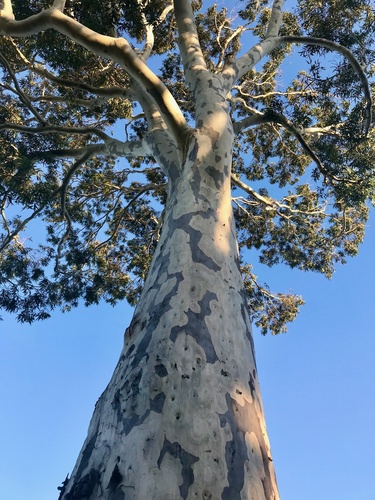
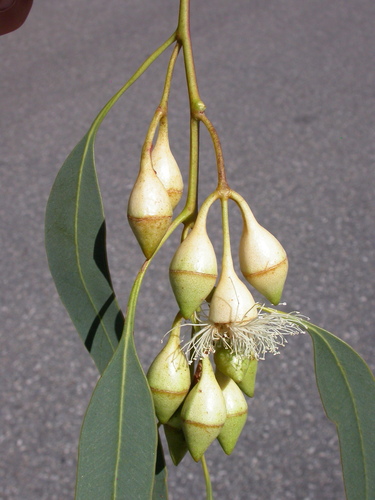
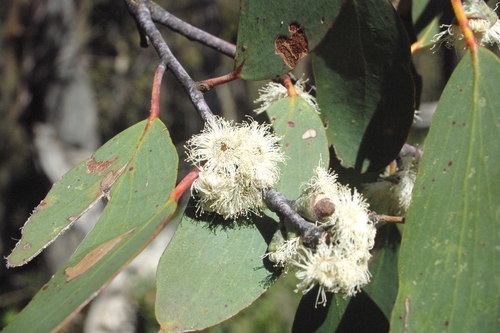
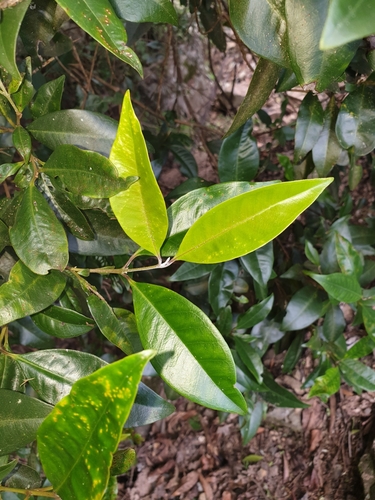
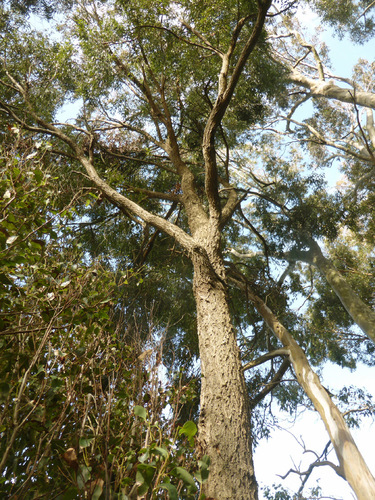
Eucalyptus paniculata Sm., commonly known as grey ironbark, is a tree that typically reaches a height of 30 to 50 meters (98 to 164 feet) and forms a lignotuber. Its trunk and branches are covered in grey to black or brownish, deeply furrowed ironbark. Young plants and coppice regrowth have egg-shaped to lance-shaped leaves that are paler green on the lower surface, measuring 35–70 mm (1.4–2.8 in) long and 15–30 mm (0.59–1.18 in) wide. Adult leaves are glossy green with a paler lower side, and are lance-shaped to curved. They are 50–180 mm (2.0–7.1 in) long and 12–30 mm (0.47–1.18 in) wide, tapering to a 9–25 mm (0.35–0.98 in) long petiole. Flower buds are mostly arranged in groups of seven on a branched peduncle 5–15 mm (0.20–0.59 in) long, with individual buds attached to 3–9 mm (0.12–0.35 in) long pedicels. Mature buds are oval to diamond-shaped, 5–9 mm (0.20–0.35 in) long and 4–5 mm (0.16–0.20 in) wide, with a conical operculum and a floral cup that is roughly square in cross-section. White flowers bloom across most months of the year. The fruit is a woody conical, hemispherical, or cup-shaped capsule, 4–8 mm (0.16–0.31 in) long and wide, with valves positioned near the rim.
Grey ironbark grows in high-rainfall coastal areas extending from Bermagui to Bulahdelah. It was previously a common tree in the inner western suburbs of Sydney, and a remnant individual still grows at St. Johns church in the inner Sydney suburb of Glebe.
The timber of Eucalyptus paniculata is very dense, with a weight of 1120 kilograms per cubic meter. The heartwood is red-brown or dark brown. This timber is used for many purposes, including railway sleepers, heavy engineering, construction, poles, and cross-arms. Working with the timber presents challenges: it is difficult to plane and nail, it dries slowly, and requires careful handling to prevent surface checking. Annual wood production potential ranges from 9 to 18 cubic meters per hectare, and the timber is not susceptible to attack by the lyctus borer.