About Eucalyptus oleosa F.Muell. ex Miq.
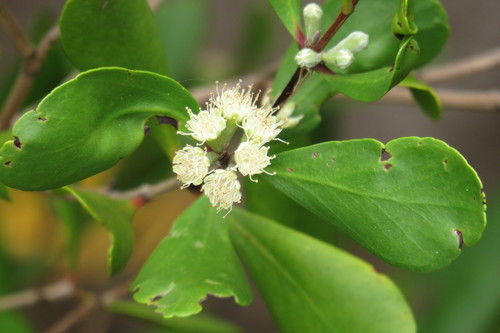
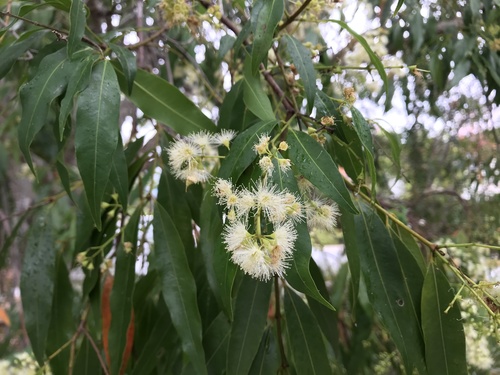
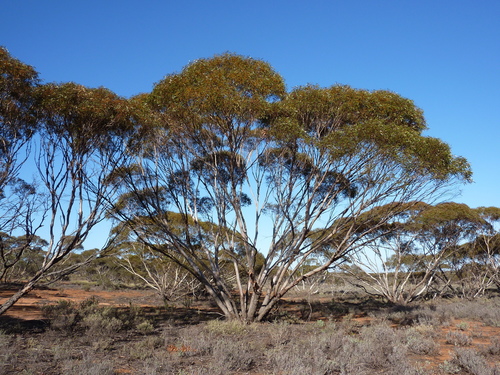
Eucalyptus oleosa, commonly called red mallee, is typically a multi-stemmed tree or mallee that usually grows 11 to 12 metres (36 to 39 feet) tall. It has rough, fibrous brown bark at its base, which becomes smooth and grey on the upper parts of the plant. This species blooms between November and December, producing yellow flowers. Mature adult leaves grow to around 130 millimetres (5.1 inches) long and 19 millimetres (0.7 inches) wide, with a narrow-lanceolate to lanceolate shape, and are glossy green in colour. Flowers are arranged in groups of seven to eleven in leaf axils. Smooth buds develop after flowering, reaching approximately 10 millimetres (0.4 inches) in length and 4.5 millimetres (0.18 inches) in width, with a cone-shaped to cylinder-shaped cap. Fruits are round, around 7 millimetres (0.28 inches) in diameter, with a descending disc and three or four exserted valves that have narrowed, pointed tips. The seeds are dark brown, ovoid-shaped, and 2 millimetres (0.08 inches) long. Red mallee is one of the most widely distributed mallee species across Australia. In Western Australia, it grows on hills, sand plains, flats, and gravel pits in the southern Wheatbelt, Great Southern, and Goldfields-Esperance regions, found in sandy or loamy soils that often sit over limestone. The species' range extends east through most of southern and central South Australia, then into northern and eastern Victoria, and into south-western New South Wales south of Coonbah and west of Koraleigh. It is often a codominant species in mallee shrubland communities growing on red aeolian sands, and is associated with two mallee subgroups: the western mallee subgroup and the chenopod mallee subgroup. The western mallee subgroup is characterized by multiple eucalypt species including Eucalyptus eremophila, Eucalyptus moderata, Eucalyptus incrassata, Eucalyptus foecunda, Eucalyptus redunca, and Eucalyptus uncinata, with a predominantly shrubby understorey of Melaleuca and Acacia species, and occasional Triodia. In the chenopod mallee subgroup, E. oleosa grows alongside other tree species including Eucalyptus gracilis, Eucalyptus dumosa, and Eucalyptus calycogona, with an understorey of Maireana, Sclerolaena, Enchylaena, Chenopodium, and Zygophyllum species. Eucalyptus oleosa has a number of uses. In addition to being harvested for eucalyptus oil production, it is suitable for producing large volumes of biomass, yielding 10 to 20 metric tons (11 to 22 short tons) per hectare per year. In Western Australia's wheatbelt regions, it provides multiple benefits: it reduces soil salinity, provides shade for livestock, acts as a windbreak, and reduces erosion. Its seeds are sold commercially for cultivation as a garden plant. The seeds germinate easily, and the plant is known to be very hardy, with resistance to salt, drought, and frost. It can be grown as a hedge, used as a shade tree, and supports honey production.