About Eucalyptus obliqua L'Hér.
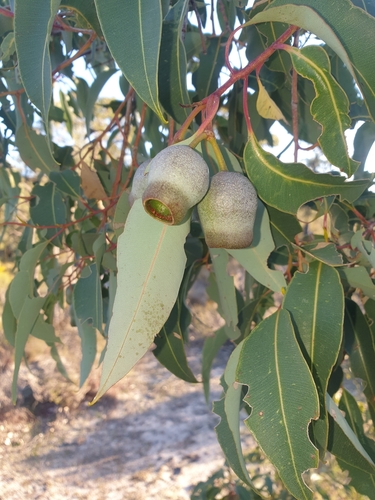
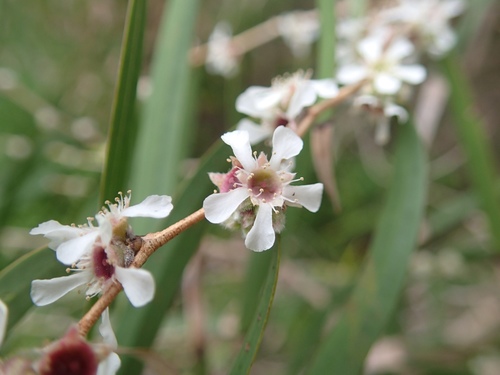
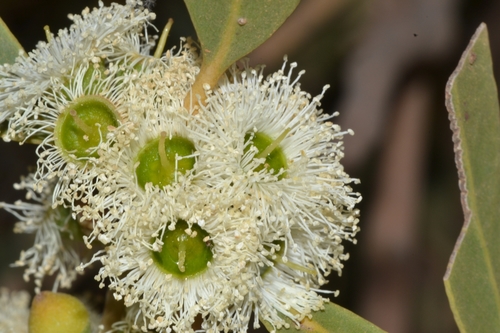
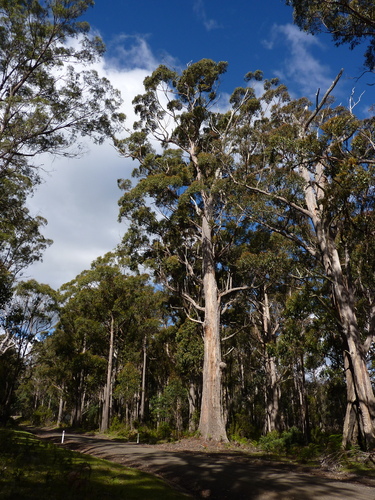
Eucalyptus obliqua, commonly known as messmate stringybark, is most often a tree that typically reaches 90 metres (300 feet) in height, and sometimes grows as a mallee. All forms of the species form a lignotuber. The trunk can grow up to 3 metres (9.8 feet) in diameter, and is covered in thick, rough, stringy or fibrous bark. Branches over 80 millimetres (3.1 inches) in diameter retain stringy bark, while thinner branches have smooth greenish or greyish bark. Young plants and coppice regrowth have glossy green, broadly egg-shaped to lance-shaped leaves that measure 60–210 millimetres (2.4–8.3 inches) long and 23–85 millimetres (0.91–3.35 inches) wide. Adult leaves are the same shade of glossy green on both sides, are lance-shaped to curved, and measure 60–220 millimetres (2.4–8.7 inches) long and 15–70 millimetres (0.59–2.76 inches) wide, growing from a 7–34 millimetre (0.28–1.34 inch) long petiole. Flower buds are arranged in leaf axils in groups of seven to fifteen or more, growing on an unbranched peduncle 4–25 millimetres (0.16–0.98 inches) long, with individual buds attached to 3–8 millimetre (0.12–0.31 inch) long pedicels. Mature buds are oval to club-shaped, 4–9 millimetres (0.16–0.35 inches) long and 3–5 millimetres (0.12–0.20 inches) wide, with a conical to rounded operculum. Flowering occurs in most months of the year, and the flowers are white. The fruit is a woody, cup-shaped to barrel-shaped capsule 6–12 millimetres (0.24–0.47 inches) long and 5–11 millimetres (0.20–0.43 inches) wide, with valves that sit near the rim of the capsule. The tallest confirmed living specimen of the species, located in Tasmania, measures 86 metres (282 feet) tall; historical records note specimens reaching up to 98.8 metres (324 feet) in height. This species is widespread across cooler areas of south eastern Australia. It is found from Kangaroo Island through southeast South Australia, across all of Victoria and Tasmania, and occurs mainly east of the tablelands in New South Wales, with a small number of populations extending into southern Queensland. Its overall geographic range falls between 28°S and 43 and a half degrees South latitude. It grows from sea level up to elevations of 1,475 metres (4,839 feet) in the Northern Tablelands of New South Wales. It occupies regions with humid or subhumid climates ranging from cool to warm temperatures, with annual rainfall between 500 and 2,400 millimetres (20 to 94 inches). Severe winter frosts are common in its habitat, while severe drought is extremely uncommon. It grows on a wide range of soil types in hilly or mountainous areas. In cool mountainous regions, it forms open forest alongside other Eucalyptus species including E. fastigata (brown barrel), E. nitens (shining gum), E. cypellocarpa (mountain grey gum), E. viminalis (manna gum) and E. delegatensis (alpine ash). Eucalyptus obliqua is one of the most important commercial Australian hardwoods. It is often sold mixed with E. regnans (mountain ash) under the trade names Victorian ash or Tasmanian oak, depending on its origin. It is slightly denser than E. regnans, with recorded density ranging from 720 to 830 kg per cubic metre (1,500 to 1,700 lb per cubic yard). Its sapwood is pale brown, while its heartwood is light brown. The timber has an even texture, with mostly straight grain that is sometimes interlocked, and has well-defined growth rings. Gum veins are common in the timber. The timber has moderate hardness and strength, but low durability. It splits easily, and is easy to work, glue and stain; it is also suitable for steam bending. It is mostly used for pulp production, construction, and general manufacture, with common applications including house building, joinery, flooring, and furniture.