About Eucalyptus nortonii (Blakely) L.A.S.Johnson
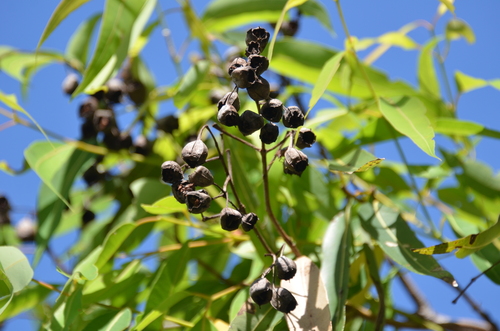
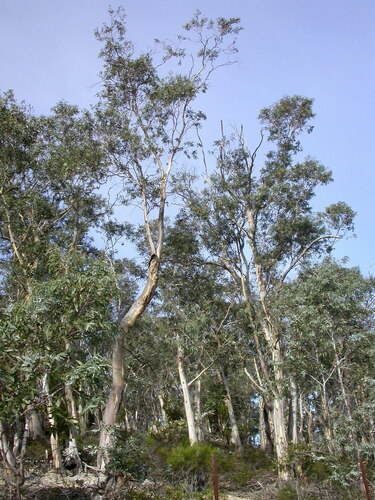
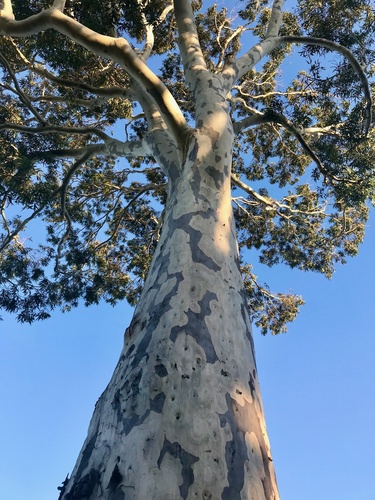
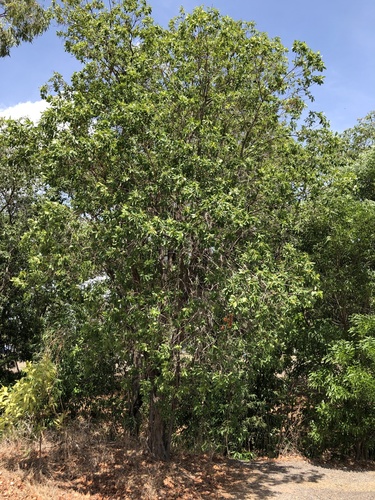
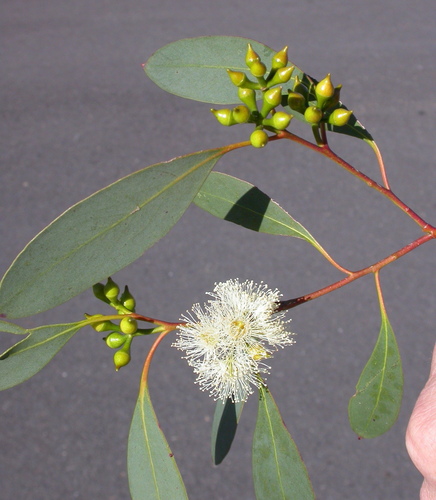
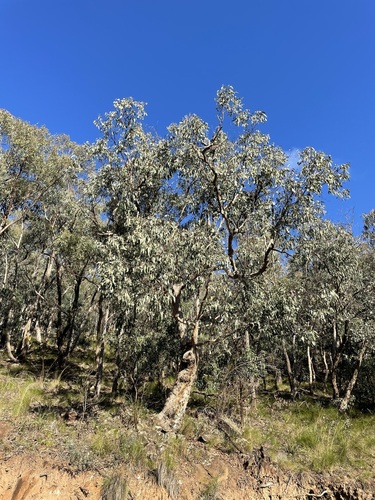
Eucalyptus nortonii is a tree that typically reaches a height of 15–18 meters (49–59 feet) and forms a lignotuber. It has rough, coarse, thick, fibrous or flaky bark covering its trunk and larger branches, while the thinnest branches sometimes have smooth greyish bark. Young plants and coppice regrowth have glaucous foliage, with sessile, heart-shaped to roughly round leaves that are 25–90 mm (0.98–3.54 in) long, 30–80 mm (1.2–3.1 in) wide, and arranged in opposite pairs. Adult leaves are the same dull bluish, greyish green, or glaucous shade on both sides, measuring 85–300 mm (3.3–11.8 in) long and 15–40 mm (0.59–1.57 in) wide, tapering to a 14–40 mm (0.55–1.57 in) long petiole. Flower buds are grouped in clusters of seven in leaf axils, growing on an unbranched peduncle 4–13 mm (0.16–0.51 in) long. Individual buds are either sessile or borne on pedicels up to 2 mm (0.079 in) long. Mature buds are oblong to oval, 7–13 mm (0.28–0.51 in) long and 3–6 mm (0.12–0.24 in) wide, with a conical operculum. Flowering mainly occurs between January and April, and the flowers are white. The fruit is a woody cup-shaped or cylindrical capsule, 5–9 mm (0.20–0.35 in) long and 5–7 mm (0.20–0.28 in) wide, with valves positioned near the rim of the capsule. This species is widespread and locally common in open woodland growing on dry, rocky sites across tablelands. It is found in New South Wales and the Australian Capital Territory, south of Manilla, and also occurs in central and eastern Victoria, including areas near Suggan Buggan, Whitfield, and the region from Castlemaine to the Pyrenees.