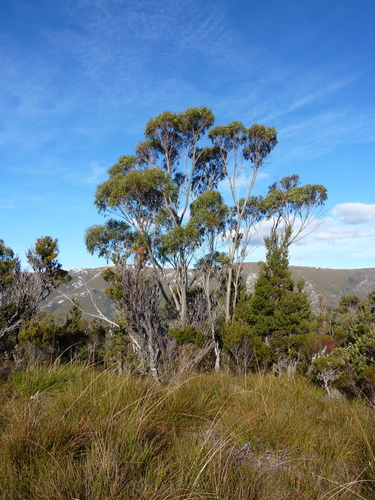
About Eucalyptus nitida Hook.fil.
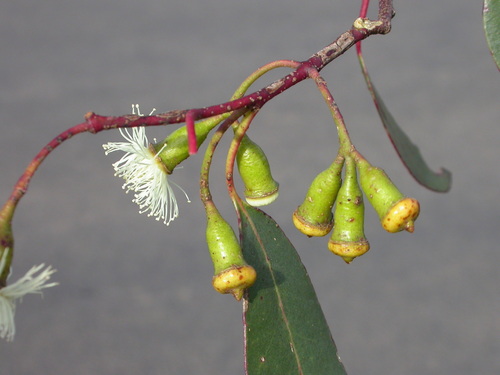
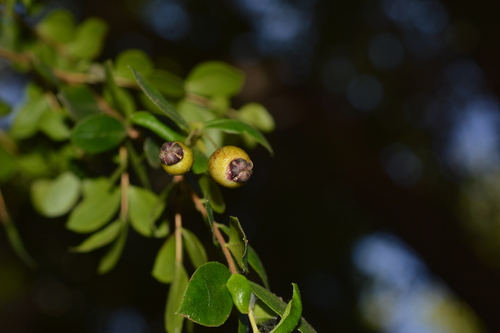
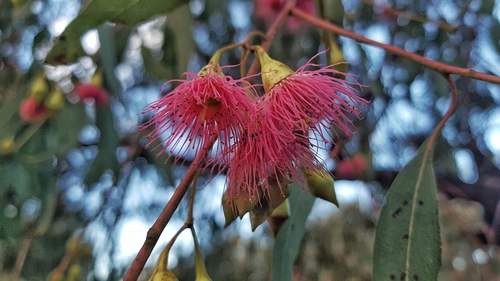
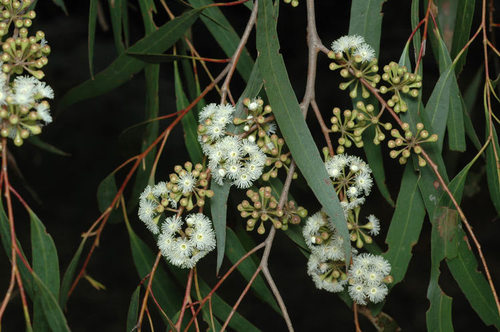
Eucalyptus nitida Hook.fil., commonly known as Smithton peppermint, typically grows as a tree reaching 40 m (130 ft) in height, or as a mallee up to 5 m (16 ft), and forms a lignotuber. It has smooth cream-coloured to greyish bark, though older or larger specimens have rough, fibrous or flaky bark covering the trunk, and sometimes the larger branches. Young plants and coppice regrowth have sessile, lance-shaped to elliptical leaves that are 45–85 mm (1.8–3.3 in) long and 10–30 mm (0.39–1.18 in) wide, arranged in opposite pairs and clasping the stem. Adult leaves are arranged alternately, are the same shade of glossy green on both sides, measure 55–130 mm (2.2–5.1 in) long and 6–17 mm (0.24–0.67 in) wide, and taper to a petiole 4–17 mm (0.16–0.67 in) long. Flower buds are arranged in leaf axils in groups of nine to fifteen, growing on an unbranched peduncle 2–9 mm (0.079–0.354 in) long, with individual buds attached to pedicels 1–6 mm (0.039–0.236 in) long. Mature buds are club-shaped, 3–5 mm (0.12–0.20 in) long and 3–4 mm (0.12–0.16 in) wide, with a rounded to conical operculum. Flowering occurs from November to January, and the flowers are white. The fruit is a woody, cup-shaped, hemispherical or conical capsule 4–8 mm (0.16–0.31 in) long and 5–9 mm (0.20–0.35 in) wide, with valves positioned near the rim level. Smithton peppermint is widespread across northern, western and southern Tasmania, and also grows on some Bass Strait Islands. It occurs in forest from sea level up to hills and plateaus, and sometimes grows as a mallee in coastal sand dunes.