About Eucalyptus miniata A.Cunn. ex Schauer
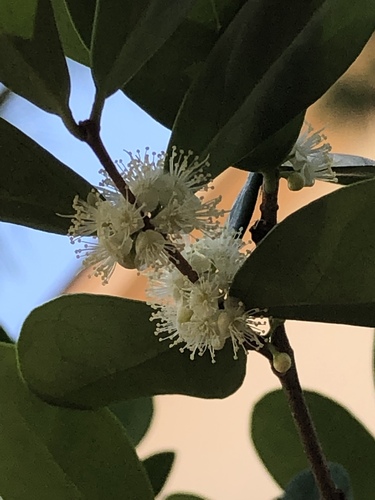
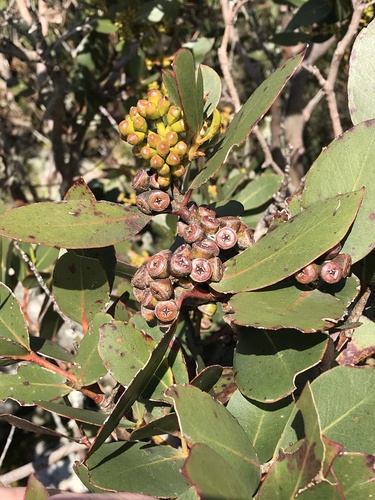
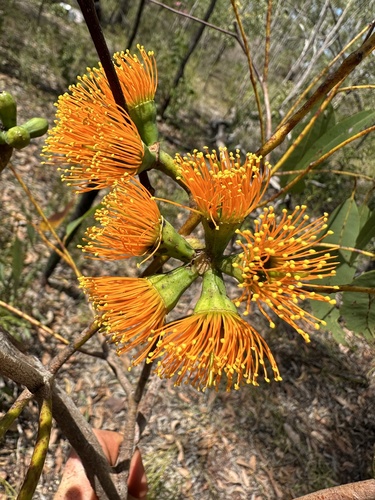
Eucalyptus miniata A.Cunn. ex Schauer is a tree that typically grows 15–25 m (49–82 ft) tall, and may reach up to 30 m (98 ft). It usually has a single trunk and forms a lignotuber. The bark on the trunk is soft, rough, fibrous, fissured, and ranges in colour from grey to red-yellow-brown, while the upper trunk and branches have smooth white to pale grey bark. Young plants and coppice regrowth have elliptical greenish-brown leaves that measure 30–60 mm (1.2–2.4 in) long and 20–30 mm (0.79–1.18 in) wide. Adult leaves are dull to slightly glossy green, paler on the lower surface, lance-shaped to curved, 75–150 mm (3.0–5.9 in) long and 25–50 mm (0.98–1.97 in) wide, tapering to a 12–27 mm (0.47–1.06 in) long petiole. Flower buds are arranged in groups of seven on an unbranched peduncle 10–35 mm (0.39–1.38 in) long; individual buds are either sessile or on pedicles up to 7 mm (0.28 in) long. Mature buds are club-shaped, rarely spindle-shaped, glaucous, 10–23 mm (0.39–0.91 in) long and 9–12 mm (0.35–0.47 in) wide, with ribs along the sides and a rounded to conical operculum. Flowering takes place from May to September, and the flowers are orange or scarlet, reaching up to 35 mm (1.4 in) in diameter. The fruits are woody capsules, shaped cylindrical to barrel-shaped or urn-shaped, 33–60 mm (1.3–2.4 in) long and 20–40 mm (0.79–1.57 in) wide, with longitudinal ribbing and valves enclosed below the rim level. Fruits are glaucous when young but lose this covering over time. They contain dark grey to black seeds 5–7 mm (0.20–0.28 in) long, with an obliquely pyramidal to flattened cuboid shape. Eucalyptus miniata is most often found in open forest, savanna communities, and on sandstone escarpments, growing in sandy soils. It has a wide distribution ranging from the Kimberley region of Western Australia, through northern parts of the Northern Territory, to the Burketown region of far northwestern Queensland. It occurs in the Arnhem Coast, Arnhem Plateau, Central Kimberley, Daly Basin, Darwin Coastal, Einasleigh Uplands, Gulf Coastal, Gulf Fall and Uplands, Gulf Plains, Northern Kimberley, Ord Victoria Plain, Pine Creek, Tiwi Cobourg, and Victoria Bonaparte bioregions. In northern Australia, red-tailed black cockatoos prefer feeding on this species, which is also commonly known as Darwin woollybutt.