About Eucalyptus microcorys F.Muell.
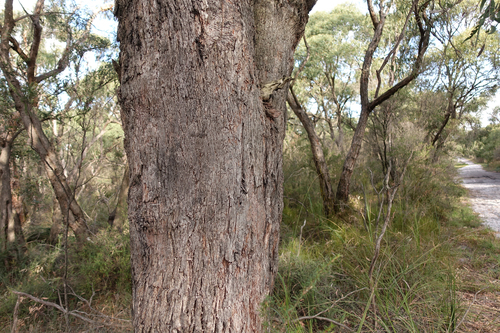
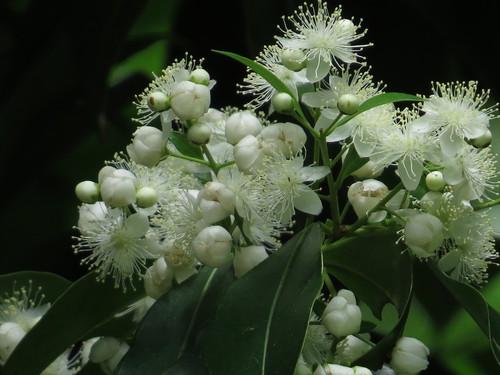
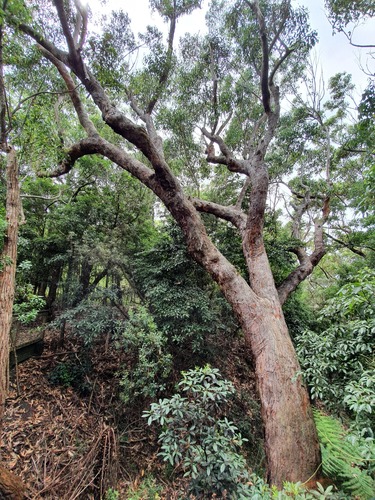
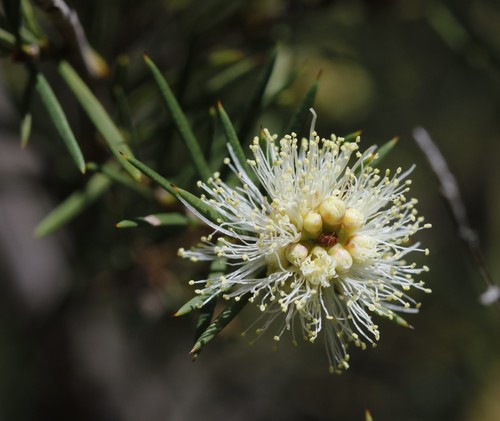
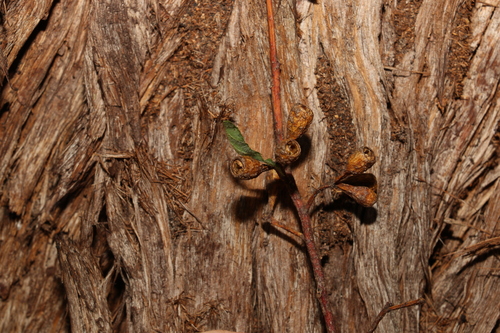
Eucalyptus microcorys F.Muell., commonly known as tallowwood, is a tree species that typically reaches a height of 40–60 m (130–200 ft), and may occasionally grow as tall as 70 m (230 ft). This species forms a lignotuber, and has rough, fibrous or stringy brownish bark covering its trunk and branches. Young plants and coppice regrowth have egg-shaped leaves that are paler on the lower surface, measuring 40–110 mm (1.6–4.3 in) in length and 15–50 mm (0.59–1.97 in) in width. Adult leaves are glossy green, paler on the lower surface, and range from lance-shaped to egg-shaped or slightly curved. They are 60–150 mm (2.4–5.9 in) long, 15–35 mm (0.59–1.38 in) wide, and borne on a petiole 10–15 mm (0.39–0.59 in) long. The leaf veins are prominent, widely spaced, and arranged at an angle greater than 45° relative to the leaf midrib. Flower buds are usually arranged at the ends of branchlets, in groups of seven or nine on a branched peduncle. The peduncle is 4–18 mm (0.16–0.71 in) long, and individual buds sit on pedicels 4–8 mm (0.16–0.31 in) long. Mature buds are club-shaped, yellow, 3–5 mm (0.12–0.20 in) long, about 3 mm (0.12 in) wide, and have a rounded operculum. Flowering occurs between August and January, and the flowers are white to lemon-yellow. The fruit is a woody conical capsule 5–9 mm (0.20–0.35 in) long and 5–6 mm (0.20–0.24 in) wide, with valves positioned near the rim of the capsule. Tallowwood grows mainly in tall open forest on fertile soil, found on slopes, ridges, and in valleys. It occurs from K'gari in Queensland, south to Cooranbong in New South Wales, and extends inland as far as Toowoomba.