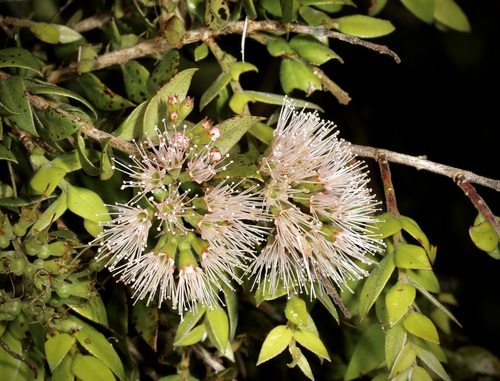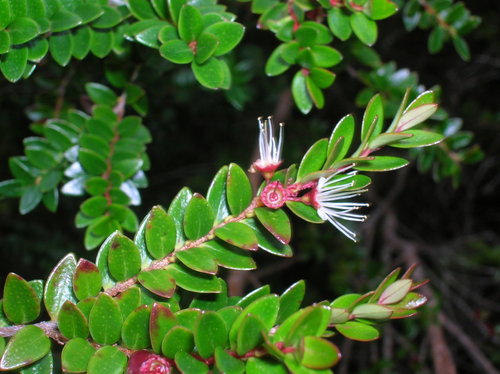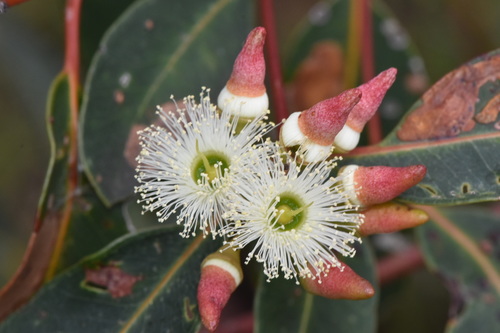
About Eucalyptus marginata Sm.
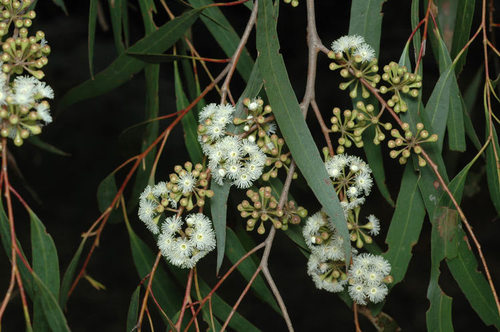
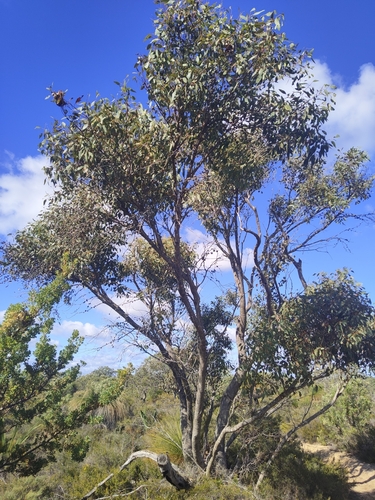
Eucalyptus marginata Sm., commonly known as jarrah, is most often a tree that typically reaches 40 m (130 ft) in height with a diameter at breast height (DBH) of up to 2 m (6 ft 7 in), and occasionally grows as tall as 50 m (160 ft) with a DBH of 3.5 m (11 ft). Less commonly, it grows as a small mallee only 3 m (9.8 ft) high. Older jarrah specimens have a lignotuber and roots that extend as far down as 40 m (100 ft). It has rough, greyish-brown, vertically grooved, fibrous stringybark that sheds in long flat strips. Its leaves are arranged alternately along branches, and are narrow lance-shaped, often curved, 8–13 cm (3–5 in) long and 1.5–3 cm (0.6–1 in) broad, with a shiny dark green upper surface and paler lower surface. The leaves have a distinct midvein, spreading lateral veins, and a marginal vein separated from the leaf margin. Stalked flower buds are arranged in umbels of between 4 and 8, with each bud having a narrow, conical cap 5–9 mm (0.2–0.4 in) long. The flowers are 1–2 cm (0.4–0.8 in) in diameter, with many white stamens, and bloom in spring and early summer. The fruit are spherical to barrel-shaped, 9–20 mm (0.4–0.8 in) in both length and breadth. This species occurs in the south-west corner of Western Australia, generally where the annual rainfall exceeds 600 mm (20 in). It grows inland as far as Mooliabeenee, Clackline and Narrogin, and reaches as far east as the Stirling Range in the south. Its northern limit is Mount Peron near Jurien Bay, with outlier populations at Kulin and Tutanning in the Pingelly Shire. It often grows as a mallee in locations such as Mount Lesueur and the Stirling Range, but is usually a tree that often reaches 40 metres (130 ft) in height in southern forests. It typically grows in soils derived from ironstone, and is generally found anywhere ironstone occurs within its range. Jarrah forest occurs either as intimate mixtures or as a mosaic with other forest types including marri (Corymbia calophylla), wandoo (E. wandoo), powderbark wandoo (E. accedens), blackbutt (E. patens), karri (E. diversicolor) and yellow tingle (E. guilfoylei). At the time of European settlement, the area of jarrah forest is estimated to have been 2.8 million hectares, though the species occurred across an area twice that size. Sixty-five per cent of the original jarrah forest area remains, with approximately 1.6 million hectares located on public land. Jarrah forests lie within the south-west botanical province of Western Australia, recognized as one of the world's 25 global biodiversity hotspots, which hosts approximately 7,400 species of vascular plants (half of which are endemic) and 245 vertebrate species (29 mammals, 150 birds, 44 reptiles, 11 amphibians and 11 fish). Jarrah is counted as one of the six forest giants of Western Australia; the other five are Eucalyptus gomphocephala (tuart), Eucalyptus diversicolor (karri), Eucalyptus jacksonii (red tingle), Corymbia calophylla (marri) and Eucalyptus patens (yarri). It is an important part of its ecosystem, providing numerous habitats for animal life—especially birds and bees—while alive, including in hollows that form as heartwood decays. When a jarrah tree falls, it provides shelter for ground-dwelling species such as the chuditch (Dasyurus geoffroii), a carnivorous marsupial. Jarrah has adapted well to different ecological zones including the Swan Coastal Plain, areas further north, and the distinct habitat of the lateritic Darling Scarp. This species is very vulnerable to dieback caused by the oomycete Phytophthora cinnamomi. Various measures have been implemented across large sections of the Darling Scarp to reduce the spread of dieback, including washing vehicles and restricting access to forest areas that are not yet infected. This evergreen hardwood tree lives for 400 or more years, typically reaches maturity at 70–120 years, and senescence is believed to occur beyond 250 years. Jarrah produces an abundance of creamy white flowers between September and January, is capable of flowering every year, but its full floral cycle takes three years to complete. Significant flowering events happen on a four to six year cycle, with most trees in a given region flowering at the same time. Jarrah produces a dark, thick, tasty honey, and its wood is its main use. It is a heavy wood with a specific gravity of 1.1 when green. Its long, straight trunks produce richly coloured, beautifully grained, termite-resistant timber that is valued for cabinet making, flooring, panelling and outdoor furniture. Finished jarrah lumber has a deep rich reddish-brown colour and an attractive grain. Fresh jarrah is quite workable, but becomes so hard once seasoned that conventional wood-working tools are nearly useless on it. While it is mainly used for cabinet making and furniture now, it was historically used for general construction, railway sleepers and piles. In the 19th century, famous roads in other countries were paved with jarrah blocks covered in asphalt. Jarrah wood is very similar to that of karri (Eucalyptus diversicolor), which also grows in southwestern Australia, and the two woods are frequently confused. They can be distinguished by cutting an unweathered splinter and burning it: karri burns completely to a white ash, while jarrah forms charcoal. This charcoal-forming property was critical to charcoal making and charcoal iron smelting operations at Wundowie from 1948 to 1981. Most of the highest quality jarrah has been logged in southwestern Australia, and a large amount was exported to the United Kingdom, where it was cut into blocks and covered with asphalt for roads. One major exporter in the late nineteenth century was M. C. Davies, who operated mills in the Augusta-Margaret River region of the southwest, and had ports at Hamelin Bay and Flinders Bay. Local poet Dryblower Murphy wrote a poem titled Comeanavajarrah, published in The Sunday Times in May 1904, about the potential to extract alcohol from jarrah timber. Following the 2024 ban on native logging in Western Australia, jarrah has become more highly prized, and can only be obtained as recycled timber from sources such as demolished houses and old railway sleepers. Jarrah is used to make musical instruments, including percussion instruments and guitar inlays. Due to its remarkable rot resistance, it is also used to make hot tubs. Eucalyptus marginata has also been used for traditional purposes: parts of the tree, specifically leaves and bark, were traditionally used as a remedy to treat fever, colds, headaches, skin diseases and snake bites. Jarrah honey is a premium monofloral honey produced by bees that forage on jarrah nectar, and has antibacterial, antifungal, antioxidant, and anti-inflammatory properties, as well as a low glycemic index and prebiotic effects. Average annual jarrah honey production is only 100 tonnes, and yield is heavily impacted by environmental conditions including fire, rainfall, soil moisture and temperature. For example, a peak yield of 400 tonnes was recorded in the 2011–12 season, while the harvest was only 50 tonnes in the 2023–24 season.