About Eucalyptus macrandra F.Muell. ex Benth.
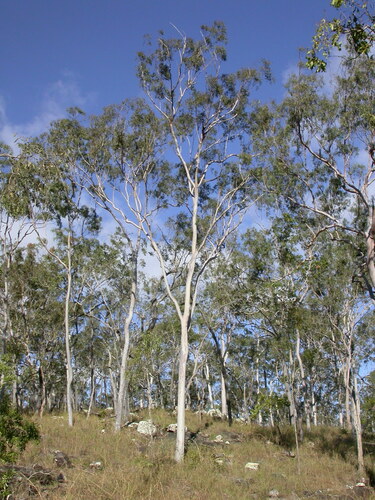
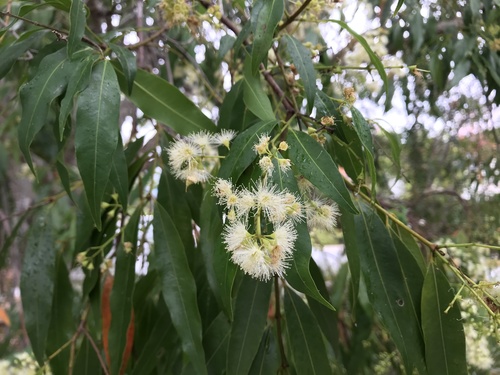
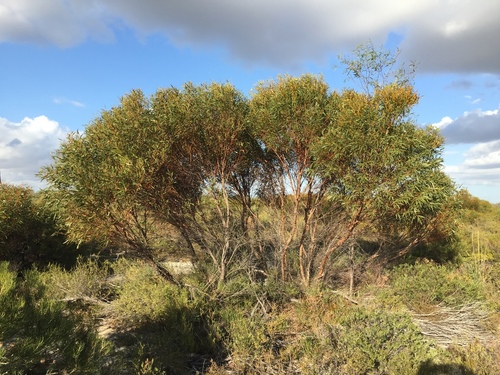
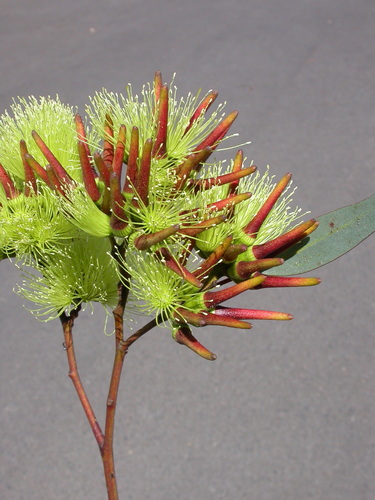
Eucalyptus macrandra F.Muell. ex Benth. is typically a mallee, and sometimes grows as a small tree. It usually reaches a height of 2 to 8 metres (7 to 26 ft) and forms a lignotuber. Its bark is smooth, and ranges in color from pale grey to light brown; rough, blackish bark is sometimes present near the base of the plant. Young plants and coppice regrowth have glossy green, alternately arranged egg-shaped leaves that are 40–70 mm (1.6–2.8 in) long and 15–30 mm (0.59–1.18 in) wide. Adult leaves are also alternately arranged, the same shade of glossy green on both sides, and lance-shaped. They are 55–120 mm (2.2–4.7 in) long and 10–25 mm (0.39–0.98 in) wide, tapering to a petiole 8–20 mm (0.31–0.79 in) long. Flowers grow in groups of 13 to 31 (most often fifteen) in leaf axils, on a flattened, unbranched peduncle 6–26 mm (0.24–1.02 in) long. Individual flower buds grow on pedicels 1–4 mm (0.039–0.157 in) long. Mature buds are 15–36 mm (0.59–1.42 in) long and 2–7 mm (0.079–0.276 in) wide, with an operculum up to five times as long as the floral cup. Flowering occurs either from November to December or from January to April, and the flowers are pale yellowish green. The fruit is a woody, elongated capsule that ranges in shape from cup-shaped to bell-shaped, 6–10 mm (0.24–0.39 in) long and wide, with valves that sit at roughly rim level. This species, also called long-flowered marlock, grows in a variety of soil types in areas north of Albany, and favours river plains or depressions. It occurs in semi-arid regions of south-west Western Australia, in the Avon Wheatbelt, Esperance Plains, Jarrah Forest and Mallee biogeographic regions, including Dryandra Woodland. In horticulture, Eucalyptus macrandra grows easily from seed, but needs good drainage and a dry, frost-free climate. It is used for bonsai and as suburban street trees, and is cultivated in countries outside Australia.