About Eucalyptus luehmanniana F.Muell.
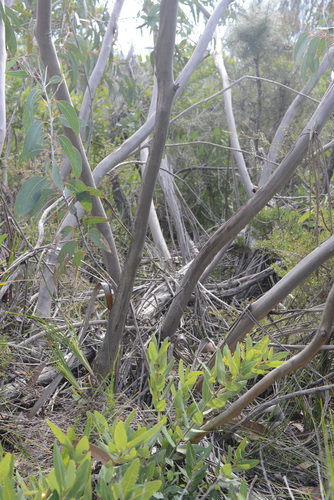
Eucalyptus luehmanniana F.Muell. is a mallee that typically grows to a height of 6–7 m (20–23 ft) and forms a lignotuber. It has smooth white to brown bark that is shed in long ribbons. Young plants and coppice regrowth have stems that are more or less square in cross-section, and bear sessile, glossy green, elliptic to broadly lance-shaped leaves that are 70–175 mm (2.8–6.9 in) long and 30–75 mm (1.2–3.0 in) wide. Adult leaves are the same shade of glossy green on both sides, shaped as lance to curved, 100–200 mm (3.9–7.9 in) long and 20–45 mm (0.79–1.77 in) wide, attached to a petiole 17–40 mm (0.67–1.57 in) long. Flower buds are arranged in leaf axils in groups of between seven and eleven or more on a flattened, unbranched peduncle 15–25 mm (0.59–0.98 in) long, with individual buds attached to pedicels 3–11 mm (0.12–0.43 in) long. Mature buds are club-shaped to diamond shaped, 6–10 mm (0.24–0.39 in) long and 4–7 mm (0.16–0.28 in) wide, with a conical operculum about the same size as the floral cup. Flowering occurs between June and December and the flowers are white. The fruit is a woody, cup-shaped, urn-shaped or barrel-shaped capsule 8–13 mm (0.31–0.51 in) long and 9–12 mm (0.35–0.47 in) wide, with valves close to rim level. This mallee has sometimes been confused with the tree species E. haemastoma and E. stricta. Common name yellow top mallee ash, this species grows in mallee heath on shallow sandstone-derived soils on the coastal plateau in the Sydney region, between the Hawkesbury River and Bulli. Despite having a restricted distribution, it is locally abundant.