About Eucalyptus loxophleba Benth.
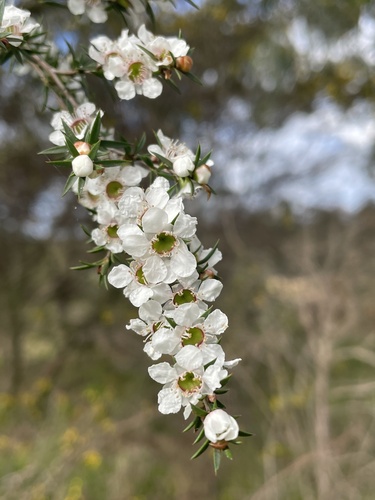
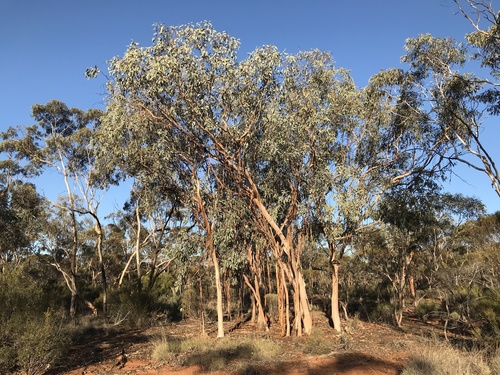
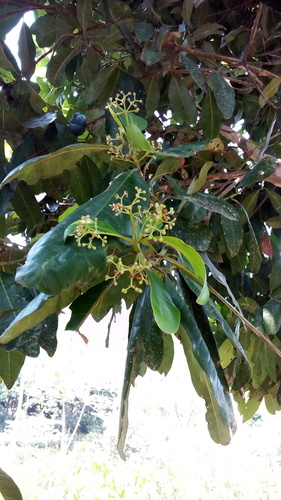
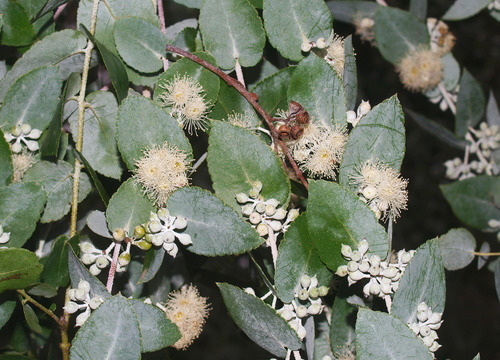
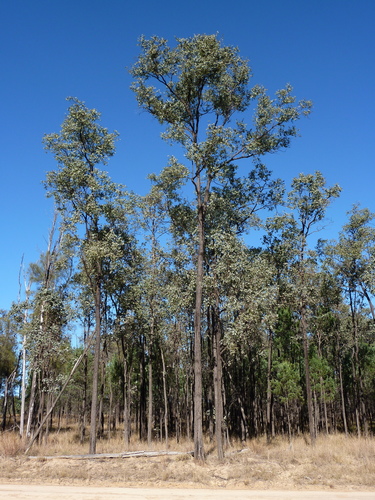
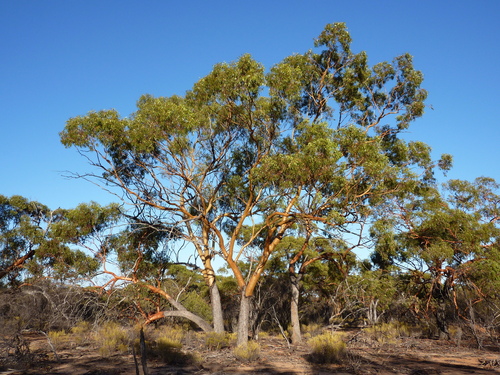
Eucalyptus loxophleba Benth. (common name York gum) is a species of eucalyptus that grows as either a mallee or a tree. It typically reaches 5 to 15 metres (16 to 49 ft) in height, forms a lignotuber, and has a trunk with a diameter of around 0.6 metres (2 ft). The amount of rough fibrous-flaky or smooth bark on the trunk varies by subspecies, and the bark above the trunk is smooth grey-brown over copper. Young plants and coppice regrowth have more or less triangular, egg-shaped, or almost round glaucous leaves that are 45–100 mm (1.8–3.9 in) long and 35–90 mm (1.4–3.5 in) wide. Adult leaves are lance-shaped to curved, glossy dark green on both sides, 70–155 mm (2.8–6.1 in) long and 10–20 mm (0.39–0.79 in) wide, tapering to a 10–25 mm (0.39–0.98 in) long petiole. Flower buds are arranged in leaf axils in groups of seven, nine, or eleven on an unbranched 5–15 mm (0.20–0.59 in) long peduncle, with individual buds attached to 1–5 mm (0.039–0.197 in) long pedicels. Mature buds are oval to pear-shaped, 5–8 mm (0.20–0.31 in) long and 3–4 mm (0.12–0.16 in) wide, with a rounded operculum. Flowering has been recorded in most months, and the flowers are white. The fruit is a woody, conical capsule 4–8 mm (0.16–0.31 in) long and 4–6 mm (0.16–0.24 in) wide, with valves held below the rim of the capsule. Woodlands containing Eucalyptus loxophleba occur across a large area of Western Australia, stretching from the state’s Mid West south through the Wheatbelt and east into the Goldfields-Esperance region. It grows on rocky outcrops, flats, rises, slopes, hilltops, near salt lakes, and along drainage lines. It can grow in a range of soil types, including red-brown or rocky loam, sands, and sandy clays over laterite, dolerite, or granite. The species was recorded as common around the early settlement of York, which is the origin of its common name "York gum"; it also occurs naturally near Bolgart, Toodyay, Northam, and in the area from Narrogin to Broomehill. Four subspecies have distinct ranges: subspecies gratiae occurs between Dumbleyung and Lake King; subspecies loxophleba occurs from near Moora to Bruce Rock and Chillinup on the Pallinup River; subspecies lissophloia occurs further inland, between Bencubbin, Merredin, Lake Minigwal, Coonana and Peak Charles; and subspecies supralaevis occurs in more northern areas between the Murchison River, Dongara, Lake Barlee, the Die Hardy Range and Wongan Hills. Hollows in live or dead Eucalyptus loxophleba trees with a diameter at breast height of over 500 mm (20 in) are known nesting sites for six species of black cockatoo. Two of these six species are endangered, including Carnaby's black cockatoo. When the hollows are located in woodlands or forests, black cockatoos use them as breeding habitat. Carnaby's black cockatoo also uses E. loxophleba’s flowers and seeds as a food source, and the tree as a roosting site. Natural populations of E. loxophleba grow in areas affected by dryland salinity. All four subspecies have potential use for remediating dryland salinity, but subspecies lissophloia has been more widely cultivated for its potential as an oil mallee. This subspecies has also been introduced to Australia’s eastern states for carbon sequestration plantings. Historically, the wood of subspecies loxophleba was used by wheelwrights and similar trades. The heartwood of the tree is yellow-brown, hard, tough, and has an interlocked grain. The wood has a green density of about 1185 kg/m3 and an air-dried density of about 1060 kg/m3.