About Eucalyptus leucophloia Brooker
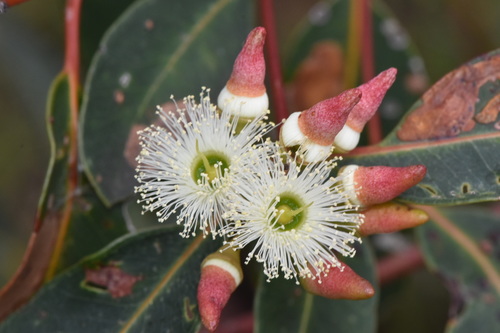
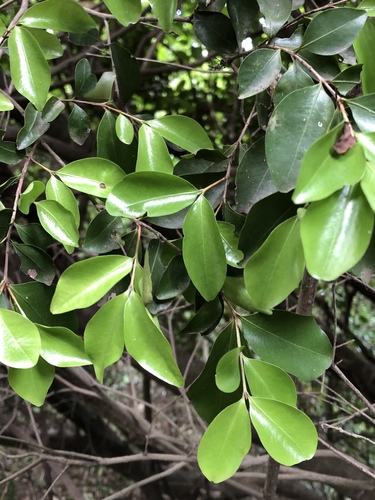
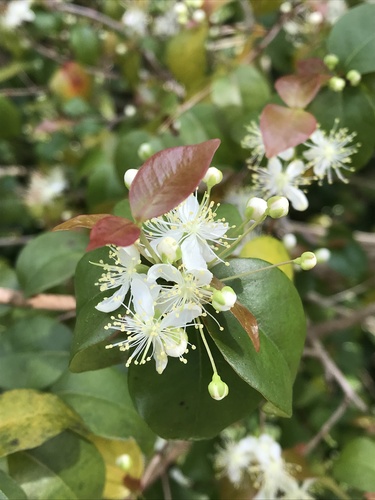
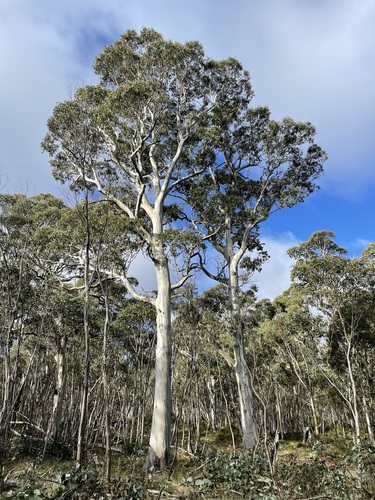
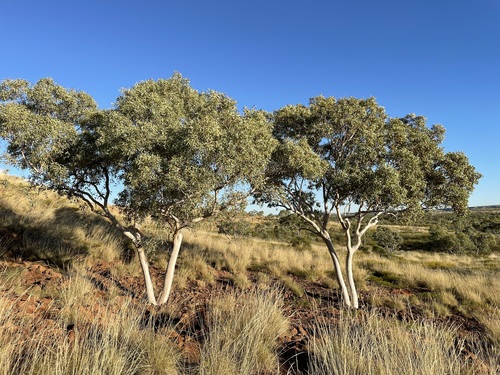
Eucalyptus leucophloia Brooker is a mallee or small tree that develops a lignotuber, and typically reaches a height of 2.5 to 10 metres (8 to 33 ft). New bark of this species is pale pink to pale orange; as it matures it turns white, and patches of older bark become dark pink or grey. The trunk is often crooked, with a base diameter of approximately 40 cm (16 in). The tree's crown is usually as wide as the tree is tall, and bears a moderately dense canopy. Young plants and coppice regrowth have glaucous stems that are roughly square in cross-section, with a wing on each corner. Their leaves are egg-shaped to more or less round, 32–70 mm (1.3–2.8 in) long and 30–85 mm (1.2–3.3 in) wide. Adult leaves are arranged alternately, are the same dull green to grey-green colour on both sides, 50–120 mm (2.0–4.7 in) long and 10–40 mm (0.39–1.57 in) wide, tapering to a petiole 7–20 mm (0.28–0.79 in) long. Flower buds are arranged in leaf axils in groups of seven, sometimes up to eleven, on an unbranched peduncle 6–12 mm (0.24–0.47 in) long; individual buds grow on pedicels 1–3 mm (0.039–0.118 in) long. Mature buds are oval, 3–7 mm (0.12–0.28 in) long and 3–5 mm (0.12–0.20 in) wide, with a rounded, blunt conical or shortly beaked operculum. Flowering takes place between March and August, and the flowers are creamy white. The fruit is a woody capsule that can be cup-shaped, barrel-shaped or hemispherical; it is 5–8 mm (0.20–0.31 in) long and 4–6 mm (0.16–0.24 in) wide, with valves that are either enclosed below the rim or prominently protruding, depending on the subspecies. The seeds are yellow-brown, and shaped round or elliptical. Subspecies leucophloia is distributed in gullies, hills and plains of the western Pilbara region of Western Australia, growing in skeletal soils over sandstone. Subspecies euroa occurs in central parts of the Northern Territory between Katherine, Tennant Creek and the southern part of Arnhem Land, and extends into north-western Queensland between Mount Isa, Cloncurry and Dajarra. This species grows within low woodland communities, and often forms pure stands over an understorey of Acacia shrubs and Triodia spinifex grasses. In mixed woodland, it is commonly associated with Eucalyptus gamophylla, Corymbia terminalis and Eucalyptus odontocarpa.