About Eucalyptus largiflorens F.Muell.
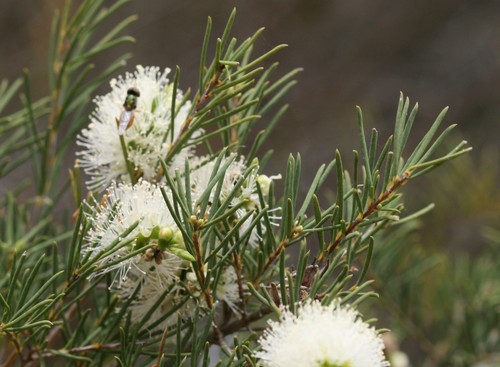
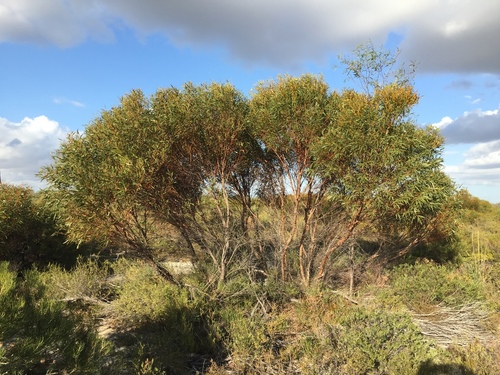
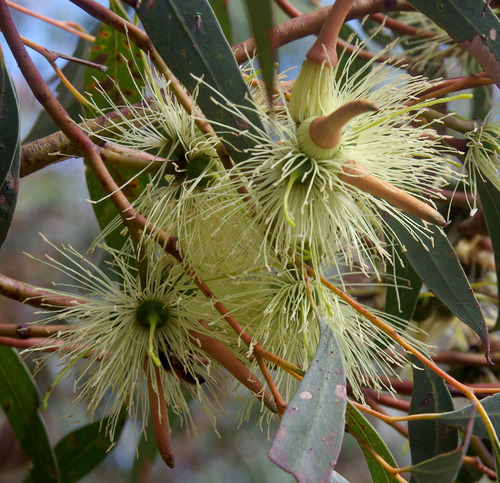
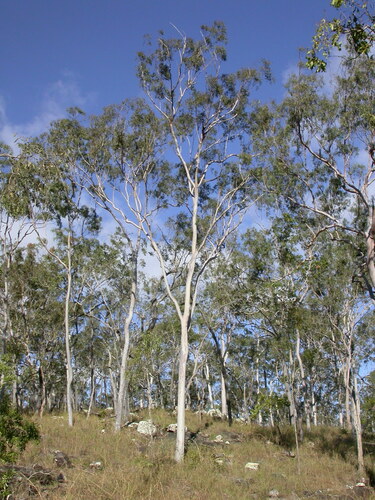
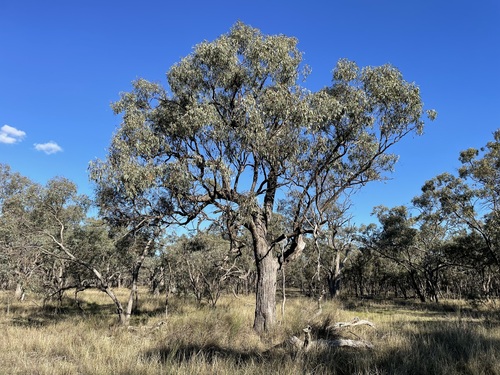
Eucalyptus largiflorens, commonly known as black box, is a tree that reaches a maximum height of 20 metres (66 ft). It has rough, dark grey, fibrous or flaky bark that extends all the way to its thinnest branches, and the bark on the trunk is sometimes furrowed. Young trees produce dull greyish-green to bluish leaves that are linear to narrow lance-shaped, measuring 40–155 mm (2–6 in) long and 4–18 mm (0.2–0.7 in) wide. Adult leaves are lance-shaped and the same shade of green on both sides, growing 60–180 mm (2–7 in) long and 8–20 mm (0.3–0.8 in) wide. Flowers are arranged in groups of mostly seven to eleven, growing on branch ends or in leaf axils. The groups are held on a cylindrical peduncle 3–11 mm (0.12–0.43 in) long, and each individual flower sits on a cylindrical pedicel 1–5 mm (0.039–0.20 in) long. Mature buds are green to yellow, oval to club-shaped, 4–5 mm (0.16–0.20 in) long and 2–3 mm (0.079–0.12 in) wide. The operculum is hemispherical to cone-shaped, and is both shorter and narrower than the flower cup. The stamens are white. Flowering occurs in most months of the year, with peak flowering in autumn and spring. The fruit is a hemispherical to oval capsule that measures 3–6 mm (0.1–0.2 in) long and 3–5 mm (0.1–0.2 in) wide. This species is widespread across Queensland, New South Wales, Victoria and South Australia, where it grows most commonly in grassy woodland on the floodplains of the Murray–Darling basin. It typically occupies drier sites than the related river red gum, Eucalyptus camaldulensis. Before European colonisation, Eucalyptus largiflorens occupied a total area of 517,812 km² (199,928 sq mi). Its current occupied range is reduced to 293,631 km² (113,372 sq mi), and its existing population is severely fragmented. In 2019, the International Union for the Conservation of Nature listed Eucalyptus largiflorens as a vulnerable species. Indigenous Australians used the small seeds of the black box as food when grass seeds were scarce, eating them raw. To harvest the seeds, people cut down fruiting branches and left them in the sun to encourage the capsules to open. Once extracted, the seeds were soaked and treated with multiple changes of water to remove their bitterness. The processed seeds were then dried, ground on a grinding stone, and eaten raw.